

reducing like hydrogen sulfide, carbon monoxide, ammonia, methane, sulfur dioxide, etc. The concentration of electrons on the surface of metal oxide is decreased
during sensing of oxidizing gaseous pollutant as a result of oxidation reaction with
adsorbed ionic oxygen species on the metal oxide surfaces. Therefore, the resistance
of n-type sensing layer of metal oxide increases, while the resistance of p-type metal
oxide surface decreases. In contrast, the electrons are released by the chemisorbed
oxygen back to the conduction band due to reduction of gaseous pollutants by the
ionic oxygen species on the metal oxide surface. As a result, the resistance of n-type
sensing layer of metal oxide decreases and that of p-type metal oxide surface
increases. The sensing performance of metal oxide can be limited by limiting analyte
or oxygen adsorption–desorption process in bulk morphology and microstructure
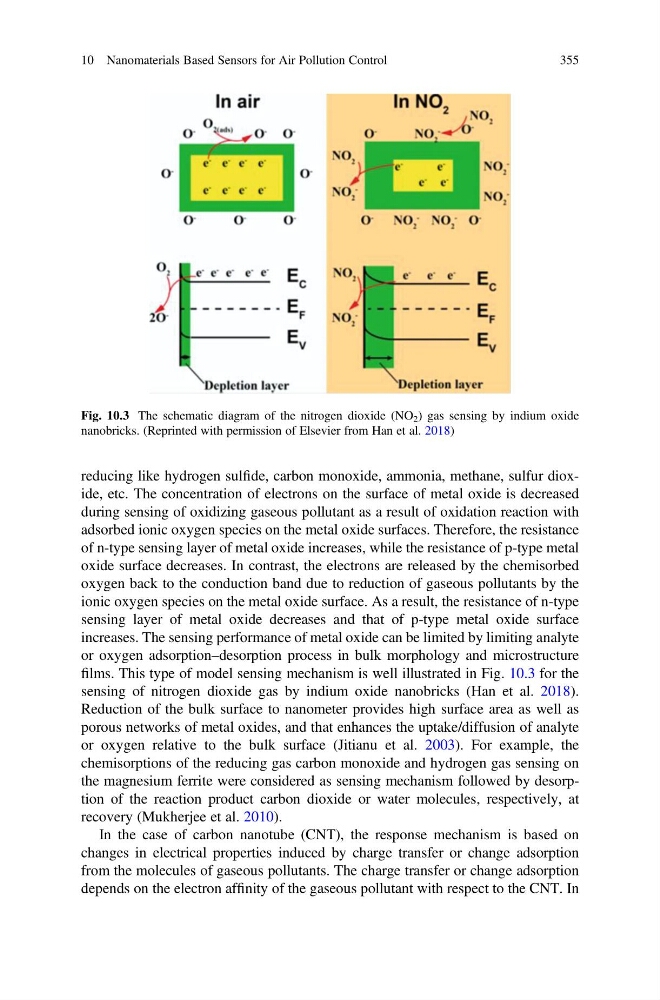
films. This type of model sensing mechanism is well illustrated in Fig. 10.3 for the
sensing of nitrogen dioxide gas by indium oxide nanobricks (Han et al. 2018).
Reduction of the bulk surface to nanometer provides high surface area as well as
porous networks of metal oxides, and that enhances the uptake/diffusion of analyte
or oxygen relative to the bulk surface (Jitianu et al. 2003). For example, the
chemisorptions of the reducing gas carbon monoxide and hydrogen gas sensing on
the magnesium ferrite were considered as sensing mechanism followed by desorption of the reaction product carbon dioxide or water molecules, respectively, at
recovery (Mukherjee et al. 2010).
In the case of carbon nanotube (CNT), the response mechanism is based on
changes in electrical properties induced by charge transfer or change adsorption
from the molecules of gaseous pollutants. The charge transfer or change adsorption
depends on the electron affinity of the gaseous pollutant with respect to the CNT. In
Fig. 10.3 The schematic diagram of the nitrogen dioxide (NO 2 ) gas sensing by indium oxide
nanobricks. (Reprinted with permission of Elsevier from Han et al. 2018)
10 Nanomaterials Based Sensors for Air Pollution Control
355
during sensing of oxidizing gaseous pollutant as a result of oxidation reaction with
adsorbed ionic oxygen species on the metal oxide surfaces. Therefore, the resistance
of n-type sensing layer of metal oxide increases, while the resistance of p-type metal
oxide surface decreases. In contrast, the electrons are released by the chemisorbed
oxygen back to the conduction band due to reduction of gaseous pollutants by the
ionic oxygen species on the metal oxide surface. As a result, the resistance of n-type
sensing layer of metal oxide decreases and that of p-type metal oxide surface
increases. The sensing performance of metal oxide can be limited by limiting analyte
or oxygen adsorption–desorption process in bulk morphology and microstructure
films. This type of model sensing mechanism is well illustrated in Fig. 10.3 for the
sensing of nitrogen dioxide gas by indium oxide nanobricks (Han et al. 2018).
Reduction of the bulk surface to nanometer provides high surface area as well as
porous networks of metal oxides, and that enhances the uptake/diffusion of analyte
or oxygen relative to the bulk surface (Jitianu et al. 2003). For example, the
chemisorptions of the reducing gas carbon monoxide and hydrogen gas sensing on
the magnesium ferrite were considered as sensing mechanism followed by desorption of the reaction product carbon dioxide or water molecules, respectively, at
recovery (Mukherjee et al. 2010).
In the case of carbon nanotube (CNT), the response mechanism is based on
changes in electrical properties induced by charge transfer or change adsorption
from the molecules of gaseous pollutants. The charge transfer or change adsorption
depends on the electron affinity of the gaseous pollutant with respect to the CNT. In
Fig. 10.3 The schematic diagram of the nitrogen dioxide (NO 2 ) gas sensing by indium oxide
nanobricks. (Reprinted with permission of Elsevier from Han et al. 2018)
10 Nanomaterials Based Sensors for Air Pollution Control
355