

the sensing of air pollutant. These should be categorized to study their synthesis,
properties as well as applications elaborately and systematically. The fundamental
chemical nature of the materials in chemistry is organic or inorganic. In addition,
polymer is a special type of organic or inorganic material with respect to its
properties as well as versatility. The mixture of two or more materials may also be
included in the classification. Therefore, according to the nature of nanomaterials,
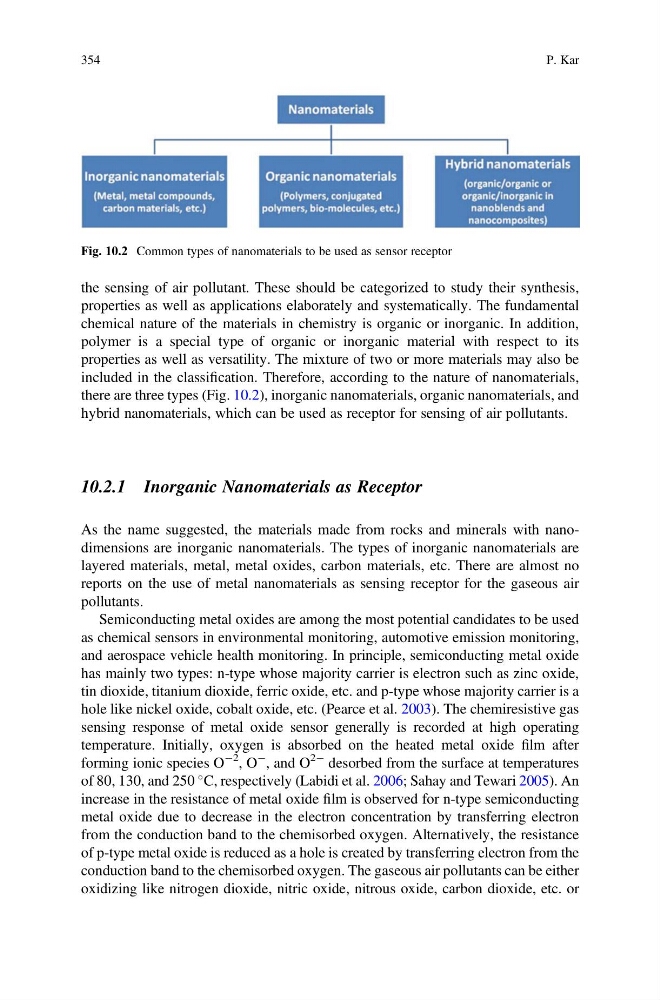
there are three types (Fig. 10.2), inorganic nanomaterials, organic nanomaterials, and
hybrid nanomaterials, which can be used as receptor for sensing of air pollutants.
10.2.1 Inorganic Nanomaterials as Receptor
As the name suggested, the materials made from rocks and minerals with nanodimensions are inorganic nanomaterials. The types of inorganic nanomaterials are
layered materials, metal, metal oxides, carbon materials, etc. There are almost no
reports on the use of metal nanomaterials as sensing receptor for the gaseous air
pollutants.
Semiconducting metal oxides are among the most potential candidates to be used
as chemical sensors in environmental monitoring, automotive emission monitoring,
and aerospace vehicle health monitoring. In principle, semiconducting metal oxide
has mainly two types: n-type whose majority carrier is electron such as zinc oxide,
tin dioxide, titanium dioxide, ferric oxide, etc. and p-type whose majority carrier is a
hole like nickel oxide, cobalt oxide, etc. (Pearce et al. 2003). The chemiresistive gas
sensing response of metal oxide sensor generally is recorded at high operating
temperature. Initially, oxygen is absorbed on the heated metal oxide film after
forming ionic species O
À2 , O
À , and O
2À desorbed from the surface at temperatures
of 80, 130, and 250
C, respectively (Labidi et al. 2006; Sahay and Tewari 2005). An
increase in the resistance of metal oxide film is observed for n-type semiconducting
metal oxide due to decrease in the electron concentration by transferring electron
from the conduction band to the chemisorbed oxygen. Alternatively, the resistance
of p-type metal oxide is reduced as a hole is created by transferring electron from the
conduction band to the chemisorbed oxygen. The gaseous air pollutants can be either
oxidizing like nitrogen dioxide, nitric oxide, nitrous oxide, carbon dioxide, etc. or
Fig. 10.2 Common types of nanomaterials to be used as sensor receptor
354
P. Kar
properties as well as applications elaborately and systematically. The fundamental
chemical nature of the materials in chemistry is organic or inorganic. In addition,
polymer is a special type of organic or inorganic material with respect to its
properties as well as versatility. The mixture of two or more materials may also be
included in the classification. Therefore, according to the nature of nanomaterials,
there are three types (Fig. 10.2), inorganic nanomaterials, organic nanomaterials, and
hybrid nanomaterials, which can be used as receptor for sensing of air pollutants.
10.2.1 Inorganic Nanomaterials as Receptor
As the name suggested, the materials made from rocks and minerals with nanodimensions are inorganic nanomaterials. The types of inorganic nanomaterials are
layered materials, metal, metal oxides, carbon materials, etc. There are almost no
reports on the use of metal nanomaterials as sensing receptor for the gaseous air
pollutants.
Semiconducting metal oxides are among the most potential candidates to be used
as chemical sensors in environmental monitoring, automotive emission monitoring,
and aerospace vehicle health monitoring. In principle, semiconducting metal oxide
has mainly two types: n-type whose majority carrier is electron such as zinc oxide,
tin dioxide, titanium dioxide, ferric oxide, etc. and p-type whose majority carrier is a
hole like nickel oxide, cobalt oxide, etc. (Pearce et al. 2003). The chemiresistive gas
sensing response of metal oxide sensor generally is recorded at high operating
temperature. Initially, oxygen is absorbed on the heated metal oxide film after
forming ionic species O
À2 , O
À , and O
2À desorbed from the surface at temperatures
of 80, 130, and 250
C, respectively (Labidi et al. 2006; Sahay and Tewari 2005). An
increase in the resistance of metal oxide film is observed for n-type semiconducting
metal oxide due to decrease in the electron concentration by transferring electron
from the conduction band to the chemisorbed oxygen. Alternatively, the resistance
of p-type metal oxide is reduced as a hole is created by transferring electron from the
conduction band to the chemisorbed oxygen. The gaseous air pollutants can be either
oxidizing like nitrogen dioxide, nitric oxide, nitrous oxide, carbon dioxide, etc. or
Fig. 10.2 Common types of nanomaterials to be used as sensor receptor
354
P. Kar