

different organs such as the tongue, skin, eye, ear, and nose. However, the sensing of
toxic pollutants in the air may create some serious problems like irritation, vomiting,
suffocation, illness, etc., or it may be even deadly poisonous for living bodies above
the threshold limit value. For example, any animal or plants are not able to live
without oxygen. Not only living parts but also the nonliving parts of environment or
materials are also badly attacked by air pollutants in their respective life cycle. The
simplest example is the rusting of iron in the air. Thus it is better to sense artificially
of those hazardous and toxic pollutants before interacting with the living or
nonliving parts of environments more efficiently than that the animal detector as
well. In order to take timely action over the pollutants, constant analysis is required.
Moreover, the threshold limit value can only be detected after the successful sensing
of the pollutants in the air. In that goal, the sensing of air pollutants becomes an
emerging technological field in the modern period.
A sensor is a device that gives an observable signal by interacting with a
particular analyte, viz., physical, chemical, and bio-species. Hence, three types of
sensors are known, namely, physical sensors used to measure physical properties
like temperature, mass, distance, pressure, etc.; chemical sensors used to analyze
chemicals; and biosensors used to analyze biomolecules or bioactivity. The chemical
sensors have been categorized into three general groups according to the operating
principle: (1) electrochemical sensors (2) optical sensors, and (3) mass sensors. The
advantage of sensor is that it measures a physical quantity and converts it into a
signal which can be read by an observer or by an instrument consisting of optics,
detectors, and electronics. Sensor collects radiation and converts it into some other
form suitable for obtaining information in certain pattern (an image, a profile, etc.), a
warning, a control signal, or some other signal. Thus using a miniaturized low-cost
sensor device, an observable signal or warning bell may be set to control the
pollution level of outdoor as well as indoor air. The functioning of simple sensor
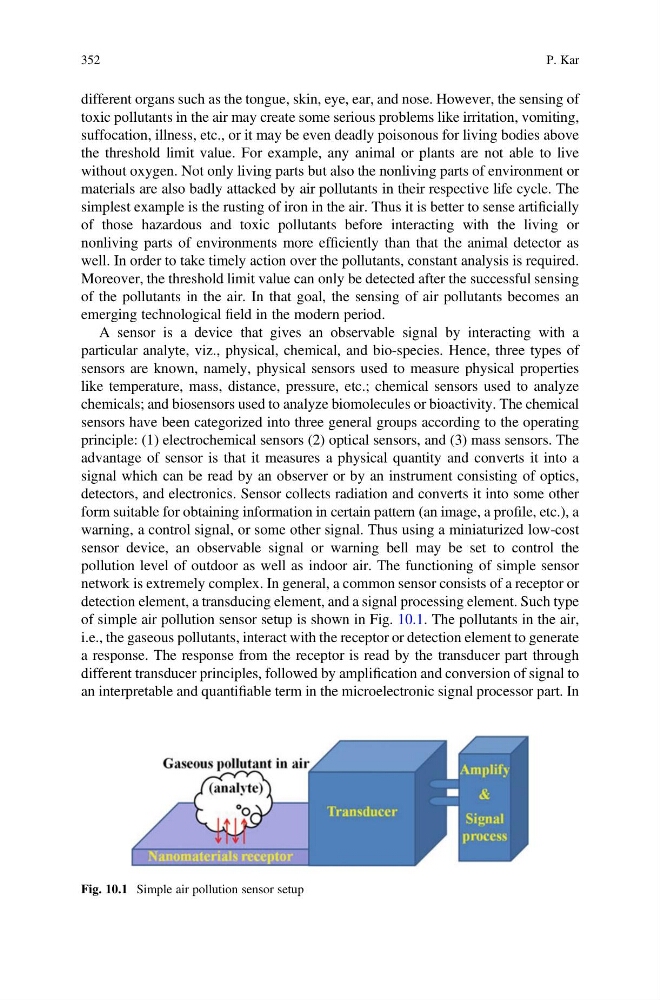
network is extremely complex. In general, a common sensor consists of a receptor or
detection element, a transducing element, and a signal processing element. Such type
of simple air pollution sensor setup is shown in Fig. 10.1. The pollutants in the air,
i.e., the gaseous pollutants, interact with the receptor or detection element to generate
a response. The response from the receptor is read by the transducer part through
different transducer principles, followed by amplification and conversion of signal to
an interpretable and quantifiable term in the microelectronic signal processor part. In
Fig. 10.1 Simple air pollution sensor setup
352
P. Kar
toxic pollutants in the air may create some serious problems like irritation, vomiting,
suffocation, illness, etc., or it may be even deadly poisonous for living bodies above
the threshold limit value. For example, any animal or plants are not able to live
without oxygen. Not only living parts but also the nonliving parts of environment or
materials are also badly attacked by air pollutants in their respective life cycle. The
simplest example is the rusting of iron in the air. Thus it is better to sense artificially
of those hazardous and toxic pollutants before interacting with the living or
nonliving parts of environments more efficiently than that the animal detector as
well. In order to take timely action over the pollutants, constant analysis is required.
Moreover, the threshold limit value can only be detected after the successful sensing
of the pollutants in the air. In that goal, the sensing of air pollutants becomes an
emerging technological field in the modern period.
A sensor is a device that gives an observable signal by interacting with a
particular analyte, viz., physical, chemical, and bio-species. Hence, three types of
sensors are known, namely, physical sensors used to measure physical properties
like temperature, mass, distance, pressure, etc.; chemical sensors used to analyze
chemicals; and biosensors used to analyze biomolecules or bioactivity. The chemical
sensors have been categorized into three general groups according to the operating
principle: (1) electrochemical sensors (2) optical sensors, and (3) mass sensors. The
advantage of sensor is that it measures a physical quantity and converts it into a
signal which can be read by an observer or by an instrument consisting of optics,
detectors, and electronics. Sensor collects radiation and converts it into some other
form suitable for obtaining information in certain pattern (an image, a profile, etc.), a
warning, a control signal, or some other signal. Thus using a miniaturized low-cost
sensor device, an observable signal or warning bell may be set to control the
pollution level of outdoor as well as indoor air. The functioning of simple sensor
network is extremely complex. In general, a common sensor consists of a receptor or
detection element, a transducing element, and a signal processing element. Such type
of simple air pollution sensor setup is shown in Fig. 10.1. The pollutants in the air,
i.e., the gaseous pollutants, interact with the receptor or detection element to generate
a response. The response from the receptor is read by the transducer part through
different transducer principles, followed by amplification and conversion of signal to
an interpretable and quantifiable term in the microelectronic signal processor part. In
Fig. 10.1 Simple air pollution sensor setup
352
P. Kar