

tool for remediation with nano-iron. A nanoparticle slurry is also used for sitespecific regions (Lowry 2007). Performance of many reactive nanoparticles has been
evaluated. Nanoscale zeolites, noble metals, carbon nanotubes (CNT), metal oxides,
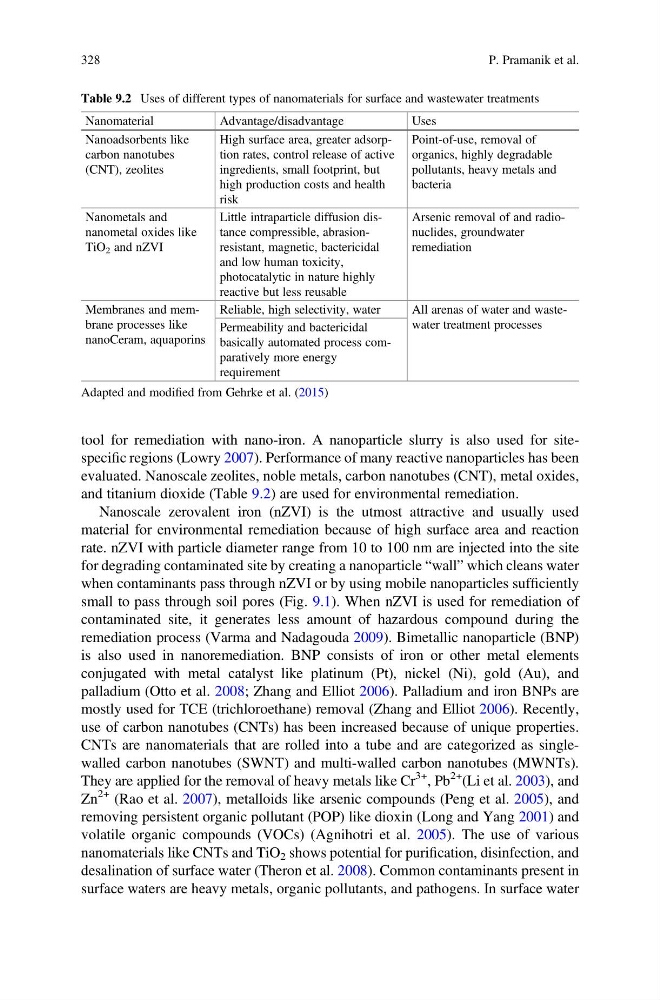
and titanium dioxide (Table 9.2) are used for environmental remediation.
Nanoscale zerovalent iron (nZVI) is the utmost attractive and usually used
material for environmental remediation because of high surface area and reaction
rate. nZVI with particle diameter range from 10 to 100 nm are injected into the site
for degrading contaminated site by creating a nanoparticle “wall” which cleans water
when contaminants pass through nZVI or by using mobile nanoparticles sufficiently
small to pass through soil pores (Fig. 9.1). When nZVI is used for remediation of
contaminated site, it generates less amount of hazardous compound during the
remediation process (Varma and Nadagouda 2009). Bimetallic nanoparticle (BNP)
is also used in nanoremediation. BNP consists of iron or other metal elements
conjugated with metal catalyst like platinum (Pt), nickel (Ni), gold (Au), and
palladium (Otto et al. 2008; Zhang and Elliot 2006). Palladium and iron BNPs are
mostly used for TCE (trichloroethane) removal (Zhang and Elliot 2006). Recently,
use of carbon nanotubes (CNTs) has been increased because of unique properties.
CNTs are nanomaterials that are rolled into a tube and are categorized as singlewalled carbon nanotubes (SWNT) and multi-walled carbon nanotubes (MWNTs).
They are applied for the removal of heavy metals like Cr
3+ , Pb
2+ (Li et al. 2003), and
Zn
2+ (Rao et al. 2007), metalloids like arsenic compounds (Peng et al. 2005), and
removing persistent organic pollutant (POP) like dioxin (Long and Yang 2001) and
volatile organic compounds (VOCs) (Agnihotri et al. 2005). The use of various
nanomaterials like CNTs and TiO 2 shows potential for purification, disinfection, and
desalination of surface water (Theron et al. 2008). Common contaminants present in
surface waters are heavy metals, organic pollutants, and pathogens. In surface water
Table 9.2 Uses of different types of nanomaterials for surface and wastewater treatments
Nanomaterial
Advantage/disadvantage
Uses
Nanoadsorbents like
carbon nanotubes
(CNT), zeolites
High surface area, greater adsorption rates, control release of active
ingredients, small footprint, but
high production costs and health
risk
Point-of-use, removal of
organics, highly degradable
pollutants, heavy metals and
bacteria
Nanometals and
nanometal oxides like
TiO 2 and nZVI
Little intraparticle diffusion distance compressible, abrasionresistant, magnetic, bactericidal
and low human toxicity,
photocatalytic in nature highly
reactive but less reusable
Arsenic removal of and radionuclides, groundwater
remediation
Membranes and membrane processes like
nanoCeram, aquaporins
Reliable, high selectivity, water
All arenas of water and wastewater treatment processes
Permeability and bactericidal
basically automated process comparatively more energy
requirement
Adapted and modified from Gehrke et al. (2015)
328
P. Pramanik et al.
evaluated. Nanoscale zeolites, noble metals, carbon nanotubes (CNT), metal oxides,
and titanium dioxide (Table 9.2) are used for environmental remediation.
Nanoscale zerovalent iron (nZVI) is the utmost attractive and usually used
material for environmental remediation because of high surface area and reaction
rate. nZVI with particle diameter range from 10 to 100 nm are injected into the site
for degrading contaminated site by creating a nanoparticle “wall” which cleans water
when contaminants pass through nZVI or by using mobile nanoparticles sufficiently
small to pass through soil pores (Fig. 9.1). When nZVI is used for remediation of
contaminated site, it generates less amount of hazardous compound during the
remediation process (Varma and Nadagouda 2009). Bimetallic nanoparticle (BNP)
is also used in nanoremediation. BNP consists of iron or other metal elements
conjugated with metal catalyst like platinum (Pt), nickel (Ni), gold (Au), and
palladium (Otto et al. 2008; Zhang and Elliot 2006). Palladium and iron BNPs are
mostly used for TCE (trichloroethane) removal (Zhang and Elliot 2006). Recently,
use of carbon nanotubes (CNTs) has been increased because of unique properties.
CNTs are nanomaterials that are rolled into a tube and are categorized as singlewalled carbon nanotubes (SWNT) and multi-walled carbon nanotubes (MWNTs).
They are applied for the removal of heavy metals like Cr
3+ , Pb
2+ (Li et al. 2003), and
Zn
2+ (Rao et al. 2007), metalloids like arsenic compounds (Peng et al. 2005), and
removing persistent organic pollutant (POP) like dioxin (Long and Yang 2001) and
volatile organic compounds (VOCs) (Agnihotri et al. 2005). The use of various
nanomaterials like CNTs and TiO 2 shows potential for purification, disinfection, and
desalination of surface water (Theron et al. 2008). Common contaminants present in
surface waters are heavy metals, organic pollutants, and pathogens. In surface water
Table 9.2 Uses of different types of nanomaterials for surface and wastewater treatments
Nanomaterial
Advantage/disadvantage
Uses
Nanoadsorbents like
carbon nanotubes
(CNT), zeolites
High surface area, greater adsorption rates, control release of active
ingredients, small footprint, but
high production costs and health
risk
Point-of-use, removal of
organics, highly degradable
pollutants, heavy metals and
bacteria
Nanometals and
nanometal oxides like
TiO 2 and nZVI
Little intraparticle diffusion distance compressible, abrasionresistant, magnetic, bactericidal
and low human toxicity,
photocatalytic in nature highly
reactive but less reusable
Arsenic removal of and radionuclides, groundwater
remediation
Membranes and membrane processes like
nanoCeram, aquaporins
Reliable, high selectivity, water
All arenas of water and wastewater treatment processes
Permeability and bactericidal
basically automated process comparatively more energy
requirement
Adapted and modified from Gehrke et al. (2015)
328
P. Pramanik et al.