

interaction mechanism was elaborated for the understanding of the cation transport.
The serious drawback with nanofiller was that at high concentration, it was not able
to play its effective role in enhancing the properties may be due to the possibility of
aggregation. Also, the lack of a continuous path for cation limits the enhancement in
the rate of ion transport. In order to resolve the issue of agglomeration, search of new
nanoparticle ended with the nanoclay. The advantage with the nanoclay is that
percolation threshold is lower as compared to nanofiller, and it is fit for the
elimination of most detrimental factor, i.e., concentration polarization. It may be
considered as the first step toward the realization of single-ion solid polymer
electrolyte (PNC), as the specific surface area plays an effective role in enhancing
the electrical and transport properties along with mechanical properties. So, the
research was focused toward the use of nanoparticle with the high specific surface
area and sufficient oxygen vacancies that promote the faster ion transport. This leads
the development of nanorod and nanowire as the dispersive element in the solid
polymer electrolytes. One remarkable advantage with the nanorod was that a long
continuous path was available for ion migration. This provides the smoother ion
migration between the electrodes along with improved mechanical and thermal
properties. The nanowire dispersion is the recent advancement in solid polymer
electrolytes. The oxygen vacancies on the nanowire surface provide additional sites
to the ion for a long time. This enhances the ionic conductivity and thermal–
mechanical properties. But one barrier was the random alignment of the nanowire
that hinders the ion migration. This was solved by the alignment of the nanowire,
and it provides continuous path to the ion between the electrodes without any
constraint. The electrochemical cells fabricated using the nanorod and nanowire
promise their launch at a commercial level.
Acknowledgments The author thanks the Central University of Punjab for providing fellowship.
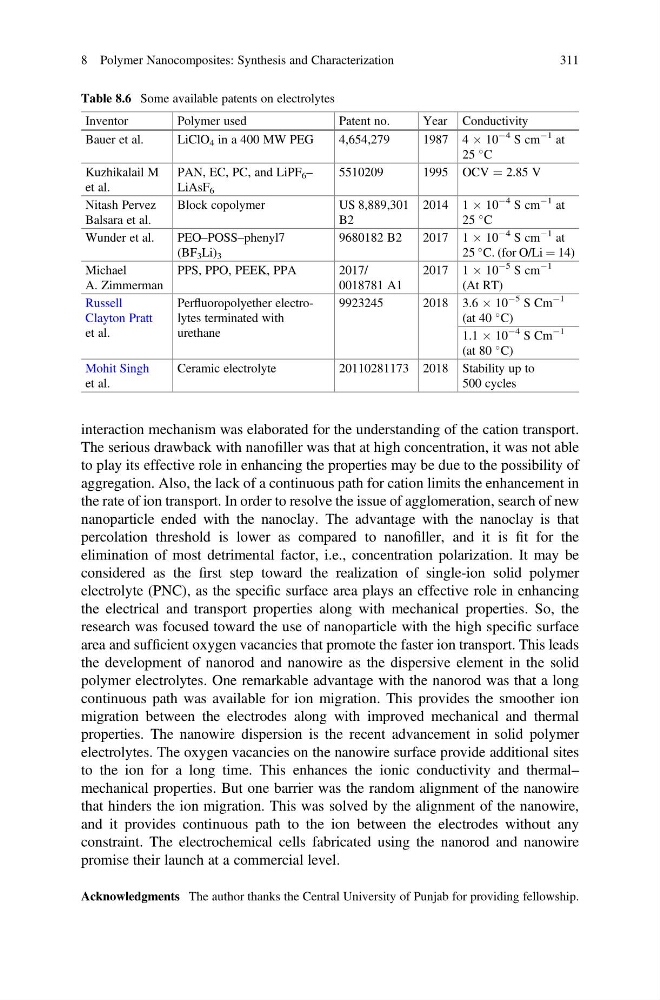
Table 8.6 Some available patents on electrolytes
Inventor
Polymer used
Patent no.
Year Conductivity
Bauer et al.
LiClO 4 in a 400 MW PEG
4,654,279
1987 4 Â 10
À4 S cm
À1 at
25
C
Kuzhikalail M
et al.
PAN, EC, PC, and LiPF 6 –
LiAsF 6
5510209
1995 OCV ¼ 2.85 V
Nitash Pervez
Balsara et al.
Block copolymer
US 8,889,301
B2
2014 1 Â 10
À4 S cm
À1 at
25
C
Wunder et al.
PEO–POSS–phenyl7
(BF 3 Li) 3
9680182 B2
2017 1 Â 10
À4 S cm
À1 at
25
C. (for O/Li ¼ 14)
Michael
A. Zimmerman
PPS, PPO, PEEK, PPA
2017/
0018781 A1
2017 1 Â 10
À5 S cm
À1
(At RT)
Russell
Clayton Pratt
et al.
Perfluoropolyether electrolytes terminated with
urethane
9923245
2018 3.6 Â 10
À5 S Cm
À1
(at 40
C)
1.1 Â 10
À4 S Cm
À1
(at 80
C)
Mohit Singh
et al.
Ceramic electrolyte
20110281173 2018 Stability up to
500 cycles
8 Polymer Nanocomposites: Synthesis and Characterization
311
The serious drawback with nanofiller was that at high concentration, it was not able
to play its effective role in enhancing the properties may be due to the possibility of
aggregation. Also, the lack of a continuous path for cation limits the enhancement in
the rate of ion transport. In order to resolve the issue of agglomeration, search of new
nanoparticle ended with the nanoclay. The advantage with the nanoclay is that
percolation threshold is lower as compared to nanofiller, and it is fit for the
elimination of most detrimental factor, i.e., concentration polarization. It may be
considered as the first step toward the realization of single-ion solid polymer
electrolyte (PNC), as the specific surface area plays an effective role in enhancing
the electrical and transport properties along with mechanical properties. So, the
research was focused toward the use of nanoparticle with the high specific surface
area and sufficient oxygen vacancies that promote the faster ion transport. This leads
the development of nanorod and nanowire as the dispersive element in the solid
polymer electrolytes. One remarkable advantage with the nanorod was that a long
continuous path was available for ion migration. This provides the smoother ion
migration between the electrodes along with improved mechanical and thermal
properties. The nanowire dispersion is the recent advancement in solid polymer
electrolytes. The oxygen vacancies on the nanowire surface provide additional sites
to the ion for a long time. This enhances the ionic conductivity and thermal–
mechanical properties. But one barrier was the random alignment of the nanowire
that hinders the ion migration. This was solved by the alignment of the nanowire,
and it provides continuous path to the ion between the electrodes without any
constraint. The electrochemical cells fabricated using the nanorod and nanowire
promise their launch at a commercial level.
Acknowledgments The author thanks the Central University of Punjab for providing fellowship.
Table 8.6 Some available patents on electrolytes
Inventor
Polymer used
Patent no.
Year Conductivity
Bauer et al.
LiClO 4 in a 400 MW PEG
4,654,279
1987 4 Â 10
À4 S cm
À1 at
25
C
Kuzhikalail M
et al.
PAN, EC, PC, and LiPF 6 –
LiAsF 6
5510209
1995 OCV ¼ 2.85 V
Nitash Pervez
Balsara et al.
Block copolymer
US 8,889,301
B2
2014 1 Â 10
À4 S cm
À1 at
25
C
Wunder et al.
PEO–POSS–phenyl7
(BF 3 Li) 3
9680182 B2
2017 1 Â 10
À4 S cm
À1 at
25
C. (for O/Li ¼ 14)
Michael
A. Zimmerman
PPS, PPO, PEEK, PPA
2017/
0018781 A1
2017 1 Â 10
À5 S cm
À1
(At RT)
Russell
Clayton Pratt
et al.
Perfluoropolyether electrolytes terminated with
urethane
9923245
2018 3.6 Â 10
À5 S Cm
À1
(at 40
C)
1.1 Â 10
À4 S Cm
À1
(at 80
C)
Mohit Singh
et al.
Ceramic electrolyte
20110281173 2018 Stability up to
500 cycles
8 Polymer Nanocomposites: Synthesis and Characterization
311