

point is that separator must have good compatibility and less thickness (<25 μm)
with the electrodes and possess desirable mechanical, electrochemical, and stability
(thermal–voltage) properties (Arora and Zhang 2004; Zhang 2007b). Table 8.6
summarizes the selected patents in polymer electrolytes.
8.5 Summary and Conclusions
This chapter highlighted the recent updates on the solid PNCs with nanoparticle of
different shapes and specific surface area. The development of solid polymer
electrolyte as an alternative to liquid–gel polymer electrolyte has been the focus of
researchers all over the world. From the last three decades, the nanoparticles have
gained attention for the preparation of the solid polymer electrolyte for the energy
storage systems. Among the various nanoparticles used for dispersion in the polymer
matrix, nanoclay and active–passive nanofiller have been most studied. The
nanofiller and nanoclay improved the overall properties of the polymer electrolytes.
The nanofiller enhanced the electrical properties along with mechanical properties
depending on the preparation method, dispersion, surface group interaction with
polymer chains, surface area, and dielectric constant. The Lewis acid–base
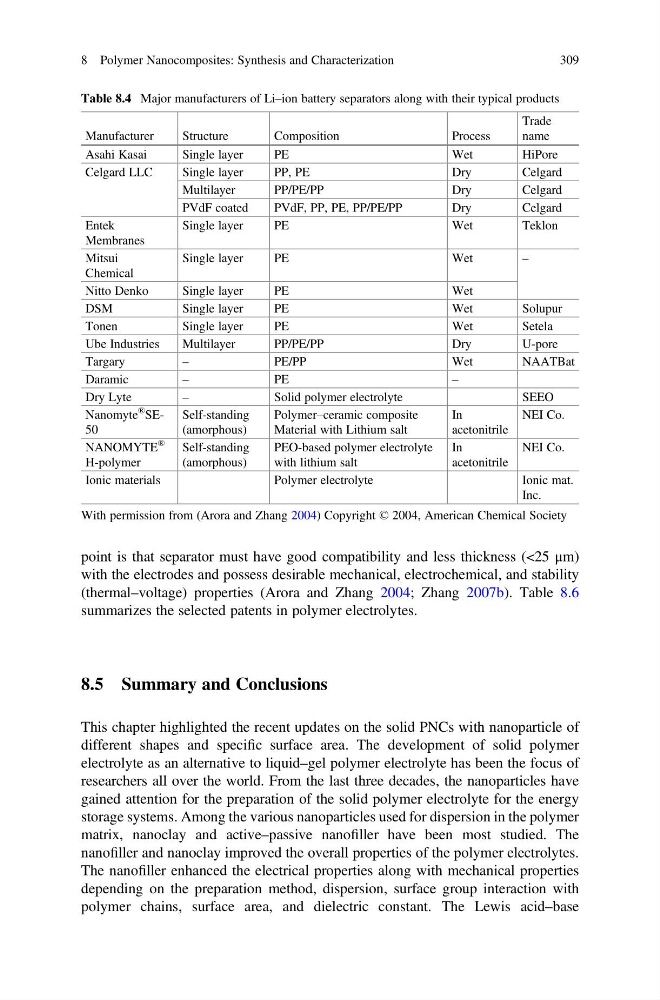
Table 8.4 Major manufacturers of Li–ion battery separators along with their typical products
Manufacturer
Structure
Composition
Process
Trade
name
Asahi Kasai
Single layer
PE
Wet
HiPore
Celgard LLC
Single layer
PP, PE
Dry
Celgard
Multilayer
PP/PE/PP
Dry
Celgard
PVdF coated
PVdF, PP, PE, PP/PE/PP
Dry
Celgard
Entek
Membranes
Single layer
PE
Wet
Teklon
Mitsui
Chemical
Single layer
PE
Wet
–
Nitto Denko
Single layer
PE
Wet
DSM
Single layer
PE
Wet
Solupur
Tonen
Single layer
PE
Wet
Setela
Ube Industries
Multilayer
PP/PE/PP
Dry
U-pore
Targary
–
PE/PP
Wet
NAATBat
Daramic
–
PE
–
Dry Lyte
–
Solid polymer electrolyte
SEEO
Nanomyte
®
SE50
Self-standing
(amorphous)
Polymer–ceramic composite
Material with Lithium salt
In
acetonitrile
NEI Co.
NANOMYTE
®
H-polymer
Self-standing
(amorphous)
PEO-based polymer electrolyte
with lithium salt
In
acetonitrile
NEI Co.
Ionic materials
Polymer electrolyte
Ionic mat.
Inc.
With permission from (Arora and Zhang 2004) Copyright © 2004, American Chemical Society
8 Polymer Nanocomposites: Synthesis and Characterization
309
with the electrodes and possess desirable mechanical, electrochemical, and stability
(thermal–voltage) properties (Arora and Zhang 2004; Zhang 2007b). Table 8.6
summarizes the selected patents in polymer electrolytes.
8.5 Summary and Conclusions
This chapter highlighted the recent updates on the solid PNCs with nanoparticle of
different shapes and specific surface area. The development of solid polymer
electrolyte as an alternative to liquid–gel polymer electrolyte has been the focus of
researchers all over the world. From the last three decades, the nanoparticles have
gained attention for the preparation of the solid polymer electrolyte for the energy
storage systems. Among the various nanoparticles used for dispersion in the polymer
matrix, nanoclay and active–passive nanofiller have been most studied. The
nanofiller and nanoclay improved the overall properties of the polymer electrolytes.
The nanofiller enhanced the electrical properties along with mechanical properties
depending on the preparation method, dispersion, surface group interaction with
polymer chains, surface area, and dielectric constant. The Lewis acid–base
Table 8.4 Major manufacturers of Li–ion battery separators along with their typical products
Manufacturer
Structure
Composition
Process
Trade
name
Asahi Kasai
Single layer
PE
Wet
HiPore
Celgard LLC
Single layer
PP, PE
Dry
Celgard
Multilayer
PP/PE/PP
Dry
Celgard
PVdF coated
PVdF, PP, PE, PP/PE/PP
Dry
Celgard
Entek
Membranes
Single layer
PE
Wet
Teklon
Mitsui
Chemical
Single layer
PE
Wet
–
Nitto Denko
Single layer
PE
Wet
DSM
Single layer
PE
Wet
Solupur
Tonen
Single layer
PE
Wet
Setela
Ube Industries
Multilayer
PP/PE/PP
Dry
U-pore
Targary
–
PE/PP
Wet
NAATBat
Daramic
–
PE
–
Dry Lyte
–
Solid polymer electrolyte
SEEO
Nanomyte
®
SE50
Self-standing
(amorphous)
Polymer–ceramic composite
Material with Lithium salt
In
acetonitrile
NEI Co.
NANOMYTE
®
H-polymer
Self-standing
(amorphous)
PEO-based polymer electrolyte
with lithium salt
In
acetonitrile
NEI Co.
Ionic materials
Polymer electrolyte
Ionic mat.
Inc.
With permission from (Arora and Zhang 2004) Copyright © 2004, American Chemical Society
8 Polymer Nanocomposites: Synthesis and Characterization
309