

8.4.4 Separator Development: Commercial and Patents
As the electrolyte–separator is the key component of the battery, the first commercialized battery produced in 1991 by Sony Corporation comprised a porous plastic
film soaked typically in LiPF 6 dissolved in a mixture of EC–EMC–DEC. The role of
the separator is to provide path to ions, (i) cathode to the anode during charging and
(ii) anode to cathode during discharging. Table 8.4 summarizes the various manufacturers and composition of the separator, and Table 8.5 (information available on
their site) summarizes the properties of commercial separators.
The separator must provide smooth ion migration and should be as thin as
possible and lightweight and must prevent electronic conduction. The most crucial
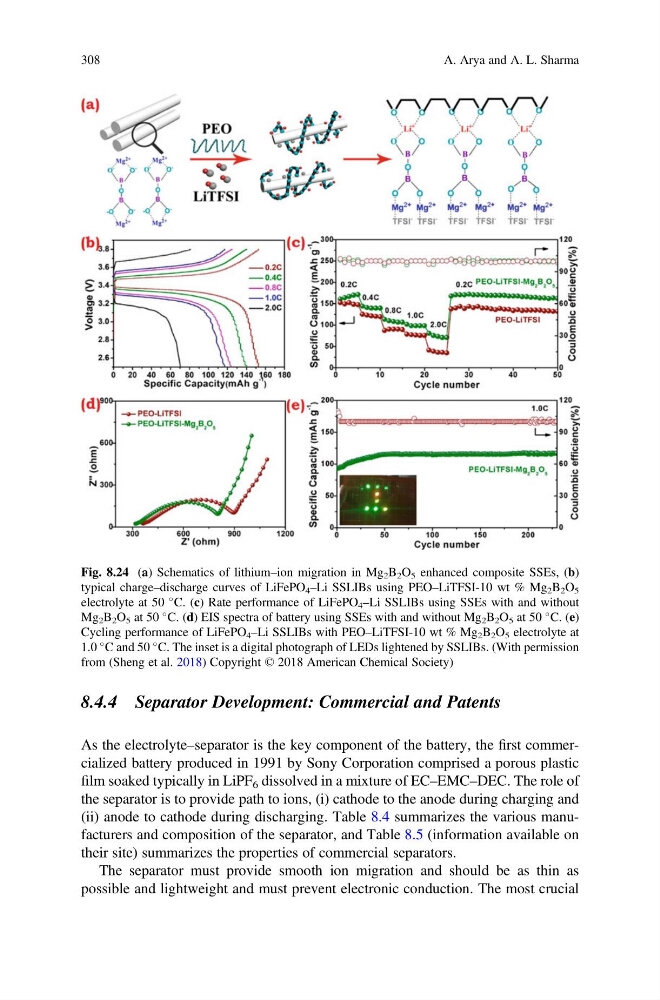
Fig. 8.24 (a) Schematics of lithium–ion migration in Mg 2 B 2 O 5 enhanced composite SSEs, (b)
typical charge–discharge curves of LiFePO 4 –Li SSLIBs using PEO–LiTFSI-10 wt % Mg 2 B 2 O 5
electrolyte at 50
C. (c) Rate performance of LiFePO 4 –Li SSLIBs using SSEs with and without
Mg 2 B 2 O 5 at 50
C. (d) EIS spectra of battery using SSEs with and without Mg 2 B 2 O 5 at 50
C. (e)
Cycling performance of LiFePO 4 –Li SSLIBs with PEO–LiTFSI-10 wt % Mg 2 B 2 O 5 electrolyte at
1.0
C and 50
C. The inset is a digital photograph of LEDs lightened by SSLIBs. (With permission
from (Sheng et al. 2018) Copyright © 2018 American Chemical Society)
308
A. Arya and A. L. Sharma
As the electrolyte–separator is the key component of the battery, the first commercialized battery produced in 1991 by Sony Corporation comprised a porous plastic
film soaked typically in LiPF 6 dissolved in a mixture of EC–EMC–DEC. The role of
the separator is to provide path to ions, (i) cathode to the anode during charging and
(ii) anode to cathode during discharging. Table 8.4 summarizes the various manufacturers and composition of the separator, and Table 8.5 (information available on
their site) summarizes the properties of commercial separators.
The separator must provide smooth ion migration and should be as thin as
possible and lightweight and must prevent electronic conduction. The most crucial
Fig. 8.24 (a) Schematics of lithium–ion migration in Mg 2 B 2 O 5 enhanced composite SSEs, (b)
typical charge–discharge curves of LiFePO 4 –Li SSLIBs using PEO–LiTFSI-10 wt % Mg 2 B 2 O 5
electrolyte at 50
C. (c) Rate performance of LiFePO 4 –Li SSLIBs using SSEs with and without
Mg 2 B 2 O 5 at 50
C. (d) EIS spectra of battery using SSEs with and without Mg 2 B 2 O 5 at 50
C. (e)
Cycling performance of LiFePO 4 –Li SSLIBs with PEO–LiTFSI-10 wt % Mg 2 B 2 O 5 electrolyte at
1.0
C and 50
C. The inset is a digital photograph of LEDs lightened by SSLIBs. (With permission
from (Sheng et al. 2018) Copyright © 2018 American Chemical Society)
308
A. Arya and A. L. Sharma