

amorphous content. The highest ionic conductivity was 3.22 Â 10
À4 S cm
À1 at 60
C
for 10 wt. % MMT and cation transport number (t Li
+ ) was 0.45.
The voltage stability window of the optimized electrolyte was 4 V. The cyclic
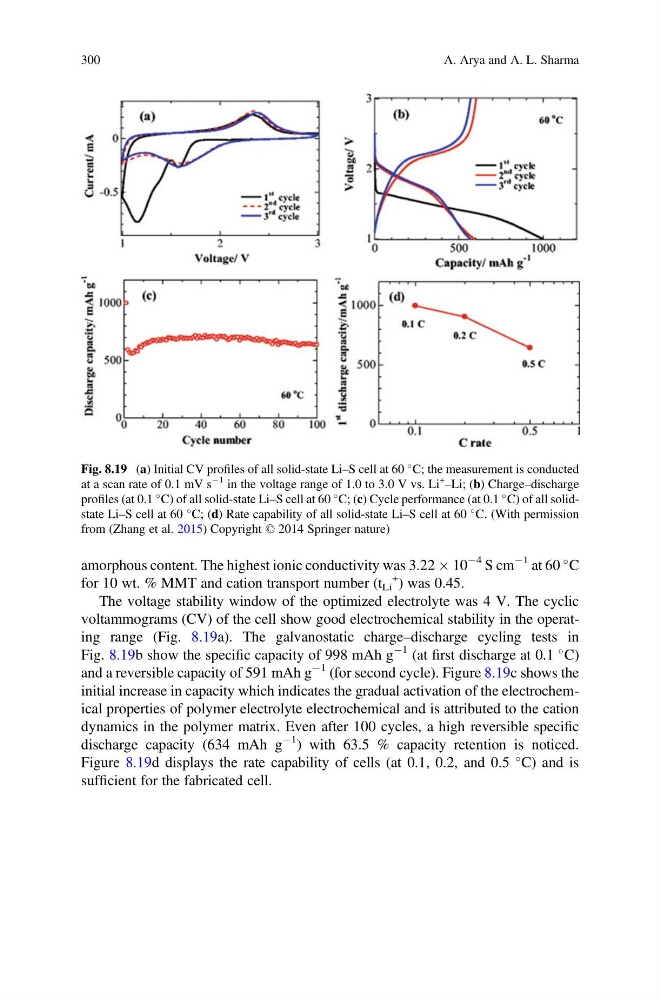
voltammograms (CV) of the cell show good electrochemical stability in the operating range (Fig. 8.19a). The galvanostatic charge–discharge cycling tests in
Fig. 8.19b show the specific capacity of 998 mAh g
À1 (at first discharge at 0.1
C)
and a reversible capacity of 591 mAh g
À1 (for second cycle). Figure 8.19c shows the
initial increase in capacity which indicates the gradual activation of the electrochemical properties of polymer electrolyte electrochemical and is attributed to the cation
dynamics in the polymer matrix. Even after 100 cycles, a high reversible specific
discharge capacity (634 mAh g
À1 ) with 63.5 % capacity retention is noticed.
Figure 8.19d displays the rate capability of cells (at 0.1, 0.2, and 0.5
C) and is
sufficient for the fabricated cell.
Fig. 8.19 (a) Initial CV profiles of all solid-state Li–S cell at 60
C; the measurement is conducted
at a scan rate of 0.1 mV s
À1 in the voltage range of 1.0 to 3.0 V vs. Li
+ –Li; (b) Charge–discharge
profiles (at 0.1
C) of all solid-state Li–S cell at 60
C; (c) Cycle performance (at 0.1
C) of all solidstate Li–S cell at 60
C; (d) Rate capability of all solid-state Li–S cell at 60
C. (With permission
from (Zhang et al. 2015) Copyright © 2014 Springer nature)
300
A. Arya and A. L. Sharma
À4 S cm
À1 at 60
C
for 10 wt. % MMT and cation transport number (t Li
+ ) was 0.45.
The voltage stability window of the optimized electrolyte was 4 V. The cyclic
voltammograms (CV) of the cell show good electrochemical stability in the operating range (Fig. 8.19a). The galvanostatic charge–discharge cycling tests in
Fig. 8.19b show the specific capacity of 998 mAh g
À1 (at first discharge at 0.1
C)
and a reversible capacity of 591 mAh g
À1 (for second cycle). Figure 8.19c shows the
initial increase in capacity which indicates the gradual activation of the electrochemical properties of polymer electrolyte electrochemical and is attributed to the cation
dynamics in the polymer matrix. Even after 100 cycles, a high reversible specific
discharge capacity (634 mAh g
À1 ) with 63.5 % capacity retention is noticed.
Figure 8.19d displays the rate capability of cells (at 0.1, 0.2, and 0.5
C) and is
sufficient for the fabricated cell.
Fig. 8.19 (a) Initial CV profiles of all solid-state Li–S cell at 60
C; the measurement is conducted
at a scan rate of 0.1 mV s
À1 in the voltage range of 1.0 to 3.0 V vs. Li
+ –Li; (b) Charge–discharge
profiles (at 0.1
C) of all solid-state Li–S cell at 60
C; (c) Cycle performance (at 0.1
C) of all solidstate Li–S cell at 60
C; (d) Rate capability of all solid-state Li–S cell at 60
C. (With permission
from (Zhang et al. 2015) Copyright © 2014 Springer nature)
300
A. Arya and A. L. Sharma