

Sharma et al. (Sharma and Thakur 2010) reported the preparation of the polymer
nanocomposites based on (PAN) 8 LiCF 3 SO 3 -x wt %DMMT. From XRD analysis,
the increase in the interlayer spacing and the clay gallery width was observed. This
increase was attributed to the polymer chain intercalation in the clay nanometric clay
galleries. The ionic conductivity was highest for the 7.5 wt. % clay content and is
about 6.8 Â 10
À3 S cm
À1 . The ion transference number was close to unity and
evidence the dominance of the ionic nature of the electrolyte. The cation transference
number was 0.67 and is an indication of proper dissociation of the salt after polymer
chain intercalation inside clay galleries. The voltage stability window was 5.6 V, and
thermal stability window was approx. 200
C.
Moreno et al. (2011) prepared the polymer nanocomposite based on the PEO
(with molecular weight 600,000 and 4,000,000) bentonite. XRD analysis demonstrated the absence of peak associated with the bentonite confirmed the polymer
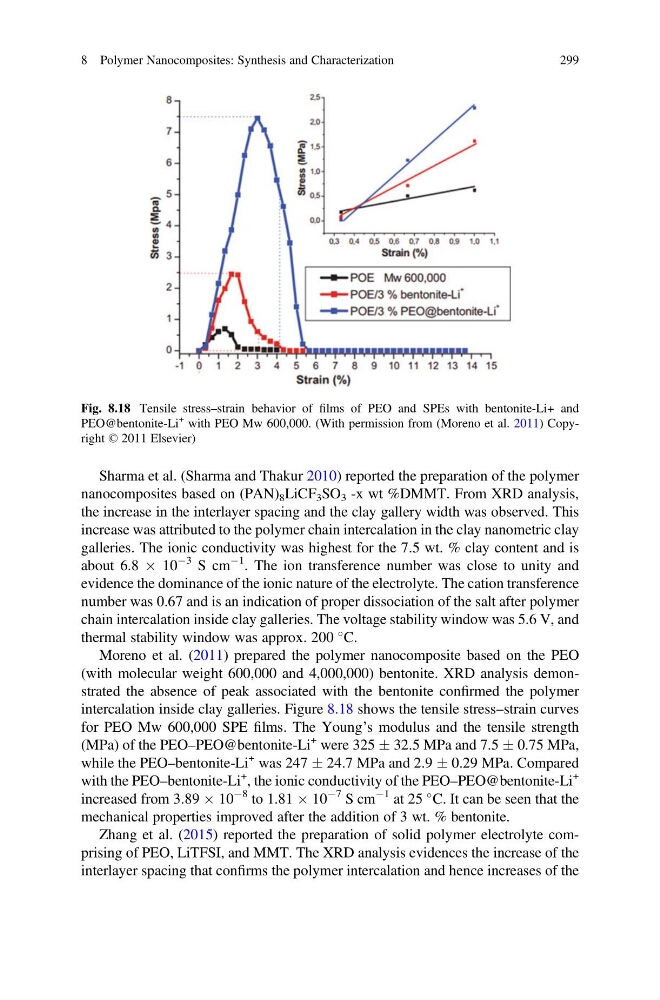
intercalation inside clay galleries. Figure 8.18 shows the tensile stress–strain curves
for PEO Mw 600,000 SPE films. The Young’s modulus and the tensile strength
(MPa) of the PEO–PEO@bentonite-Li
+ were 325 Æ 32.5 MPa and 7.5 Æ 0.75 MPa,
while the PEO–bentonite-Li
+ was 247 Æ 24.7 MPa and 2.9 Æ 0.29 MPa. Compared
with the PEO–bentonite-Li
+
, the ionic conductivity of the PEO–PEO@bentonite-Li
+
increased from 3.89 Â 10
À8 to 1.81 Â 10
À7 S cm
À1 at 25
C. It can be seen that the
mechanical properties improved after the addition of 3 wt. % bentonite.
Zhang et al. (2015) reported the preparation of solid polymer electrolyte comprising of PEO, LiTFSI, and MMT. The XRD analysis evidences the increase of the
interlayer spacing that confirms the polymer intercalation and hence increases of the
Fig. 8.18 Tensile stress–strain behavior of films of PEO and SPEs with bentonite-Li+ and
PEO@bentonite-Li
+ with PEO Mw 600,000. (With permission from (Moreno et al. 2011) Copyright © 2011 Elsevier)
8 Polymer Nanocomposites: Synthesis and Characterization
299
nanocomposites based on (PAN) 8 LiCF 3 SO 3 -x wt %DMMT. From XRD analysis,
the increase in the interlayer spacing and the clay gallery width was observed. This
increase was attributed to the polymer chain intercalation in the clay nanometric clay
galleries. The ionic conductivity was highest for the 7.5 wt. % clay content and is
about 6.8 Â 10
À3 S cm
À1 . The ion transference number was close to unity and
evidence the dominance of the ionic nature of the electrolyte. The cation transference
number was 0.67 and is an indication of proper dissociation of the salt after polymer
chain intercalation inside clay galleries. The voltage stability window was 5.6 V, and
thermal stability window was approx. 200
C.
Moreno et al. (2011) prepared the polymer nanocomposite based on the PEO
(with molecular weight 600,000 and 4,000,000) bentonite. XRD analysis demonstrated the absence of peak associated with the bentonite confirmed the polymer
intercalation inside clay galleries. Figure 8.18 shows the tensile stress–strain curves
for PEO Mw 600,000 SPE films. The Young’s modulus and the tensile strength
(MPa) of the PEO–PEO@bentonite-Li
+ were 325 Æ 32.5 MPa and 7.5 Æ 0.75 MPa,
while the PEO–bentonite-Li
+ was 247 Æ 24.7 MPa and 2.9 Æ 0.29 MPa. Compared
with the PEO–bentonite-Li
+
, the ionic conductivity of the PEO–PEO@bentonite-Li
+
increased from 3.89 Â 10
À8 to 1.81 Â 10
À7 S cm
À1 at 25
C. It can be seen that the
mechanical properties improved after the addition of 3 wt. % bentonite.
Zhang et al. (2015) reported the preparation of solid polymer electrolyte comprising of PEO, LiTFSI, and MMT. The XRD analysis evidences the increase of the
interlayer spacing that confirms the polymer intercalation and hence increases of the
Fig. 8.18 Tensile stress–strain behavior of films of PEO and SPEs with bentonite-Li+ and
PEO@bentonite-Li
+ with PEO Mw 600,000. (With permission from (Moreno et al. 2011) Copyright © 2011 Elsevier)
8 Polymer Nanocomposites: Synthesis and Characterization
299