

8.4.2 Nanoclay Dispersed Polymer Nanocomposites
As studied earlier, the nanofiller enhances the possibility of interaction between
polymer–ions via the Lewis acid–base interactions. It alters the polymer chain
arrangement, and the more free volume is available for the ion transport. Another
important role is played by the surface group of the nanofiller, and it leads to the
formation of the conductive continuous network. The overall enhancement is of the
amorphous content that is beneficial for a fast solid-state ionic conductor. But with
nanofiller, one issue is still there that is of dual-ion conduction. So, an alternative is
the use of nanoclay instead of the nanofiller.
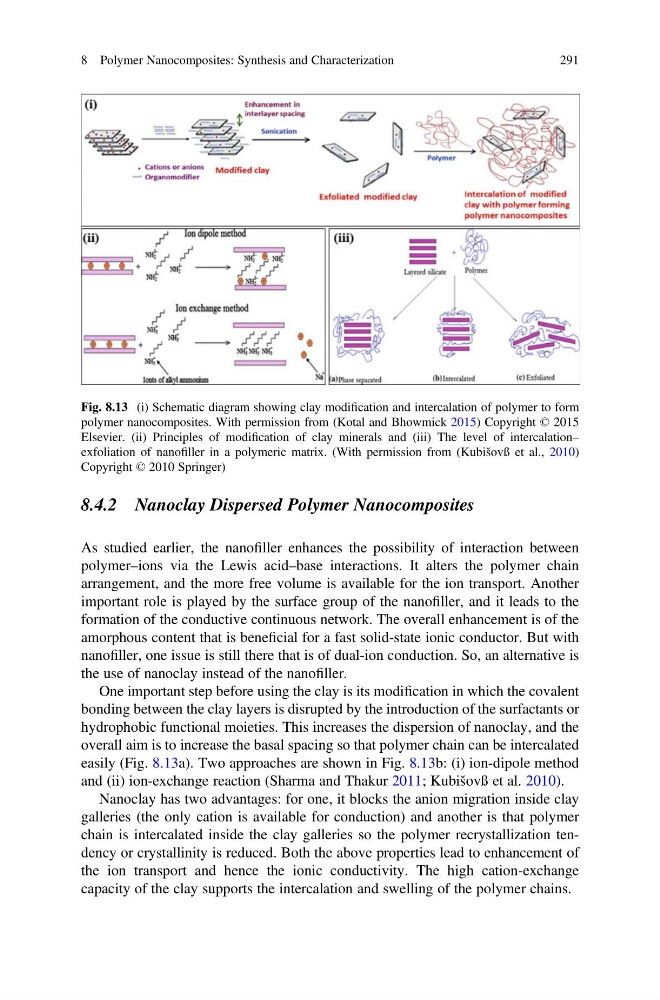
One important step before using the clay is its modification in which the covalent
bonding between the clay layers is disrupted by the introduction of the surfactants or
hydrophobic functional moieties. This increases the dispersion of nanoclay, and the
overall aim is to increase the basal spacing so that polymer chain can be intercalated
easily (Fig. 8.13a). Two approaches are shown in Fig. 8.13b: (i) ion-dipole method
and (ii) ion-exchange reaction (Sharma and Thakur 2011; Kubišovß et al. 2010).
Nanoclay has two advantages: for one, it blocks the anion migration inside clay
galleries (the only cation is available for conduction) and another is that polymer
chain is intercalated inside the clay galleries so the polymer recrystallization tendency or crystallinity is reduced. Both the above properties lead to enhancement of
the ion transport and hence the ionic conductivity. The high cation-exchange
capacity of the clay supports the intercalation and swelling of the polymer chains.
Fig. 8.13 (i) Schematic diagram showing clay modification and intercalation of polymer to form
polymer nanocomposites. With permission from (Kotal and Bhowmick 2015) Copyright © 2015
Elsevier. (ii) Principles of modification of clay minerals and (iii) The level of intercalation–
exfoliation of nanofiller in a polymeric matrix. (With permission from (Kubišovß et al., 2010)
Copyright © 2010 Springer)
8 Polymer Nanocomposites: Synthesis and Characterization
291
As studied earlier, the nanofiller enhances the possibility of interaction between
polymer–ions via the Lewis acid–base interactions. It alters the polymer chain
arrangement, and the more free volume is available for the ion transport. Another
important role is played by the surface group of the nanofiller, and it leads to the
formation of the conductive continuous network. The overall enhancement is of the
amorphous content that is beneficial for a fast solid-state ionic conductor. But with
nanofiller, one issue is still there that is of dual-ion conduction. So, an alternative is
the use of nanoclay instead of the nanofiller.
One important step before using the clay is its modification in which the covalent
bonding between the clay layers is disrupted by the introduction of the surfactants or
hydrophobic functional moieties. This increases the dispersion of nanoclay, and the
overall aim is to increase the basal spacing so that polymer chain can be intercalated
easily (Fig. 8.13a). Two approaches are shown in Fig. 8.13b: (i) ion-dipole method
and (ii) ion-exchange reaction (Sharma and Thakur 2011; Kubišovß et al. 2010).
Nanoclay has two advantages: for one, it blocks the anion migration inside clay
galleries (the only cation is available for conduction) and another is that polymer
chain is intercalated inside the clay galleries so the polymer recrystallization tendency or crystallinity is reduced. Both the above properties lead to enhancement of
the ion transport and hence the ionic conductivity. The high cation-exchange
capacity of the clay supports the intercalation and swelling of the polymer chains.
Fig. 8.13 (i) Schematic diagram showing clay modification and intercalation of polymer to form
polymer nanocomposites. With permission from (Kotal and Bhowmick 2015) Copyright © 2015
Elsevier. (ii) Principles of modification of clay minerals and (iii) The level of intercalation–
exfoliation of nanofiller in a polymeric matrix. (With permission from (Kubišovß et al., 2010)
Copyright © 2010 Springer)
8 Polymer Nanocomposites: Synthesis and Characterization
291