

i-t Characteristics (Transference Number)
It is one of the essential parameters that must be close to the unity (~1) for a good
ionic conductor and function of the ionic conductivity. One main drawback associated with the polymer electrolytes is concentration polarization (CP) on the electrode
interface which hinders the ion migration during cell operation. This affects the
overall performance of the device and observed in terms of the low-energy density
and power density. So, the main strategy to reduce the CP is to immobilize the anion
and keep only the active species as the main hero of the charge transport scenario.
This fulfills the idea of the single-state ionic conductor. So, the large value of the
cation transference number also plays an effective role in the enhancement of the
ionic conductivity. Two approaches are adopted for immobilizing the anion. One
approach suggests the anion interaction with the hydrogen of the polymer backbone
(hydrogen bond formation); another is the introduction of the anon receptors.
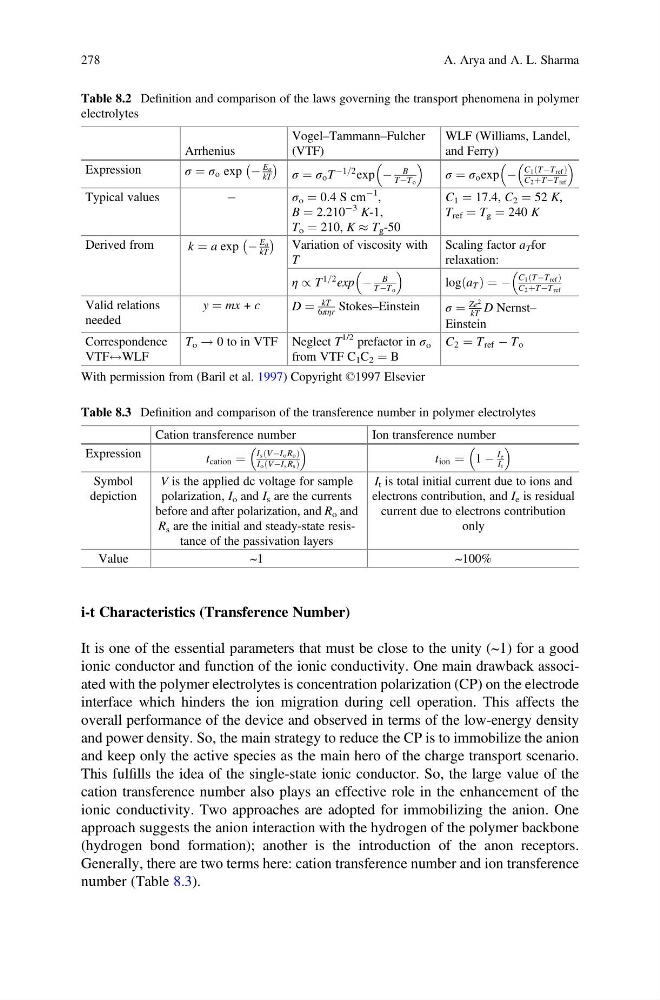
Generally, there are two terms here: cation transference number and ion transference
number (Table 8.3).
Table 8.2 Definition and comparison of the laws governing the transport phenomena in polymer
electrolytes
Arrhenius
Vogel–Tammann–Fulcher
(VTF)
WLF (Williams, Landel,
and Ferry)
Expression
σ ¼ σ o exp À
Ea
kT
À
Á
σ ¼ σ o T
À1=2 exp À
B
TÀTo
σ ¼ σ o exp À
C1 TÀTref
ð
Þ
C2þTÀTref
Typical values
À
σ o ¼ 0.4 S cm
À1
,
B ¼ 2.210
À3 K-1,
T o ¼ 210, K % T g -50
C 1 ¼ 17.4, C 2 ¼ 52 K,
T ref ¼ T g ¼ 240 K
Derived from
k ¼ a exp À
Ea
kT
À
Á
Variation of viscosity with
T
Scaling factor a T for
relaxation:
η / T
1=2 exp À
B
TÀTo
log a T
ð Þ ¼ À
C1 TÀTref
ð
Þ
C2þTÀTref
Valid relations
needed
y ¼ mx + c
D ¼
kT
6πηr Stokes–Einstein
σ ¼
Ze
2
kT D Nernst–
Einstein
Correspondence
VTF$WLF
T o ! 0 to in VTF Neglect T
1/2 prefactor in σ o
from VTF C 1 C 2 ¼ B
C 2 ¼ T ref À T o
With permission from (Baril et al. 1997) Copyright ©1997 Elsevier
Table 8.3 Definition and comparison of the transference number in polymer electrolytes
Cation transference number
Ion transference number
Expression
t cation ¼
Is VÀIoRo
ð
Þ
Io VÀIsRs
ð
Þ
t ion ¼ 1 À
Ie
It
Symbol
depiction
V is the applied dc voltage for sample
polarization, I o and I s are the currents
before and after polarization, and R o and
R s are the initial and steady-state resistance of the passivation layers
I t is total initial current due to ions and
electrons contribution, and I e is residual
current due to electrons contribution
only
Value
~1
~100%
278
A. Arya and A. L. Sharma
It is one of the essential parameters that must be close to the unity (~1) for a good
ionic conductor and function of the ionic conductivity. One main drawback associated with the polymer electrolytes is concentration polarization (CP) on the electrode
interface which hinders the ion migration during cell operation. This affects the
overall performance of the device and observed in terms of the low-energy density
and power density. So, the main strategy to reduce the CP is to immobilize the anion
and keep only the active species as the main hero of the charge transport scenario.
This fulfills the idea of the single-state ionic conductor. So, the large value of the
cation transference number also plays an effective role in the enhancement of the
ionic conductivity. Two approaches are adopted for immobilizing the anion. One
approach suggests the anion interaction with the hydrogen of the polymer backbone
(hydrogen bond formation); another is the introduction of the anon receptors.
Generally, there are two terms here: cation transference number and ion transference
number (Table 8.3).
Table 8.2 Definition and comparison of the laws governing the transport phenomena in polymer
electrolytes
Arrhenius
Vogel–Tammann–Fulcher
(VTF)
WLF (Williams, Landel,
and Ferry)
Expression
σ ¼ σ o exp À
Ea
kT
À
Á
σ ¼ σ o T
À1=2 exp À
B
TÀTo
σ ¼ σ o exp À
C1 TÀTref
ð
Þ
C2þTÀTref
Typical values
À
σ o ¼ 0.4 S cm
À1
,
B ¼ 2.210
À3 K-1,
T o ¼ 210, K % T g -50
C 1 ¼ 17.4, C 2 ¼ 52 K,
T ref ¼ T g ¼ 240 K
Derived from
k ¼ a exp À
Ea
kT
À
Á
Variation of viscosity with
T
Scaling factor a T for
relaxation:
η / T
1=2 exp À
B
TÀTo
log a T
ð Þ ¼ À
C1 TÀTref
ð
Þ
C2þTÀTref
Valid relations
needed
y ¼ mx + c
D ¼
kT
6πηr Stokes–Einstein
σ ¼
Ze
2
kT D Nernst–
Einstein
Correspondence
VTF$WLF
T o ! 0 to in VTF Neglect T
1/2 prefactor in σ o
from VTF C 1 C 2 ¼ B
C 2 ¼ T ref À T o
With permission from (Baril et al. 1997) Copyright ©1997 Elsevier
Table 8.3 Definition and comparison of the transference number in polymer electrolytes
Cation transference number
Ion transference number
Expression
t cation ¼
Is VÀIoRo
ð
Þ
Io VÀIsRs
ð
Þ
t ion ¼ 1 À
Ie
It
Symbol
depiction
V is the applied dc voltage for sample
polarization, I o and I s are the currents
before and after polarization, and R o and
R s are the initial and steady-state resistance of the passivation layers
I t is total initial current due to ions and
electrons contribution, and I e is residual
current due to electrons contribution
only
Value
~1
~100%
278
A. Arya and A. L. Sharma