

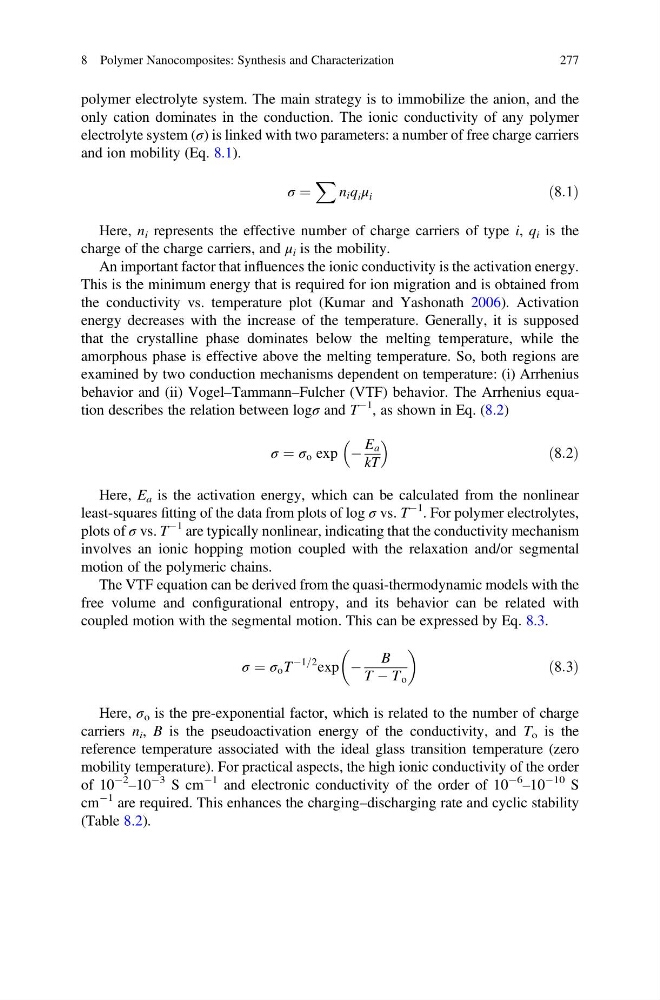
polymer electrolyte system. The main strategy is to immobilize the anion, and the
only cation dominates in the conduction. The ionic conductivity of any polymer
electrolyte system (σ) is linked with two parameters: a number of free charge carriers
and ion mobility (Eq. 8.1).
σ ¼
X
n i q i μ i
ð8:1Þ
Here, n i represents the effective number of charge carriers of type i, q i is the
charge of the charge carriers, and μ i is the mobility.
An important factor that influences the ionic conductivity is the activation energy.
This is the minimum energy that is required for ion migration and is obtained from
the conductivity vs. temperature plot (Kumar and Yashonath 2006). Activation
energy decreases with the increase of the temperature. Generally, it is supposed
that the crystalline phase dominates below the melting temperature, while the
amorphous phase is effective above the melting temperature. So, both regions are
examined by two conduction mechanisms dependent on temperature: (i) Arrhenius
behavior and (ii) Vogel–Tammann–Fulcher (VTF) behavior. The Arrhenius equation describes the relation between logσ and T
À1
, as shown in Eq. (8.2)
σ ¼ σ o exp À
E a
kT
ð8:2Þ
Here, E a is the activation energy, which can be calculated from the nonlinear
least-squares fitting of the data from plots of log σ vs. T
À1 . For polymer electrolytes,
plots of σ vs. T
À1 are typically nonlinear, indicating that the conductivity mechanism
involves an ionic hopping motion coupled with the relaxation and/or segmental
motion of the polymeric chains.
The VTF equation can be derived from the quasi-thermodynamic models with the
free volume and configurational entropy, and its behavior can be related with
coupled motion with the segmental motion. This can be expressed by Eq. 8.3.
σ ¼ σ o T
À1=2 exp À
B
T À T o
ð8:3Þ
Here, σ o is the pre-exponential factor, which is related to the number of charge
carriers n i , B is the pseudoactivation energy of the conductivity, and T o is the
reference temperature associated with the ideal glass transition temperature (zero
mobility temperature). For practical aspects, the high ionic conductivity of the order
of 10
À2
–10
À3 S cm
À1 and electronic conductivity of the order of 10
À6
–10
À10 S
cm
À1 are required. This enhances the charging–discharging rate and cyclic stability
(Table 8.2).
8 Polymer Nanocomposites: Synthesis and Characterization
277
only cation dominates in the conduction. The ionic conductivity of any polymer
electrolyte system (σ) is linked with two parameters: a number of free charge carriers
and ion mobility (Eq. 8.1).
σ ¼
X
n i q i μ i
ð8:1Þ
Here, n i represents the effective number of charge carriers of type i, q i is the
charge of the charge carriers, and μ i is the mobility.
An important factor that influences the ionic conductivity is the activation energy.
This is the minimum energy that is required for ion migration and is obtained from
the conductivity vs. temperature plot (Kumar and Yashonath 2006). Activation
energy decreases with the increase of the temperature. Generally, it is supposed
that the crystalline phase dominates below the melting temperature, while the
amorphous phase is effective above the melting temperature. So, both regions are
examined by two conduction mechanisms dependent on temperature: (i) Arrhenius
behavior and (ii) Vogel–Tammann–Fulcher (VTF) behavior. The Arrhenius equation describes the relation between logσ and T
À1
, as shown in Eq. (8.2)
σ ¼ σ o exp À
E a
kT
ð8:2Þ
Here, E a is the activation energy, which can be calculated from the nonlinear
least-squares fitting of the data from plots of log σ vs. T
À1 . For polymer electrolytes,
plots of σ vs. T
À1 are typically nonlinear, indicating that the conductivity mechanism
involves an ionic hopping motion coupled with the relaxation and/or segmental
motion of the polymeric chains.
The VTF equation can be derived from the quasi-thermodynamic models with the
free volume and configurational entropy, and its behavior can be related with
coupled motion with the segmental motion. This can be expressed by Eq. 8.3.
σ ¼ σ o T
À1=2 exp À
B
T À T o
ð8:3Þ
Here, σ o is the pre-exponential factor, which is related to the number of charge
carriers n i , B is the pseudoactivation energy of the conductivity, and T o is the
reference temperature associated with the ideal glass transition temperature (zero
mobility temperature). For practical aspects, the high ionic conductivity of the order
of 10
À2
–10
À3 S cm
À1 and electronic conductivity of the order of 10
À6
–10
À10 S
cm
À1 are required. This enhances the charging–discharging rate and cyclic stability
(Table 8.2).
8 Polymer Nanocomposites: Synthesis and Characterization
277