

Ag–TiO 2 nanocomposite prepared by a different method, has also been the
subject of various reports that show an enhancement of the photocatalytic activity
compared with pristine or commercial titanium oxide (Cheng et al. 2010; Xiang et al.
2010). The materials showed enhanced photocatalytic activity on dye degradation,
which is probably due to the transfer and separation of photogenerated electrons
from TiO 2 shell to the Ag core and to the self-sensitization of the dye molecule.
An extensive work has been carried out in order to prepare ZnO/TiO 2
heterostructures, which show good photocatalytic activity for the degradation of
organic dyes, such as methyl orange (MO) (Zhang et al. 2010c), methylene blue
(MB) (Arin et al. 2013), rhodamine dye (Liu et al. 2010b; Karunakaran et al. 2011;
Xiao 2012), malachite green (Stoyanova et al. 2013) and an azo dye (Sartori et al.
OH
O
OH
O
HO
OH
O
HO
OH
O
O
OH
O
OH
OH
O
Ibuprofen
I
II
III
IV
V
VI
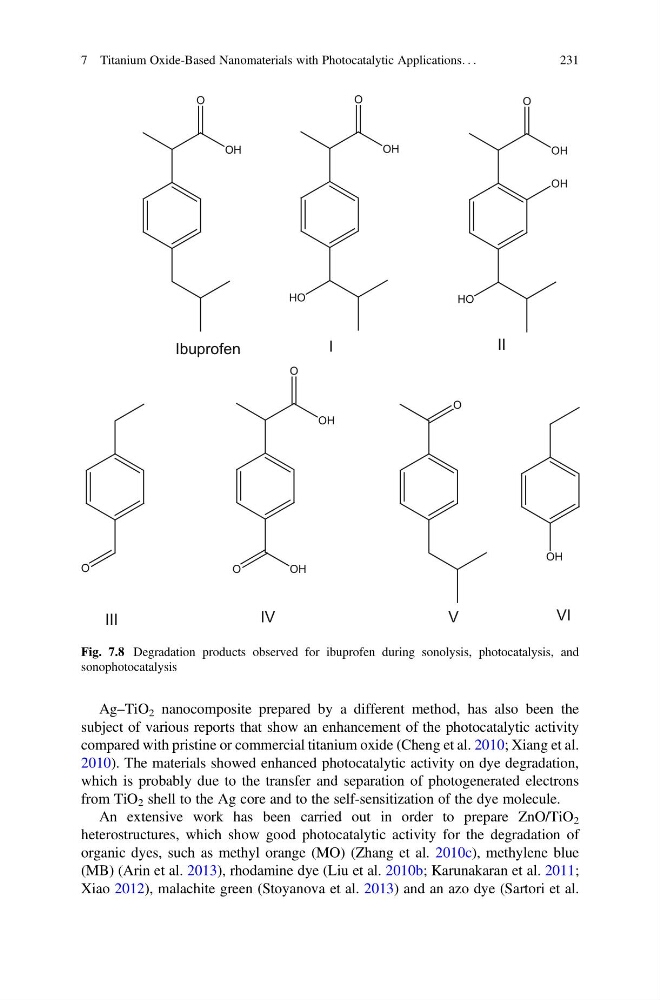
Fig. 7.8 Degradation products observed for ibuprofen during sonolysis, photocatalysis, and
sonophotocatalysis
7 Titanium Oxide-Based Nanomaterials with Photocatalytic Applications. . .
231
subject of various reports that show an enhancement of the photocatalytic activity
compared with pristine or commercial titanium oxide (Cheng et al. 2010; Xiang et al.
2010). The materials showed enhanced photocatalytic activity on dye degradation,
which is probably due to the transfer and separation of photogenerated electrons
from TiO 2 shell to the Ag core and to the self-sensitization of the dye molecule.
An extensive work has been carried out in order to prepare ZnO/TiO 2
heterostructures, which show good photocatalytic activity for the degradation of
organic dyes, such as methyl orange (MO) (Zhang et al. 2010c), methylene blue
(MB) (Arin et al. 2013), rhodamine dye (Liu et al. 2010b; Karunakaran et al. 2011;
Xiao 2012), malachite green (Stoyanova et al. 2013) and an azo dye (Sartori et al.
OH
O
OH
O
HO
OH
O
HO
OH
O
O
OH
O
OH
OH
O
Ibuprofen
I
II
III
IV
V
VI
Fig. 7.8 Degradation products observed for ibuprofen during sonolysis, photocatalysis, and
sonophotocatalysis
7 Titanium Oxide-Based Nanomaterials with Photocatalytic Applications. . .
231