

7.3.2 Principles of AOP
The principle of AOPs is to produce hydroxyl radicals (ÁOH) in water, a very
powerful oxidant capable of oxidizing a wide range of organic compounds. AOPs
generate extremely reactive ÁOH radicals that are responsible for the degradation of
pollutants (Shah et al. 2013; He et al. 2014). The main basis of these techniques is the
release of high energy (chemical, electrical, or radiating) into water in order to
generate highly reactive species such as superoxide radical anions (O 2 ÀÁ) and
hydroperoxyl radicals (HO 2
Á ) which are involved in the overall reactions.
The most important species are hydroxyl radicals, which have a considerably
high oxidation potential, and thus, they can oxidize nonselectively organic pollutants
even at ambient temperature. Next in importance as strong oxidation reagents
produced by AOP are oxygen radicals, ozone, and hydrogen peroxide. During the
activation process, AOPs are able to generate hydroxyl radicals ÁOH reactive toward
organic compounds in the presence of dissolved oxygen.
AOPs can be considered versatile technologies due to the production of hydroxyl
radicals (ÁOH) by various alternative routes. ÁOH are the main desired species due to
their nonselective reactivity caused by the high oxidation potential (2.80 V). The first
utilizes the natural and artificial light source (e.g., sun light, UV, visible light, etc.).
Examples of this are UV/H 2 O 2 , UV/O 3 , UV/TiO 2 , and UV/Fenton. In the absence of
light, they can be considered to be dark oxidative processes like ozonation (O 3 ),
fenton, and ultrasound.
Heterogeneous Photocatalysis
As one of the most important AOPs, heterogeneous photocatalytic oxidation processes are one of the most important areas in photochemistry, especially when solar
light is used. Photocatalysis is defined as a discipline inside chemistry that studies
the reactions in which the absorption of light is involved. Thus, in heterogeneous
photocatalysis a semiconductor must have the following characteristics:
OH
O
N
H 3 C
CH 3
NH 2
O
OH
O
OH
CH 3
OH
OH
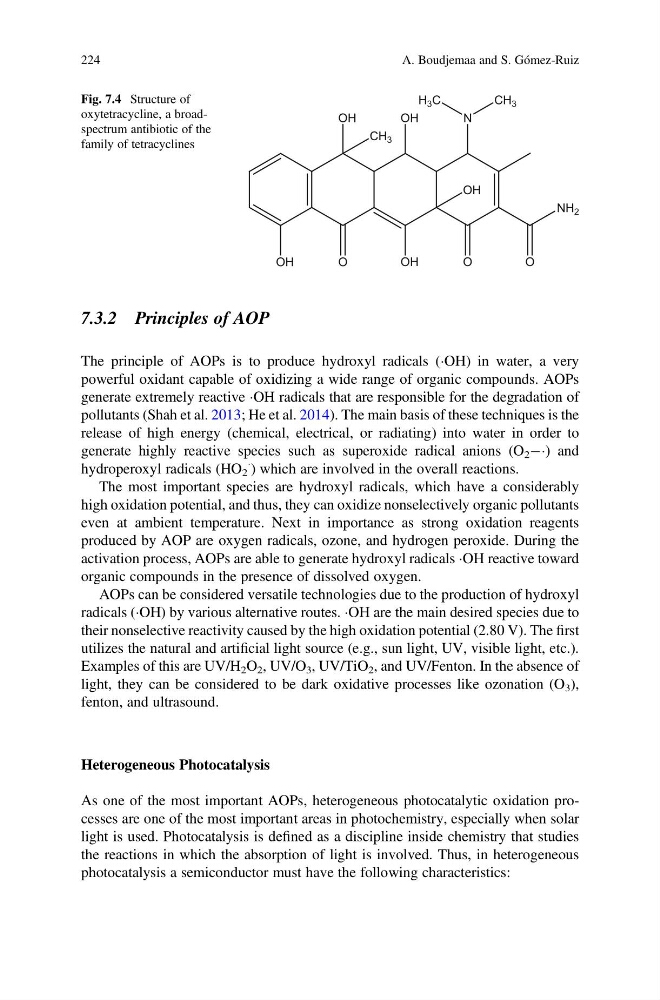
Fig. 7.4 Structure of
oxytetracycline, a broadspectrum antibiotic of the
family of tetracyclines
224
A. Boudjemaa and S. Gómez-Ruiz
The principle of AOPs is to produce hydroxyl radicals (ÁOH) in water, a very
powerful oxidant capable of oxidizing a wide range of organic compounds. AOPs
generate extremely reactive ÁOH radicals that are responsible for the degradation of
pollutants (Shah et al. 2013; He et al. 2014). The main basis of these techniques is the
release of high energy (chemical, electrical, or radiating) into water in order to
generate highly reactive species such as superoxide radical anions (O 2 ÀÁ) and
hydroperoxyl radicals (HO 2
Á ) which are involved in the overall reactions.
The most important species are hydroxyl radicals, which have a considerably
high oxidation potential, and thus, they can oxidize nonselectively organic pollutants
even at ambient temperature. Next in importance as strong oxidation reagents
produced by AOP are oxygen radicals, ozone, and hydrogen peroxide. During the
activation process, AOPs are able to generate hydroxyl radicals ÁOH reactive toward
organic compounds in the presence of dissolved oxygen.
AOPs can be considered versatile technologies due to the production of hydroxyl
radicals (ÁOH) by various alternative routes. ÁOH are the main desired species due to
their nonselective reactivity caused by the high oxidation potential (2.80 V). The first
utilizes the natural and artificial light source (e.g., sun light, UV, visible light, etc.).
Examples of this are UV/H 2 O 2 , UV/O 3 , UV/TiO 2 , and UV/Fenton. In the absence of
light, they can be considered to be dark oxidative processes like ozonation (O 3 ),
fenton, and ultrasound.
Heterogeneous Photocatalysis
As one of the most important AOPs, heterogeneous photocatalytic oxidation processes are one of the most important areas in photochemistry, especially when solar
light is used. Photocatalysis is defined as a discipline inside chemistry that studies
the reactions in which the absorption of light is involved. Thus, in heterogeneous
photocatalysis a semiconductor must have the following characteristics:
OH
O
N
H 3 C
CH 3
NH 2
O
OH
O
OH
CH 3
OH
OH
Fig. 7.4 Structure of
oxytetracycline, a broadspectrum antibiotic of the
family of tetracyclines
224
A. Boudjemaa and S. Gómez-Ruiz