

or nanoparticles reveal unique properties in terms of particle aggregation; photoemission; electrical, magnetic, and luminescent activity, heat conductivity; and
catalytic activity (Rai et al. 2012). These properties have recently been applied in
different biological studies like foodborne pathogen detection, biomolecule detection, sample separation, purification and concentration, signal transduction, and
amplification (sensors) (Jain 2007). These nanoparticles further enhance the detection sensitivity of microbial monitoring, degradation, and recovery efficiency of
chemicals (Urban and Meas 2008).
3.5.1 Nanomaterials
A nanosized material having at least one external dimension in the size ranges from
1 to 100 nanometers. Nanoscale materials are defined as a set of substances where at
least one dimension is less than approximately 100 nanometers. Nanomaterials
(NMs) are of interest because at this scale unique optical, magnetic, electrical, and
other properties emerge (Alagarasi 2011). NMs include nanoparticles (NPs), nanostructured materials and ultrafine particles, and their agglomerates and aggregates.
According to US EPA (USEPA 2007), there are four main types of nanomaterials
including carbon-based, metal-based, dendrimers and composites.
Carbon-based nanomaterials are composed mostly of carbon, most commonly
taking the form of hollow spheres, ellipsoids, or tubes. Spherical and ellipsoidal
carbon nanomaterials are referred to as fullerenes, while cylindrical ones are called
nanotubes (Roy and Jayanta 2015). These particles have many potential applications, including improved films and coatings, stronger and lighter materials, and
applications in electronics. Metal-based nanomaterials include quantum dots, nanogold, nanosilver, and metal oxides, such as titanium dioxide (Ranganathan 2015). A
quantum dot is a closely packed semiconductor crystal comprised of hundreds or
thousands of atoms and whose size is on the order of a few nanometers to a few
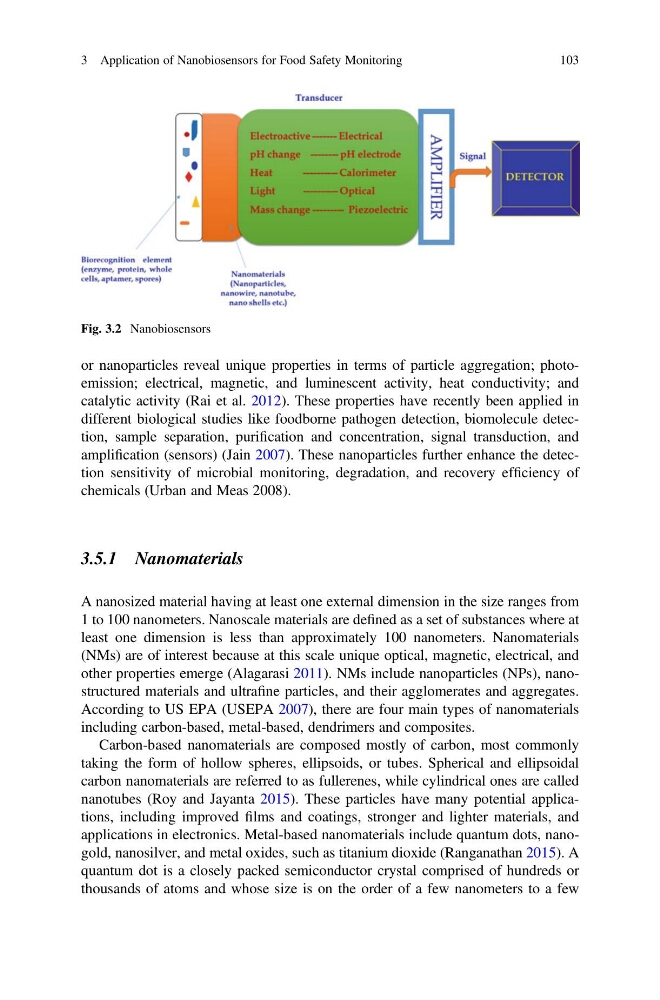
Fig. 3.2 Nanobiosensors
3 Application of Nanobiosensors for Food Safety Monitoring
103
catalytic activity (Rai et al. 2012). These properties have recently been applied in
different biological studies like foodborne pathogen detection, biomolecule detection, sample separation, purification and concentration, signal transduction, and
amplification (sensors) (Jain 2007). These nanoparticles further enhance the detection sensitivity of microbial monitoring, degradation, and recovery efficiency of
chemicals (Urban and Meas 2008).
3.5.1 Nanomaterials
A nanosized material having at least one external dimension in the size ranges from
1 to 100 nanometers. Nanoscale materials are defined as a set of substances where at
least one dimension is less than approximately 100 nanometers. Nanomaterials
(NMs) are of interest because at this scale unique optical, magnetic, electrical, and
other properties emerge (Alagarasi 2011). NMs include nanoparticles (NPs), nanostructured materials and ultrafine particles, and their agglomerates and aggregates.
According to US EPA (USEPA 2007), there are four main types of nanomaterials
including carbon-based, metal-based, dendrimers and composites.
Carbon-based nanomaterials are composed mostly of carbon, most commonly
taking the form of hollow spheres, ellipsoids, or tubes. Spherical and ellipsoidal
carbon nanomaterials are referred to as fullerenes, while cylindrical ones are called
nanotubes (Roy and Jayanta 2015). These particles have many potential applications, including improved films and coatings, stronger and lighter materials, and
applications in electronics. Metal-based nanomaterials include quantum dots, nanogold, nanosilver, and metal oxides, such as titanium dioxide (Ranganathan 2015). A
quantum dot is a closely packed semiconductor crystal comprised of hundreds or
thousands of atoms and whose size is on the order of a few nanometers to a few
Fig. 3.2 Nanobiosensors
3 Application of Nanobiosensors for Food Safety Monitoring
103