

Chapter 3
Characterizing structures using differential
geometry
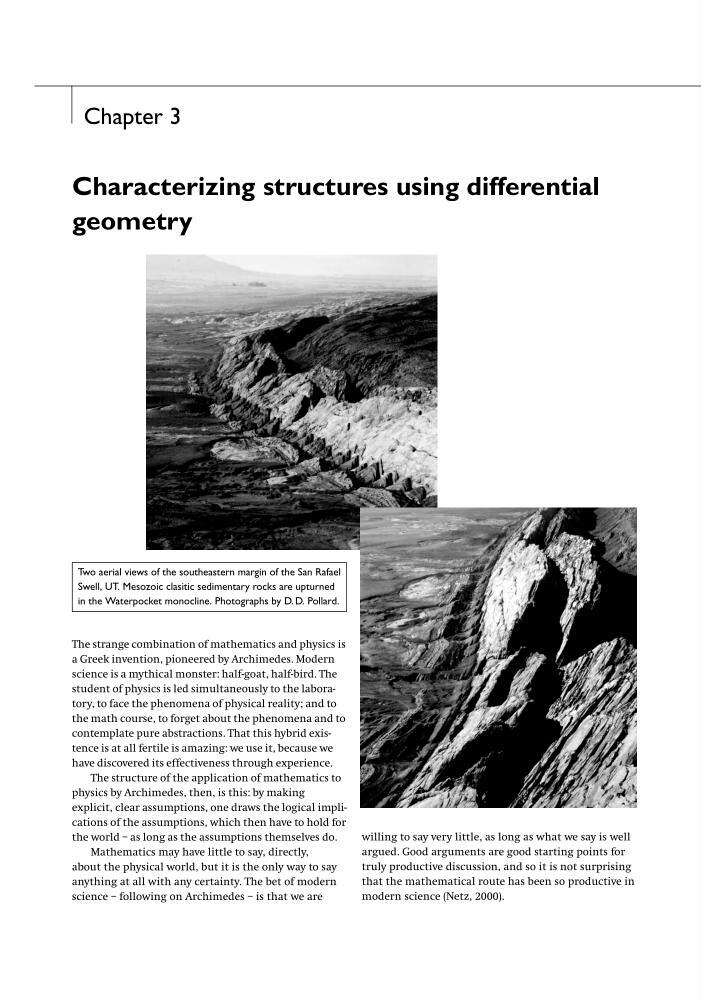
Two aerial views of the southeastern margin of the San Rafael
Swell, UT. Mesozoic clasitic sedimentary rocks are upturned
in the Waterpocket monocline. Photographs by D. D. Pollard.
The strange combination of mathematics and physics is
a Greek invention, pioneered by Archimedes. Modern
science is a mythical monster: half-goat, half-bird. The
student of physics is led simultaneously to the laboratory, to face the phenomena of physical reality; and to
the math course, to forget about the phenomena and to
contemplate pure abstractions. That this hybrid existence is at all fertile is amazing: we use it, because we
have discovered its effectiveness through experience.
The structure of the application of mathematics to
physics by Archimedes, then, is this: by making
explicit, clear assumptions, one draws the logical implications of the assumptions, which then have to hold for
the world – as long as the assumptions themselves do.
Mathematics may have little to say, directly,
about the physical world, but it is the only way to say
anything at all with any certainty. The bet of modern
science – following on Archimedes – is that we are
willing to say very little, as long as what we say is well
argued. Good arguments are good starting points for
truly productive discussion, and so it is not surprising
that the mathematical route has been so productive in
modern science (Netz, 2000).
Characterizing structures using differential
geometry
Two aerial views of the southeastern margin of the San Rafael
Swell, UT. Mesozoic clasitic sedimentary rocks are upturned
in the Waterpocket monocline. Photographs by D. D. Pollard.
The strange combination of mathematics and physics is
a Greek invention, pioneered by Archimedes. Modern
science is a mythical monster: half-goat, half-bird. The
student of physics is led simultaneously to the laboratory, to face the phenomena of physical reality; and to
the math course, to forget about the phenomena and to
contemplate pure abstractions. That this hybrid existence is at all fertile is amazing: we use it, because we
have discovered its effectiveness through experience.
The structure of the application of mathematics to
physics by Archimedes, then, is this: by making
explicit, clear assumptions, one draws the logical implications of the assumptions, which then have to hold for
the world – as long as the assumptions themselves do.
Mathematics may have little to say, directly,
about the physical world, but it is the only way to say
anything at all with any certainty. The bet of modern
science – following on Archimedes – is that we are
willing to say very little, as long as what we say is well
argued. Good arguments are good starting points for
truly productive discussion, and so it is not surprising
that the mathematical route has been so productive in
modern science (Netz, 2000).