

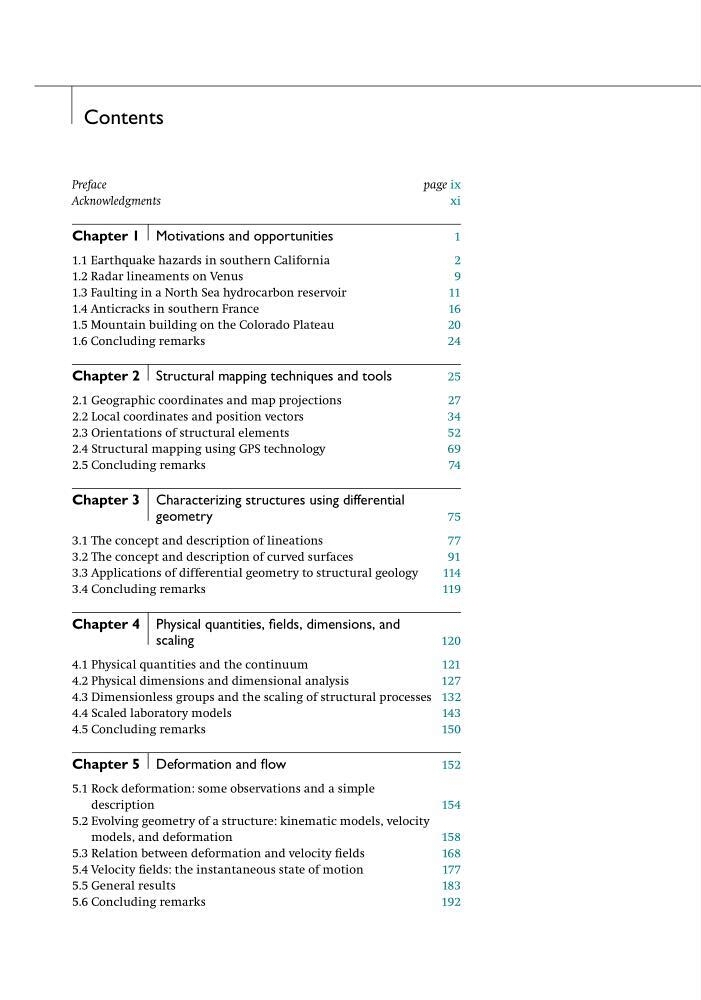
Contents
Preface
page ix
Acknowledgments
xi
Chapter 1 Motivations and opportunities
1
1.1 Earthquake hazards in southern California
2
1.2 Radar lineaments on Venus
9
1.3 Faulting in a North Sea hydrocarbon reservoir
11
1.4 Anticracks in southern France
16
1.5 Mountain building on the Colorado Plateau
20
1.6 Concluding remarks
24
Chapter 2 Structural mapping techniques and tools
25
2.1 Geographic coordinates and map projections
27
2.2 Local coordinates and position vectors
34
2.3 Orientations of structural elements
52
2.4 Structural mapping using GPS technology
69
2.5 Concluding remarks
74
Chapter 3 Characterizing structures using differential
geometry
75
3.1 The concept and description of lineations
77
3.2 The concept and description of curved surfaces
91
3.3 Applications of differential geometry to structural geology
114
3.4 Concluding remarks
119
Chapter 4 Physical quantities, fields, dimensions, and
scaling
120
4.1 Physical quantities and the continuum
121
4.2 Physical dimensions and dimensional analysis
127
4.3 Dimensionless groups and the scaling of structural processes 132
4.4 Scaled laboratory models
143
4.5 Concluding remarks
150
Chapter 5 Deformation and flow
152
5.1 Rock deformation: some observations and a simple
description
154
5.2 Evolving geometry of a structure: kinematic models, velocity
models, and deformation
158
5.3 Relation between deformation and velocity fields
168
5.4 Velocity fields: the instantaneous state of motion
177
5.5 General results
183
5.6 Concluding remarks
192
Preface
page ix
Acknowledgments
xi
Chapter 1 Motivations and opportunities
1
1.1 Earthquake hazards in southern California
2
1.2 Radar lineaments on Venus
9
1.3 Faulting in a North Sea hydrocarbon reservoir
11
1.4 Anticracks in southern France
16
1.5 Mountain building on the Colorado Plateau
20
1.6 Concluding remarks
24
Chapter 2 Structural mapping techniques and tools
25
2.1 Geographic coordinates and map projections
27
2.2 Local coordinates and position vectors
34
2.3 Orientations of structural elements
52
2.4 Structural mapping using GPS technology
69
2.5 Concluding remarks
74
Chapter 3 Characterizing structures using differential
geometry
75
3.1 The concept and description of lineations
77
3.2 The concept and description of curved surfaces
91
3.3 Applications of differential geometry to structural geology
114
3.4 Concluding remarks
119
Chapter 4 Physical quantities, fields, dimensions, and
scaling
120
4.1 Physical quantities and the continuum
121
4.2 Physical dimensions and dimensional analysis
127
4.3 Dimensionless groups and the scaling of structural processes 132
4.4 Scaled laboratory models
143
4.5 Concluding remarks
150
Chapter 5 Deformation and flow
152
5.1 Rock deformation: some observations and a simple
description
154
5.2 Evolving geometry of a structure: kinematic models, velocity
models, and deformation
158
5.3 Relation between deformation and velocity fields
168
5.4 Velocity fields: the instantaneous state of motion
177
5.5 General results
183
5.6 Concluding remarks
192