

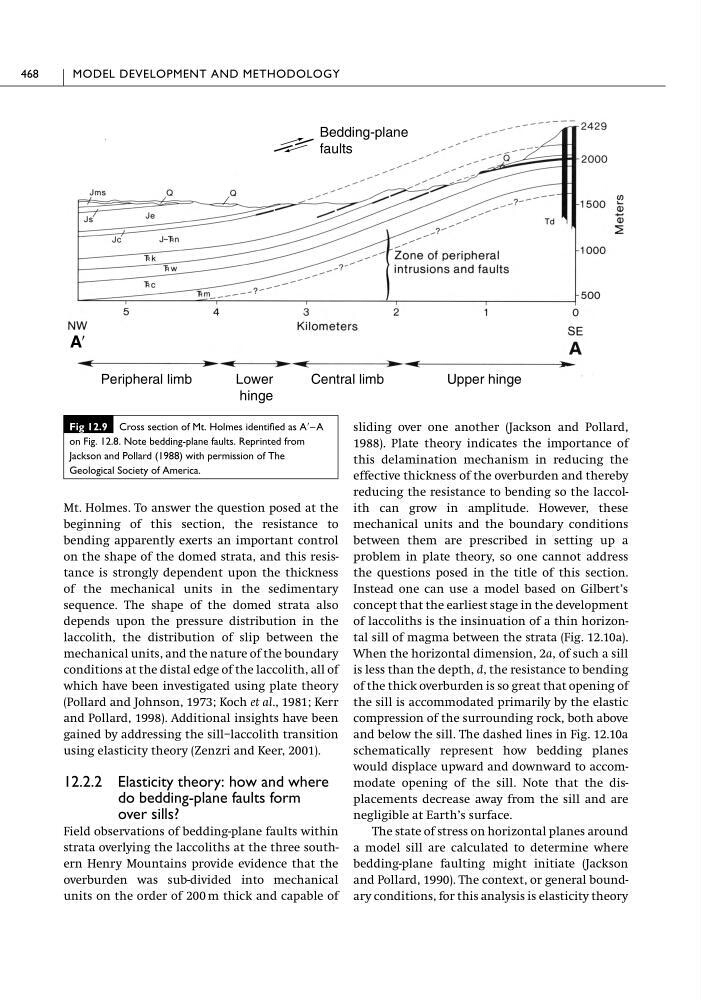
Mt. Holmes. To answer the question posed at the
beginning of this section, the resistance to
bending apparently exerts an important control
on the shape of the domed strata, and this resistance is strongly dependent upon the thickness
of the mechanical units in the sedimentary
sequence. The shape of the domed strata also
depends upon the pressure distribution in the
laccolith, the distribution of slip between the
mechanical units, and the nature of the boundary
conditions at the distal edge of the laccolith, all of
which have been investigated using plate theory
(Pollard and Johnson, 1973; Koch et al., 1981; Kerr
and Pollard, 1998). Additional insights have been
gained by addressing the sill–laccolith transition
using elasticity theory (Zenzri and Keer, 2001).
12.2.2 Elasticity theory: how and where
do bedding-plane faults form
over sills?
Field observations of bedding-plane faults within
strata overlying the laccoliths at the three southern Henry Mountains provide evidence that the
overburden was sub-divided into mechanical
units on the order of 200 m thick and capable of
sliding over one another (Jackson and Pollard,
1988). Plate theory indicates the importance of
this delamination mechanism in reducing the
effective thickness of the overburden and thereby
reducing the resistance to bending so the laccolith can grow in amplitude. However, these
mechanical units and the boundary conditions
between them are prescribed in setting up a
problem in plate theory, so one cannot address
the questions posed in the title of this section.
Instead one can use a model based on Gilbert’s
concept that the earliest stage in the development
of laccoliths is the insinuation of a thin horizontal sill of magma between the strata (Fig. 12.10a).
When the horizontal dimension, 2a, of such a sill
is less than the depth, d, the resistance to bending
of the thick overburden is so great that opening of
the sill is accommodated primarily by the elastic
compression of the surrounding rock, both above
and below the sill. The dashed lines in Fig. 12.10a
schematically represent how bedding planes
would displace upward and downward to accommodate opening of the sill. Note that the displacements decrease away from the sill and are
negligible at Earth’s surface.
The state of stress on horizontal planes around
a model sill are calculated to determine where
bedding-plane faulting might initiate (Jackson
and Pollard, 1990). The context, or general boundary conditions, for this analysis is elasticity theory
468
MODEL DEVELOPMENT AND METHODOLOGY
Fig 12.9 Cross section of Mt. Holmes identified as AЈ–A
on Fig. 12.8. Note bedding-plane faults. Reprinted from
Jackson and Pollard (1988) with permission of The
Geological Society of America.
Bedding-plane
faults
Upper hinge
Central limb
Peripheral limb
Lower
hinge
AЈ
beginning of this section, the resistance to
bending apparently exerts an important control
on the shape of the domed strata, and this resistance is strongly dependent upon the thickness
of the mechanical units in the sedimentary
sequence. The shape of the domed strata also
depends upon the pressure distribution in the
laccolith, the distribution of slip between the
mechanical units, and the nature of the boundary
conditions at the distal edge of the laccolith, all of
which have been investigated using plate theory
(Pollard and Johnson, 1973; Koch et al., 1981; Kerr
and Pollard, 1998). Additional insights have been
gained by addressing the sill–laccolith transition
using elasticity theory (Zenzri and Keer, 2001).
12.2.2 Elasticity theory: how and where
do bedding-plane faults form
over sills?
Field observations of bedding-plane faults within
strata overlying the laccoliths at the three southern Henry Mountains provide evidence that the
overburden was sub-divided into mechanical
units on the order of 200 m thick and capable of
sliding over one another (Jackson and Pollard,
1988). Plate theory indicates the importance of
this delamination mechanism in reducing the
effective thickness of the overburden and thereby
reducing the resistance to bending so the laccolith can grow in amplitude. However, these
mechanical units and the boundary conditions
between them are prescribed in setting up a
problem in plate theory, so one cannot address
the questions posed in the title of this section.
Instead one can use a model based on Gilbert’s
concept that the earliest stage in the development
of laccoliths is the insinuation of a thin horizontal sill of magma between the strata (Fig. 12.10a).
When the horizontal dimension, 2a, of such a sill
is less than the depth, d, the resistance to bending
of the thick overburden is so great that opening of
the sill is accommodated primarily by the elastic
compression of the surrounding rock, both above
and below the sill. The dashed lines in Fig. 12.10a
schematically represent how bedding planes
would displace upward and downward to accommodate opening of the sill. Note that the displacements decrease away from the sill and are
negligible at Earth’s surface.
The state of stress on horizontal planes around
a model sill are calculated to determine where
bedding-plane faulting might initiate (Jackson
and Pollard, 1990). The context, or general boundary conditions, for this analysis is elasticity theory
468
MODEL DEVELOPMENT AND METHODOLOGY
Fig 12.9 Cross section of Mt. Holmes identified as AЈ–A
on Fig. 12.8. Note bedding-plane faults. Reprinted from
Jackson and Pollard (1988) with permission of The
Geological Society of America.
Bedding-plane
faults
Upper hinge
Central limb
Peripheral limb
Lower
hinge
AЈ