

For a comparison of the model deflection distributions to field data we turn to maps and cross
sections for the southern Henry Mountains
(Jackson and Pollard, 1988, 1990). On the geologic
and structural map of Mt. Holmes (Fig. 12.8) note
that the sedimentary strata are continuous over
the top of the dome, and the beds dip more or less
in radial directions around the mountain.
Furthermore, the magnitude of the dips is small
far from the mountain, less than 10Њ; increases to
over 20Њ on the steep flanks, and decreases to less
than 10Њ near the top. The cross section along the
line AЈ–A (Fig. 12.9) is based on the bedding attitudes measured at exposures around the mountain, and the geologic and topographic maps. This
cross section reveals a form of bending that is
similar to the plate model (Fig. 12.7). In addition
to the doubly hinged structure the cross section
reveals a gently dipping peripheral limb that
extends 3–4 km beyond the lower hinge for all
three of the southern Henry Mountains (Jackson
and Pollard, 1990). This does not correlate with
the simple plate model, and may indicate the presence of underlying sills and smaller laccoliths
around the flanks of the central laccoliths.
The correlations between the plate model
deflections and the cross-sectional shapes for Mt.
Ellsworth and Mt. Hillers are more difficult to
assess because the upper parts of these domes are
eroded. Furthermore, whereas maximum limb
dips of 20Њ at Mt. Holmes are just within the range
permitted for the application of plate theory, the
dips are between 50Њ and 55Њ at Mt. Ellsworth, and
between 75Њ and 85Њ at Mt. Hillers. These intrusive
structures have developed beyond the stage where
elastic plate theory should be applied. However, if
these domes passed through an earlier stage of
development when, according to Gilbert’s conceptual model, the sedimentary overburden was
domed much like that at Mt. Holmes, plate theory
would be applicable for this earlier stage.
The diameters of the southern Henry
Mountains domes, 2a Ϸ 10 to 14 km, are only two
to three times the total overburden thickness, h Ϸ
4 km, yet applications of plate theory require a
ratio of diameter to thickness greater than about
eight. On the other hand the sedimentary section
is composed of a multitude of sandstone, siltstone, and shale beds, and this bedding provides
opportunities for the development of beddingplane faults and shear zones within softer layers
that would act to delaminate the overburden into
thinner mechanical units. Bedding-plane fault
zones are exposed within the sandstones and at
formational contacts (Fig. 12.9), indicating that
the overburden behaved in these places as a stack
of mechanical units that could slip over one
another. Measurements of bedding-plane faults at
Mt. Holmes demonstrate that they are spaced
from 150 to 200 m apart, so this may be a typical
thickness of the mechanical units (Jackson and
Pollard, 1988). In this way the total overburden
thickness of about 4 km could be reduced to an
effective thickness, h e , that was considerably less
than the diameter of the domes.
The effective thickness of a stack of bending
plates is equal to the thickness of a single plate
that would resist bending just as much as the
entire stack. For mechanical units with the same
elastic properties, E and , that are able to slide
freely over one another, the flexural rigidity
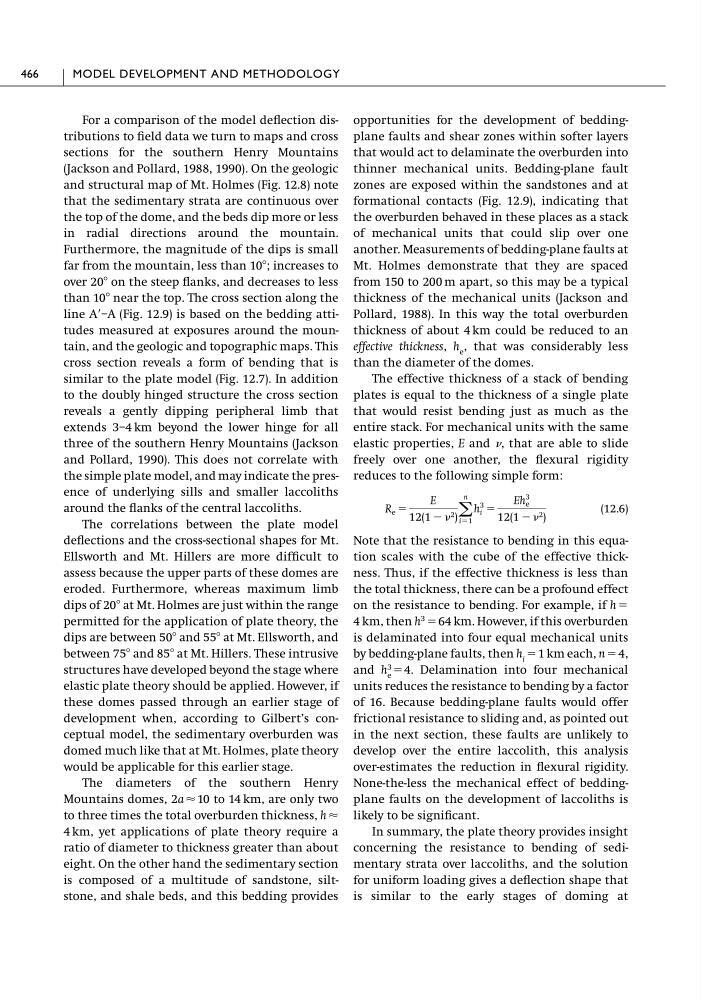
reduces to the following simple form:
(12.6)
Note that the resistance to bending in this equation scales with the cube of the effective thickness. Thus, if the effective thickness is less than
the total thickness, there can be a profound effect
on the resistance to bending. For example, if h ϭ
4 km, then h
3 ϭ 64 km. However, if this overburden
is delaminated into four equal mechanical units
by bedding-plane faults, then h i ϭ 1 km each, n ϭ 4,
and h
3
e
ϭ4. Delamination into four mechanical
units reduces the resistance to bending by a factor
of 16. Because bedding-plane faults would offer
frictional resistance to sliding and, as pointed out
in the next section, these faults are unlikely to
develop over the entire laccolith, this analysis
over-estimates the reduction in flexural rigidity.
None-the-less the mechanical effect of beddingplane faults on the development of laccoliths is
likely to be significant.
In summary, the plate theory provides insight
concerning the resistance to bending of sedimentary strata over laccoliths, and the solution
for uniform loading gives a deflection shape that
is similar to the early stages of doming at
R e ϭ
E
12(1 Ϫ 2 ) ͚
n
iϭ1
h i
3 ϭ
Eh e
3
12(1 Ϫ 2 )
466
MODEL DEVELOPMENT AND METHODOLOGY
sections for the southern Henry Mountains
(Jackson and Pollard, 1988, 1990). On the geologic
and structural map of Mt. Holmes (Fig. 12.8) note
that the sedimentary strata are continuous over
the top of the dome, and the beds dip more or less
in radial directions around the mountain.
Furthermore, the magnitude of the dips is small
far from the mountain, less than 10Њ; increases to
over 20Њ on the steep flanks, and decreases to less
than 10Њ near the top. The cross section along the
line AЈ–A (Fig. 12.9) is based on the bedding attitudes measured at exposures around the mountain, and the geologic and topographic maps. This
cross section reveals a form of bending that is
similar to the plate model (Fig. 12.7). In addition
to the doubly hinged structure the cross section
reveals a gently dipping peripheral limb that
extends 3–4 km beyond the lower hinge for all
three of the southern Henry Mountains (Jackson
and Pollard, 1990). This does not correlate with
the simple plate model, and may indicate the presence of underlying sills and smaller laccoliths
around the flanks of the central laccoliths.
The correlations between the plate model
deflections and the cross-sectional shapes for Mt.
Ellsworth and Mt. Hillers are more difficult to
assess because the upper parts of these domes are
eroded. Furthermore, whereas maximum limb
dips of 20Њ at Mt. Holmes are just within the range
permitted for the application of plate theory, the
dips are between 50Њ and 55Њ at Mt. Ellsworth, and
between 75Њ and 85Њ at Mt. Hillers. These intrusive
structures have developed beyond the stage where
elastic plate theory should be applied. However, if
these domes passed through an earlier stage of
development when, according to Gilbert’s conceptual model, the sedimentary overburden was
domed much like that at Mt. Holmes, plate theory
would be applicable for this earlier stage.
The diameters of the southern Henry
Mountains domes, 2a Ϸ 10 to 14 km, are only two
to three times the total overburden thickness, h Ϸ
4 km, yet applications of plate theory require a
ratio of diameter to thickness greater than about
eight. On the other hand the sedimentary section
is composed of a multitude of sandstone, siltstone, and shale beds, and this bedding provides
opportunities for the development of beddingplane faults and shear zones within softer layers
that would act to delaminate the overburden into
thinner mechanical units. Bedding-plane fault
zones are exposed within the sandstones and at
formational contacts (Fig. 12.9), indicating that
the overburden behaved in these places as a stack
of mechanical units that could slip over one
another. Measurements of bedding-plane faults at
Mt. Holmes demonstrate that they are spaced
from 150 to 200 m apart, so this may be a typical
thickness of the mechanical units (Jackson and
Pollard, 1988). In this way the total overburden
thickness of about 4 km could be reduced to an
effective thickness, h e , that was considerably less
than the diameter of the domes.
The effective thickness of a stack of bending
plates is equal to the thickness of a single plate
that would resist bending just as much as the
entire stack. For mechanical units with the same
elastic properties, E and , that are able to slide
freely over one another, the flexural rigidity
reduces to the following simple form:
(12.6)
Note that the resistance to bending in this equation scales with the cube of the effective thickness. Thus, if the effective thickness is less than
the total thickness, there can be a profound effect
on the resistance to bending. For example, if h ϭ
4 km, then h
3 ϭ 64 km. However, if this overburden
is delaminated into four equal mechanical units
by bedding-plane faults, then h i ϭ 1 km each, n ϭ 4,
and h
3
e
ϭ4. Delamination into four mechanical
units reduces the resistance to bending by a factor
of 16. Because bedding-plane faults would offer
frictional resistance to sliding and, as pointed out
in the next section, these faults are unlikely to
develop over the entire laccolith, this analysis
over-estimates the reduction in flexural rigidity.
None-the-less the mechanical effect of beddingplane faults on the development of laccoliths is
likely to be significant.
In summary, the plate theory provides insight
concerning the resistance to bending of sedimentary strata over laccoliths, and the solution
for uniform loading gives a deflection shape that
is similar to the early stages of doming at
R e ϭ
E
12(1 Ϫ 2 ) ͚
n
iϭ1
h i
3 ϭ
Eh e
3
12(1 Ϫ 2 )
466
MODEL DEVELOPMENT AND METHODOLOGY