

a cylindrical fault, cutting entirely through the
overburden (Fig. 1.18). This fault forms the periphery of the laccolith as the overlying piston of sedimentary rock is pushed upward. The bending of
the strata over the laccolith is completely ignored
in this idealization. Indeed, there is no deformation of the strata except along the fault. Because of
the geometry of the fault and the piston, the laccolith has a vertical side and a flat top, rather than
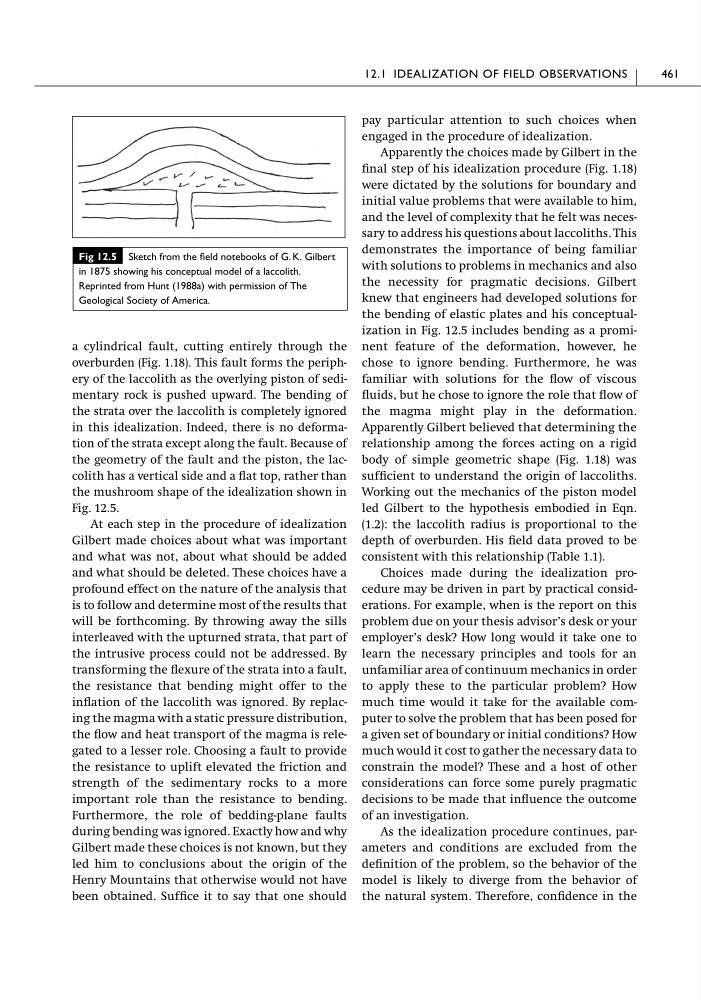
the mushroom shape of the idealization shown in
Fig. 12.5.
At each step in the procedure of idealization
Gilbert made choices about what was important
and what was not, about what should be added
and what should be deleted. These choices have a
profound effect on the nature of the analysis that
is to follow and determine most of the results that
will be forthcoming. By throwing away the sills
interleaved with the upturned strata, that part of
the intrusive process could not be addressed. By
transforming the flexure of the strata into a fault,
the resistance that bending might offer to the
inflation of the laccolith was ignored. By replacing the magma with a static pressure distribution,
the flow and heat transport of the magma is relegated to a lesser role. Choosing a fault to provide
the resistance to uplift elevated the friction and
strength of the sedimentary rocks to a more
important role than the resistance to bending.
Furthermore, the role of bedding-plane faults
during bending was ignored. Exactly how and why
Gilbert made these choices is not known, but they
led him to conclusions about the origin of the
Henry Mountains that otherwise would not have
been obtained. Suffice it to say that one should
pay particular attention to such choices when
engaged in the procedure of idealization.
Apparently the choices made by Gilbert in the
final step of his idealization procedure (Fig. 1.18)
were dictated by the solutions for boundary and
initial value problems that were available to him,
and the level of complexity that he felt was necessary to address his questions about laccoliths. This
demonstrates the importance of being familiar
with solutions to problems in mechanics and also
the necessity for pragmatic decisions. Gilbert
knew that engineers had developed solutions for
the bending of elastic plates and his conceptualization in Fig. 12.5 includes bending as a prominent feature of the deformation, however, he
chose to ignore bending. Furthermore, he was
familiar with solutions for the flow of viscous
fluids, but he chose to ignore the role that flow of
the magma might play in the deformation.
Apparently Gilbert believed that determining the
relationship among the forces acting on a rigid
body of simple geometric shape (Fig. 1.18) was
sufficient to understand the origin of laccoliths.
Working out the mechanics of the piston model
led Gilbert to the hypothesis embodied in Eqn.
(1.2): the laccolith radius is proportional to the
depth of overburden. His field data proved to be
consistent with this relationship (Table 1.1).
Choices made during the idealization procedure may be driven in part by practical considerations. For example, when is the report on this
problem due on your thesis advisor’s desk or your
employer’s desk? How long would it take one to
learn the necessary principles and tools for an
unfamiliar area of continuum mechanics in order
to apply these to the particular problem? How
much time would it take for the available computer to solve the problem that has been posed for
a given set of boundary or initial conditions? How
much would it cost to gather the necessary data to
constrain the model? These and a host of other
considerations can force some purely pragmatic
decisions to be made that influence the outcome
of an investigation.
As the idealization procedure continues, parameters and conditions are excluded from the
definition of the problem, so the behavior of the
model is likely to diverge from the behavior of
the natural system. Therefore, confidence in the
12.1 IDEALIZATION OF FIELD OBSERVATIONS
461
Fig 12.5 Sketch from the field notebooks of G. K. Gilbert
in 1875 showing his conceptual model of a laccolith.
Reprinted from Hunt (1988a) with permission of The
Geological Society of America.
overburden (Fig. 1.18). This fault forms the periphery of the laccolith as the overlying piston of sedimentary rock is pushed upward. The bending of
the strata over the laccolith is completely ignored
in this idealization. Indeed, there is no deformation of the strata except along the fault. Because of
the geometry of the fault and the piston, the laccolith has a vertical side and a flat top, rather than
the mushroom shape of the idealization shown in
Fig. 12.5.
At each step in the procedure of idealization
Gilbert made choices about what was important
and what was not, about what should be added
and what should be deleted. These choices have a
profound effect on the nature of the analysis that
is to follow and determine most of the results that
will be forthcoming. By throwing away the sills
interleaved with the upturned strata, that part of
the intrusive process could not be addressed. By
transforming the flexure of the strata into a fault,
the resistance that bending might offer to the
inflation of the laccolith was ignored. By replacing the magma with a static pressure distribution,
the flow and heat transport of the magma is relegated to a lesser role. Choosing a fault to provide
the resistance to uplift elevated the friction and
strength of the sedimentary rocks to a more
important role than the resistance to bending.
Furthermore, the role of bedding-plane faults
during bending was ignored. Exactly how and why
Gilbert made these choices is not known, but they
led him to conclusions about the origin of the
Henry Mountains that otherwise would not have
been obtained. Suffice it to say that one should
pay particular attention to such choices when
engaged in the procedure of idealization.
Apparently the choices made by Gilbert in the
final step of his idealization procedure (Fig. 1.18)
were dictated by the solutions for boundary and
initial value problems that were available to him,
and the level of complexity that he felt was necessary to address his questions about laccoliths. This
demonstrates the importance of being familiar
with solutions to problems in mechanics and also
the necessity for pragmatic decisions. Gilbert
knew that engineers had developed solutions for
the bending of elastic plates and his conceptualization in Fig. 12.5 includes bending as a prominent feature of the deformation, however, he
chose to ignore bending. Furthermore, he was
familiar with solutions for the flow of viscous
fluids, but he chose to ignore the role that flow of
the magma might play in the deformation.
Apparently Gilbert believed that determining the
relationship among the forces acting on a rigid
body of simple geometric shape (Fig. 1.18) was
sufficient to understand the origin of laccoliths.
Working out the mechanics of the piston model
led Gilbert to the hypothesis embodied in Eqn.
(1.2): the laccolith radius is proportional to the
depth of overburden. His field data proved to be
consistent with this relationship (Table 1.1).
Choices made during the idealization procedure may be driven in part by practical considerations. For example, when is the report on this
problem due on your thesis advisor’s desk or your
employer’s desk? How long would it take one to
learn the necessary principles and tools for an
unfamiliar area of continuum mechanics in order
to apply these to the particular problem? How
much time would it take for the available computer to solve the problem that has been posed for
a given set of boundary or initial conditions? How
much would it cost to gather the necessary data to
constrain the model? These and a host of other
considerations can force some purely pragmatic
decisions to be made that influence the outcome
of an investigation.
As the idealization procedure continues, parameters and conditions are excluded from the
definition of the problem, so the behavior of the
model is likely to diverge from the behavior of
the natural system. Therefore, confidence in the
12.1 IDEALIZATION OF FIELD OBSERVATIONS
461
Fig 12.5 Sketch from the field notebooks of G. K. Gilbert
in 1875 showing his conceptual model of a laccolith.
Reprinted from Hunt (1988a) with permission of The
Geological Society of America.