

The mullion structures in Fig. 10.10a have a
variable cusp-to-cusp span that is much smaller
than the vertical dimensions, not indicated in the
figure, of the bodies at whose interface they lie.
Both are probably layer-like or sheet-like in form.
Large mullions in this figure have spans of about
10 km, but many smaller “parasitic” mullions
have dimensions of a kilometer, so mullions
apparently form at multiple scales. These observations lead us to infer that mullion initiation in
this case may not depend on a characteristic
dimension of the initial configuration, such as a
layer thickness. We thus consider a configuration
consisting of two viscous half-spaces. In contrast,
the mullions in Fig. 10.10b show a regular span on
the decimeter scale with cusp-to-cusp arc lengths
comparable to the thickness of the layer separating them. The model developed here will not give
insight into this aspect of their deformation.
Suppose two materials undergo uniform shortening parallel to a planar interface without the
formation of mullion structure. Quantities in the
upper half-space are identified with the superscript (1), and those in the lower half-space with
(2). Assuming plane flow, (10.12)–(10.15), the
homogeneous shortening is described by:
(10.69)
From (10.69) and the constitutive relations (10.14)
we have:
(10.70)
The stress components
are the same in
both half-spaces, as required by the continuity
of traction at the planar interface. The surfaceparallel normal stress must be different unless
the viscosities are the same.
Taking the coordinate origin at the interface,
the velocity components, with the origin fixed, are:
(10.71)
These satisfy the condition that adjacent particles
in the two viscous fluids remain neighbors as
v (1)
y ϭ v (2)
y ϭ D yy y ϭ ϪD xx y
v (1)
x ϭ v (2)
x ϭ D xx x
yy and xy
(1)
xy ϭ (2)
xy ϭ xy ϭ 0
( (1)
xx Ϫ yy ) ր4 1 ϭ ( (2)
xx Ϫ yy ) ր4 2 ϭ D xx
D xy
(1) ϭ 0 ϭ D xy
(2)
D yy
(1) ϭ D yy
(2) ϭ D yy ϭ ϪD xx
D xx
(1) ϭ D xx
(2) ϭ D xx
deformation continues. This completes the solution for the case of a perfectly planar interface,
which we term the basic state.
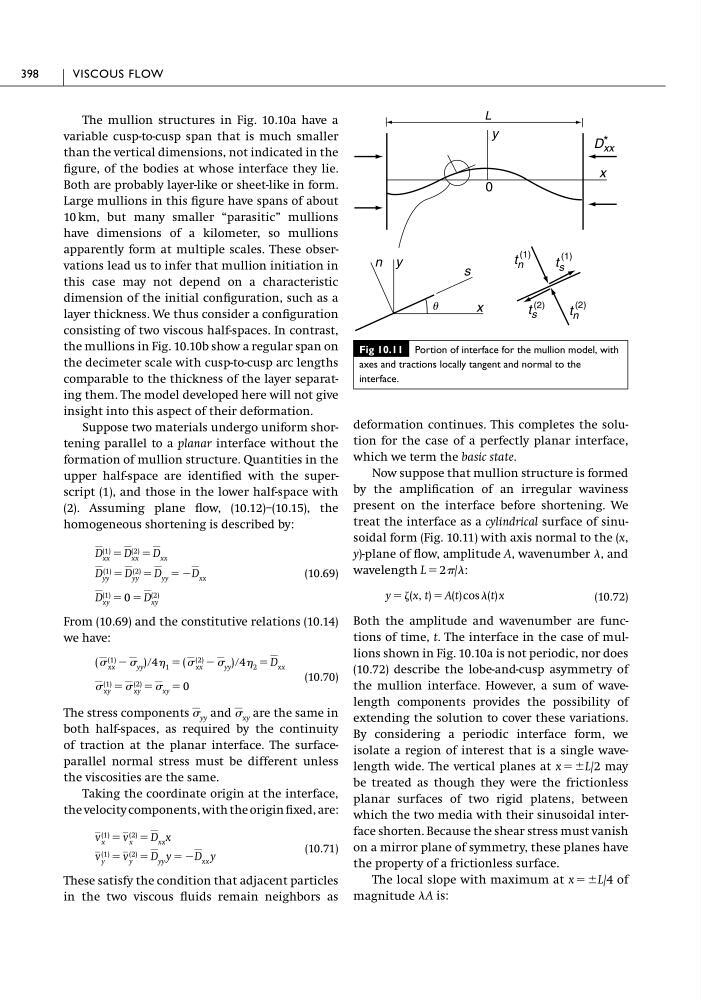
Now suppose that mullion structure is formed
by the amplification of an irregular waviness
present on the interface before shortening. We
treat the interface as a cylindrical surface of sinusoidal form (Fig. 10.11) with axis normal to the (x,
y)-plane of flow, amplitude A, wavenumber , and
wavelength L ϭ 2/:
(10.72)
Both the amplitude and wavenumber are functions of time, t. The interface in the case of mullions shown in Fig. 10.10a is not periodic, nor does
(10.72) describe the lobe-and-cusp asymmetry of
the mullion interface. However, a sum of wavelength components provides the possibility of
extending the solution to cover these variations.
By considering a periodic interface form, we
isolate a region of interest that is a single wavelength wide. The vertical planes at x ϭϮL/2 may
be treated as though they were the frictionless
planar surfaces of two rigid platens, between
which the two media with their sinusoidal interface shorten. Because the shear stress must vanish
on a mirror plane of symmetry, these planes have
the property of a frictionless surface.
The local slope with maximum at x ϭϮL/4 of
magnitude A is:
y ϭ (x, t) ϭ A(t) cos (t) x
398
VISCOUS FLOW
Fig 10.11 Portion of interface for the mullion model, with
axes and tractions locally tangent and normal to the
interface.
x
y
0
n y
s
x
u
D * xx
t n
(1)
t s
(2)
t n
(2)
t s
(1)
L
variable cusp-to-cusp span that is much smaller
than the vertical dimensions, not indicated in the
figure, of the bodies at whose interface they lie.
Both are probably layer-like or sheet-like in form.
Large mullions in this figure have spans of about
10 km, but many smaller “parasitic” mullions
have dimensions of a kilometer, so mullions
apparently form at multiple scales. These observations lead us to infer that mullion initiation in
this case may not depend on a characteristic
dimension of the initial configuration, such as a
layer thickness. We thus consider a configuration
consisting of two viscous half-spaces. In contrast,
the mullions in Fig. 10.10b show a regular span on
the decimeter scale with cusp-to-cusp arc lengths
comparable to the thickness of the layer separating them. The model developed here will not give
insight into this aspect of their deformation.
Suppose two materials undergo uniform shortening parallel to a planar interface without the
formation of mullion structure. Quantities in the
upper half-space are identified with the superscript (1), and those in the lower half-space with
(2). Assuming plane flow, (10.12)–(10.15), the
homogeneous shortening is described by:
(10.69)
From (10.69) and the constitutive relations (10.14)
we have:
(10.70)
The stress components
are the same in
both half-spaces, as required by the continuity
of traction at the planar interface. The surfaceparallel normal stress must be different unless
the viscosities are the same.
Taking the coordinate origin at the interface,
the velocity components, with the origin fixed, are:
(10.71)
These satisfy the condition that adjacent particles
in the two viscous fluids remain neighbors as
v (1)
y ϭ v (2)
y ϭ D yy y ϭ ϪD xx y
v (1)
x ϭ v (2)
x ϭ D xx x
yy and xy
(1)
xy ϭ (2)
xy ϭ xy ϭ 0
( (1)
xx Ϫ yy ) ր4 1 ϭ ( (2)
xx Ϫ yy ) ր4 2 ϭ D xx
D xy
(1) ϭ 0 ϭ D xy
(2)
D yy
(1) ϭ D yy
(2) ϭ D yy ϭ ϪD xx
D xx
(1) ϭ D xx
(2) ϭ D xx
deformation continues. This completes the solution for the case of a perfectly planar interface,
which we term the basic state.
Now suppose that mullion structure is formed
by the amplification of an irregular waviness
present on the interface before shortening. We
treat the interface as a cylindrical surface of sinusoidal form (Fig. 10.11) with axis normal to the (x,
y)-plane of flow, amplitude A, wavenumber , and
wavelength L ϭ 2/:
(10.72)
Both the amplitude and wavenumber are functions of time, t. The interface in the case of mullions shown in Fig. 10.10a is not periodic, nor does
(10.72) describe the lobe-and-cusp asymmetry of
the mullion interface. However, a sum of wavelength components provides the possibility of
extending the solution to cover these variations.
By considering a periodic interface form, we
isolate a region of interest that is a single wavelength wide. The vertical planes at x ϭϮL/2 may
be treated as though they were the frictionless
planar surfaces of two rigid platens, between
which the two media with their sinusoidal interface shorten. Because the shear stress must vanish
on a mirror plane of symmetry, these planes have
the property of a frictionless surface.
The local slope with maximum at x ϭϮL/4 of
magnitude A is:
y ϭ (x, t) ϭ A(t) cos (t) x
398
VISCOUS FLOW
Fig 10.11 Portion of interface for the mullion model, with
axes and tractions locally tangent and normal to the
interface.
x
y
0
n y
s
x
u
D * xx
t n
(1)
t s
(2)
t n
(2)
t s
(1)
L