

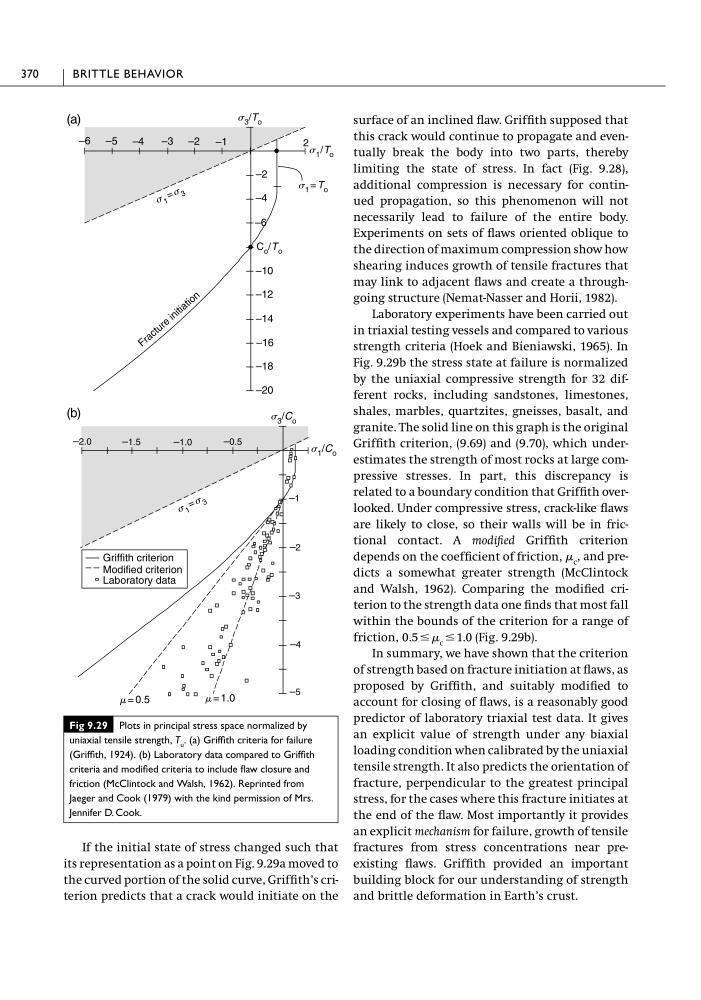
If the initial state of stress changed such that
its representation as a point on Fig. 9.29a moved to
the curved portion of the solid curve, Griffith’s criterion predicts that a crack would initiate on the
surface of an inclined flaw. Griffith supposed that
this crack would continue to propagate and eventually break the body into two parts, thereby
limiting the state of stress. In fact (Fig. 9.28),
additional compression is necessary for continued propagation, so this phenomenon will not
necessarily lead to failure of the entire body.
Experiments on sets of flaws oriented oblique to
the direction of maximum compression show how
shearing induces growth of tensile fractures that
may link to adjacent flaws and create a throughgoing structure (Nemat-Nasser and Horii, 1982).
Laboratory experiments have been carried out
in triaxial testing vessels and compared to various
strength criteria (Hoek and Bieniawski, 1965). In
Fig. 9.29b the stress state at failure is normalized
by the uniaxial compressive strength for 32 different rocks, including sandstones, limestones,
shales, marbles, quartzites, gneisses, basalt, and
granite. The solid line on this graph is the original
Griffith criterion, (9.69) and (9.70), which underestimates the strength of most rocks at large compressive stresses. In part, this discrepancy is
related to a boundary condition that Griffith overlooked. Under compressive stress, crack-like flaws
are likely to close, so their walls will be in frictional contact. A modified Griffith criterion
depends on the coefficient of friction, c , and predicts a somewhat greater strength (McClintock
and Walsh, 1962). Comparing the modified criterion to the strength data one finds that most fall
within the bounds of the criterion for a range of
friction, 0.5 Յ c Յ 1.0 (Fig. 9.29b).
In summary, we have shown that the criterion
of strength based on fracture initiation at flaws, as
proposed by Griffith, and suitably modified to
account for closing of flaws, is a reasonably good
predictor of laboratory triaxial test data. It gives
an explicit value of strength under any biaxial
loading condition when calibrated by the uniaxial
tensile strength. It also predicts the orientation of
fracture, perpendicular to the greatest principal
stress, for the cases where this fracture initiates at
the end of the flaw. Most importantly it provides
an explicit mechanism for failure, growth of tensile
fractures from stress concentrations near preexisting flaws. Griffith provided an important
building block for our understanding of strength
and brittle deformation in Earth’s crust.
370
BRITTLE BEHAVIOR
Fig 9.29 Plots in principal stress space normalized by
uniaxial tensile strength, T u . (a) Griffith criteria for failure
(Griffith, 1924). (b) Laboratory data compared to Griffith
criteria and modified criteria to include flaw closure and
friction (McClintock and Walsh, 1962). Reprinted from
Jaeger and Cook (1979) with the kind permission of Mrs.
Jennifer D. Cook.
–6 –5 –4
–3 –2
–1
–20
–18
–16
–14
–12
–10
–6
–4
–2
2
F r a c t u r e
i n i t i a t i o n
–2.0
–1.5
–1.0
–0.5
–5
–4
–3
Griffith criterion
Modified criterion
Laboratory data
s 1
= s 3
s 3 /T o
C o /T o
s 1 = T o
s 1 /T o
(a)
(b)
s 1 /C o
s 3 /C o
m = 1.0
m = 0.5
–2
–1
s 1
= s 3
its representation as a point on Fig. 9.29a moved to
the curved portion of the solid curve, Griffith’s criterion predicts that a crack would initiate on the
surface of an inclined flaw. Griffith supposed that
this crack would continue to propagate and eventually break the body into two parts, thereby
limiting the state of stress. In fact (Fig. 9.28),
additional compression is necessary for continued propagation, so this phenomenon will not
necessarily lead to failure of the entire body.
Experiments on sets of flaws oriented oblique to
the direction of maximum compression show how
shearing induces growth of tensile fractures that
may link to adjacent flaws and create a throughgoing structure (Nemat-Nasser and Horii, 1982).
Laboratory experiments have been carried out
in triaxial testing vessels and compared to various
strength criteria (Hoek and Bieniawski, 1965). In
Fig. 9.29b the stress state at failure is normalized
by the uniaxial compressive strength for 32 different rocks, including sandstones, limestones,
shales, marbles, quartzites, gneisses, basalt, and
granite. The solid line on this graph is the original
Griffith criterion, (9.69) and (9.70), which underestimates the strength of most rocks at large compressive stresses. In part, this discrepancy is
related to a boundary condition that Griffith overlooked. Under compressive stress, crack-like flaws
are likely to close, so their walls will be in frictional contact. A modified Griffith criterion
depends on the coefficient of friction, c , and predicts a somewhat greater strength (McClintock
and Walsh, 1962). Comparing the modified criterion to the strength data one finds that most fall
within the bounds of the criterion for a range of
friction, 0.5 Յ c Յ 1.0 (Fig. 9.29b).
In summary, we have shown that the criterion
of strength based on fracture initiation at flaws, as
proposed by Griffith, and suitably modified to
account for closing of flaws, is a reasonably good
predictor of laboratory triaxial test data. It gives
an explicit value of strength under any biaxial
loading condition when calibrated by the uniaxial
tensile strength. It also predicts the orientation of
fracture, perpendicular to the greatest principal
stress, for the cases where this fracture initiates at
the end of the flaw. Most importantly it provides
an explicit mechanism for failure, growth of tensile
fractures from stress concentrations near preexisting flaws. Griffith provided an important
building block for our understanding of strength
and brittle deformation in Earth’s crust.
370
BRITTLE BEHAVIOR
Fig 9.29 Plots in principal stress space normalized by
uniaxial tensile strength, T u . (a) Griffith criteria for failure
(Griffith, 1924). (b) Laboratory data compared to Griffith
criteria and modified criteria to include flaw closure and
friction (McClintock and Walsh, 1962). Reprinted from
Jaeger and Cook (1979) with the kind permission of Mrs.
Jennifer D. Cook.
–6 –5 –4
–3 –2
–1
–20
–18
–16
–14
–12
–10
–6
–4
–2
2
F r a c t u r e
i n i t i a t i o n
–2.0
–1.5
–1.0
–0.5
–5
–4
–3
Griffith criterion
Modified criterion
Laboratory data
s 1
= s 3
s 3 /T o
C o /T o
s 1 = T o
s 1 /T o
(a)
(b)
s 1 /C o
s 3 /C o
m = 1.0
m = 0.5
–2
–1
s 1
= s 3