

posed a great danger for engineering structures.
According to (9.59) a remotely applied stress that
is well within the normal safety factors for hull
plates could be amplified locally by the presence
of a crack to values well above that predicted by
(9.56), and perhaps well above the strength of the
material.
For practical purposes (9.59) suggests that the
concentration of tensile stress near the ends of
cracks in engineering structures can locally break
the material apart and create a propagating fracture that might lead to catastrophic failure of the
structure. A plausible propagation criterion
would be that the stress at the fracture tip reaches
the uniaxial tensile strength, T u , of the material at
that point:
Substituting
this condition into (9.59) and rearranging to solve
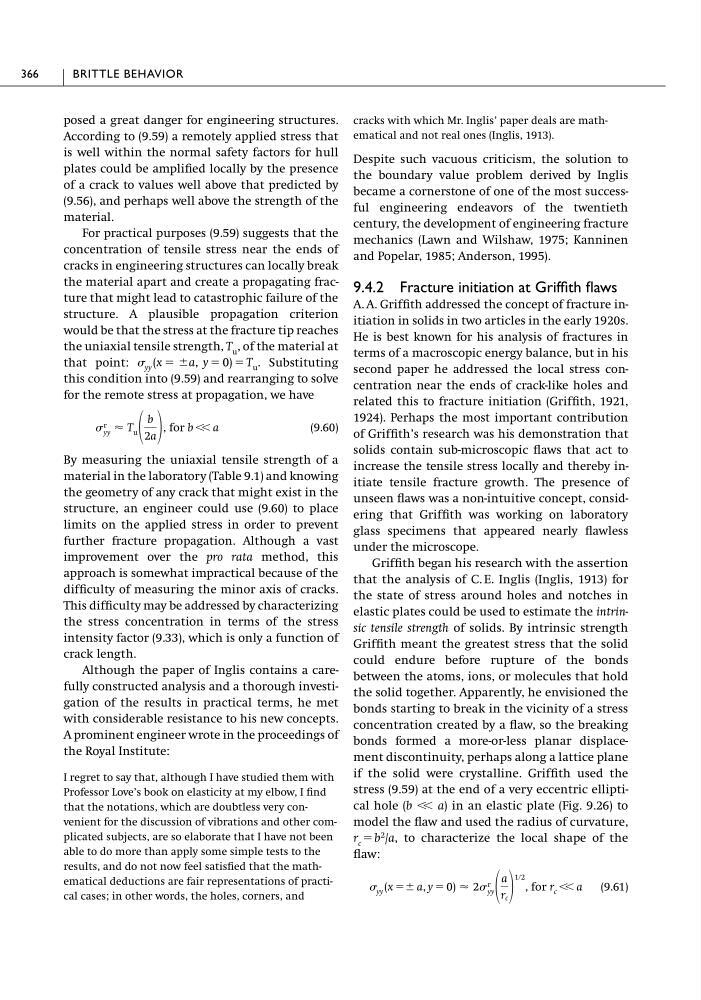
for the remote stress at propagation, we have
(9.60)
By measuring the uniaxial tensile strength of a
material in the laboratory (Table 9.1) and knowing
the geometry of any crack that might exist in the
structure, an engineer could use (9.60) to place
limits on the applied stress in order to prevent
further fracture propagation. Although a vast
improvement over the pro rata method, this
approach is somewhat impractical because of the
difficulty of measuring the minor axis of cracks.
This difficulty may be addressed by characterizing
the stress concentration in terms of the stress
intensity factor (9.33), which is only a function of
crack length.
Although the paper of Inglis contains a carefully constructed analysis and a thorough investigation of the results in practical terms, he met
with considerable resistance to his new concepts.
A prominent engineer wrote in the proceedings of
the Royal Institute:
I regret to say that, although I have studied them with
Professor Love’s book on elasticity at my elbow, I find
that the notations, which are doubtless very convenient for the discussion of vibrations and other complicated subjects, are so elaborate that I have not been
able to do more than apply some simple tests to the
results, and do not now feel satisfied that the mathematical deductions are fair representations of practical cases; in other words, the holes, corners, and
r
yy Ϸ T u
b
2a , for b Ͻ Ͻ a
yy (x ϭ Ϯa, y ϭ 0) ϭ T u .
cracks with which Mr. Inglis’ paper deals are mathematical and not real ones (Inglis, 1913).
Despite such vacuous criticism, the solution to
the boundary value problem derived by Inglis
became a cornerstone of one of the most successful engineering endeavors of the twentieth
century, the development of engineering fracture
mechanics (Lawn and Wilshaw, 1975; Kanninen
and Popelar, 1985; Anderson, 1995).
9.4.2 Fracture initiation at Griffith flaws
A. A. Griffith addressed the concept of fracture initiation in solids in two articles in the early 1920s.
He is best known for his analysis of fractures in
terms of a macroscopic energy balance, but in his
second paper he addressed the local stress concentration near the ends of crack-like holes and
related this to fracture initiation (Griffith, 1921,
1924). Perhaps the most important contribution
of Griffith’s research was his demonstration that
solids contain sub-microscopic flaws that act to
increase the tensile stress locally and thereby initiate tensile fracture growth. The presence of
unseen flaws was a non-intuitive concept, considering that Griffith was working on laboratory
glass specimens that appeared nearly flawless
under the microscope.
Griffith began his research with the assertion
that the analysis of C. E. Inglis (Inglis, 1913) for
the state of stress around holes and notches in
elastic plates could be used to estimate the intrinsic tensile strength of solids. By intrinsic strength
Griffith meant the greatest stress that the solid
could endure before rupture of the bonds
between the atoms, ions, or molecules that hold
the solid together. Apparently, he envisioned the
bonds starting to break in the vicinity of a stress
concentration created by a flaw, so the breaking
bonds formed a more-or-less planar displacement discontinuity, perhaps along a lattice plane
if the solid were crystalline. Griffith used the
stress (9.59) at the end of a very eccentric elliptical hole (b Ͻ Ͻ a) in an elastic plate (Fig. 9.26) to
model the flaw and used the radius of curvature,
r c ϭ b
2
/a, to characterize the local shape of the
flaw:
(9.61)
yy (x ϭϮ a, y ϭ 0) Ϸ 2 r
yy
a
r c
1ր2
, for r c Ͻ Ͻ a
366
BRITTLE BEHAVIOR
According to (9.59) a remotely applied stress that
is well within the normal safety factors for hull
plates could be amplified locally by the presence
of a crack to values well above that predicted by
(9.56), and perhaps well above the strength of the
material.
For practical purposes (9.59) suggests that the
concentration of tensile stress near the ends of
cracks in engineering structures can locally break
the material apart and create a propagating fracture that might lead to catastrophic failure of the
structure. A plausible propagation criterion
would be that the stress at the fracture tip reaches
the uniaxial tensile strength, T u , of the material at
that point:
Substituting
this condition into (9.59) and rearranging to solve
for the remote stress at propagation, we have
(9.60)
By measuring the uniaxial tensile strength of a
material in the laboratory (Table 9.1) and knowing
the geometry of any crack that might exist in the
structure, an engineer could use (9.60) to place
limits on the applied stress in order to prevent
further fracture propagation. Although a vast
improvement over the pro rata method, this
approach is somewhat impractical because of the
difficulty of measuring the minor axis of cracks.
This difficulty may be addressed by characterizing
the stress concentration in terms of the stress
intensity factor (9.33), which is only a function of
crack length.
Although the paper of Inglis contains a carefully constructed analysis and a thorough investigation of the results in practical terms, he met
with considerable resistance to his new concepts.
A prominent engineer wrote in the proceedings of
the Royal Institute:
I regret to say that, although I have studied them with
Professor Love’s book on elasticity at my elbow, I find
that the notations, which are doubtless very convenient for the discussion of vibrations and other complicated subjects, are so elaborate that I have not been
able to do more than apply some simple tests to the
results, and do not now feel satisfied that the mathematical deductions are fair representations of practical cases; in other words, the holes, corners, and
r
yy Ϸ T u
b
2a , for b Ͻ Ͻ a
yy (x ϭ Ϯa, y ϭ 0) ϭ T u .
cracks with which Mr. Inglis’ paper deals are mathematical and not real ones (Inglis, 1913).
Despite such vacuous criticism, the solution to
the boundary value problem derived by Inglis
became a cornerstone of one of the most successful engineering endeavors of the twentieth
century, the development of engineering fracture
mechanics (Lawn and Wilshaw, 1975; Kanninen
and Popelar, 1985; Anderson, 1995).
9.4.2 Fracture initiation at Griffith flaws
A. A. Griffith addressed the concept of fracture initiation in solids in two articles in the early 1920s.
He is best known for his analysis of fractures in
terms of a macroscopic energy balance, but in his
second paper he addressed the local stress concentration near the ends of crack-like holes and
related this to fracture initiation (Griffith, 1921,
1924). Perhaps the most important contribution
of Griffith’s research was his demonstration that
solids contain sub-microscopic flaws that act to
increase the tensile stress locally and thereby initiate tensile fracture growth. The presence of
unseen flaws was a non-intuitive concept, considering that Griffith was working on laboratory
glass specimens that appeared nearly flawless
under the microscope.
Griffith began his research with the assertion
that the analysis of C. E. Inglis (Inglis, 1913) for
the state of stress around holes and notches in
elastic plates could be used to estimate the intrinsic tensile strength of solids. By intrinsic strength
Griffith meant the greatest stress that the solid
could endure before rupture of the bonds
between the atoms, ions, or molecules that hold
the solid together. Apparently, he envisioned the
bonds starting to break in the vicinity of a stress
concentration created by a flaw, so the breaking
bonds formed a more-or-less planar displacement discontinuity, perhaps along a lattice plane
if the solid were crystalline. Griffith used the
stress (9.59) at the end of a very eccentric elliptical hole (b Ͻ Ͻ a) in an elastic plate (Fig. 9.26) to
model the flaw and used the radius of curvature,
r c ϭ b
2
/a, to characterize the local shape of the
flaw:
(9.61)
yy (x ϭϮ a, y ϭ 0) Ϸ 2 r
yy
a
r c
1ր2
, for r c Ͻ Ͻ a
366
BRITTLE BEHAVIOR