

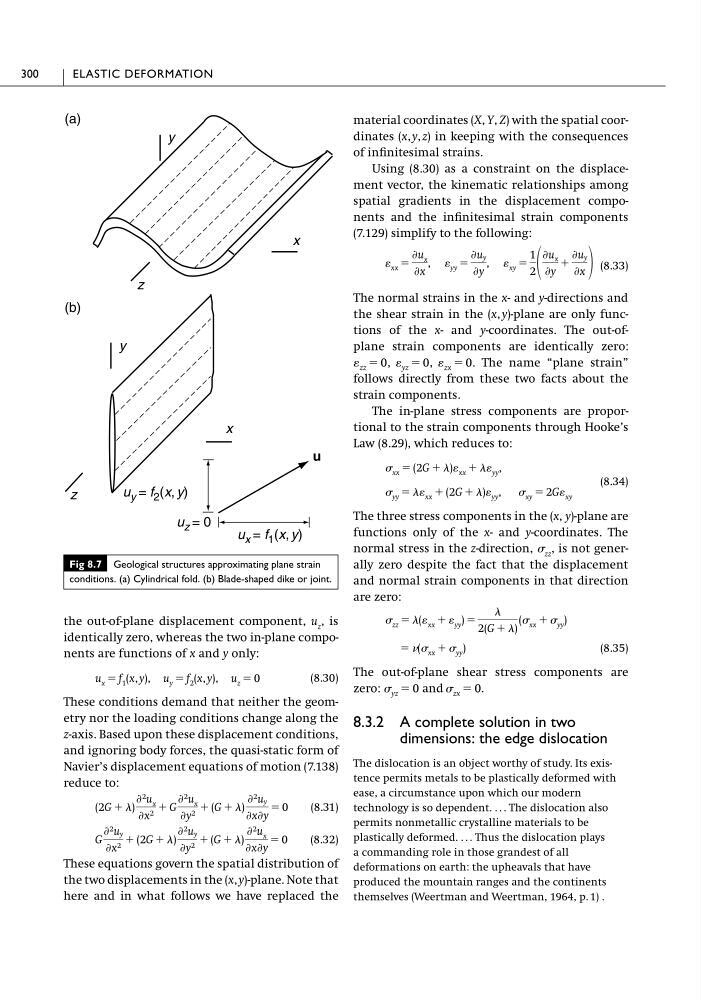
the out-of-plane displacement component, u z , is
identically zero, whereas the two in-plane components are functions of x and y only:
(8.30)
These conditions demand that neither the geometry nor the loading conditions change along the
z-axis. Based upon these displacement conditions,
and ignoring body forces, the quasi-static form of
Navier’s displacement equations of motion (7.138)
reduce to:
(8.31)
(8.32)
These equations govern the spatial distribution of
the two displacements in the (x, y)-plane. Note that
here and in what follows we have replaced the
G
Ѩ 2 u y
Ѩx 2 ϩ (2G ϩ )
Ѩ 2 u y
Ѩy 2 ϩ (G ϩ )
Ѩ 2 u x
ѨxѨy
ϭ 0
(2G ϩ )
Ѩ 2 u x
Ѩx 2 ϩ G
Ѩ 2 u x
Ѩy 2 ϩ (G ϩ )
Ѩ 2 u y
ѨxѨy
ϭ 0
u x ϭ f 1 (x, y), u y ϭ f 2 (x, y), u z ϭ 0
material coordinates (X, Y, Z) with the spatial coordinates (x, y, z) in keeping with the consequences
of infinitesimal strains.
Using (8.30) as a constraint on the displacement vector, the kinematic relationships among
spatial gradients in the displacement components and the infinitesimal strain components
(7.129) simplify to the following:
(8.33)
The normal strains in the x- and y-directions and
the shear strain in the (x, y)-plane are only functions of the x- and y-coordinates. The out-ofplane strain components are identically zero:
The name “plane strain”
follows directly from these two facts about the
strain components.
The in-plane stress components are proportional to the strain components through Hooke’s
Law (8.29), which reduces to:
(8.34)
The three stress components in the (x, y)-plane are
functions only of the x- and y-coordinates. The
normal stress in the z-direction, zz , is not generally zero despite the fact that the displacement
and normal strain components in that direction
are zero:
(8.35)
The out-of-plane shear stress components are
zero:
8.3.2 A complete solution in two
dimensions: the edge dislocation
The dislocation is an object worthy of study. Its existence permits metals to be plastically deformed with
ease, a circumstance upon which our modern
technology is so dependent. . . . The dislocation also
permits nonmetallic crystalline materials to be
plastically deformed. . . . Thus the dislocation plays
a commanding role in those grandest of all
deformations on earth: the upheavals that have
produced the mountain ranges and the continents
themselves (Weertman and Weertman, 1964, p. 1) .
yz ϭ 0 and zx ϭ 0.
ϭ ( xx ϩ yy )
zz ϭ ( xx ϩ yy ) ϭ
2(G ϩ )
( xx ϩ yy )
xy ϭ 2G xy
yy ϭ xx ϩ (2G ϩ ) yy ,
xx ϭ (2G ϩ ) xx ϩ yy ,
zz ϭ 0, yz ϭ 0, zx ϭ 0.
xx ϭ
Ѩu x
Ѩx
, yy ϭ
Ѩu y
Ѩy
, xy ϭ
1
2
Ѩu x
Ѩy
ϩ
Ѩu y
Ѩx
300
ELASTIC DEFORMATION
Fig 8.7 Geological structures approximating plane strain
conditions. (a) Cylindrical fold. (b) Blade-shaped dike or joint.
(b)
(a)
x
y
z
x
y
z
u
u y = f 2 (x, y)
u z = 0
u x = f 1 (x, y)
identically zero, whereas the two in-plane components are functions of x and y only:
(8.30)
These conditions demand that neither the geometry nor the loading conditions change along the
z-axis. Based upon these displacement conditions,
and ignoring body forces, the quasi-static form of
Navier’s displacement equations of motion (7.138)
reduce to:
(8.31)
(8.32)
These equations govern the spatial distribution of
the two displacements in the (x, y)-plane. Note that
here and in what follows we have replaced the
G
Ѩ 2 u y
Ѩx 2 ϩ (2G ϩ )
Ѩ 2 u y
Ѩy 2 ϩ (G ϩ )
Ѩ 2 u x
ѨxѨy
ϭ 0
(2G ϩ )
Ѩ 2 u x
Ѩx 2 ϩ G
Ѩ 2 u x
Ѩy 2 ϩ (G ϩ )
Ѩ 2 u y
ѨxѨy
ϭ 0
u x ϭ f 1 (x, y), u y ϭ f 2 (x, y), u z ϭ 0
material coordinates (X, Y, Z) with the spatial coordinates (x, y, z) in keeping with the consequences
of infinitesimal strains.
Using (8.30) as a constraint on the displacement vector, the kinematic relationships among
spatial gradients in the displacement components and the infinitesimal strain components
(7.129) simplify to the following:
(8.33)
The normal strains in the x- and y-directions and
the shear strain in the (x, y)-plane are only functions of the x- and y-coordinates. The out-ofplane strain components are identically zero:
The name “plane strain”
follows directly from these two facts about the
strain components.
The in-plane stress components are proportional to the strain components through Hooke’s
Law (8.29), which reduces to:
(8.34)
The three stress components in the (x, y)-plane are
functions only of the x- and y-coordinates. The
normal stress in the z-direction, zz , is not generally zero despite the fact that the displacement
and normal strain components in that direction
are zero:
(8.35)
The out-of-plane shear stress components are
zero:
8.3.2 A complete solution in two
dimensions: the edge dislocation
The dislocation is an object worthy of study. Its existence permits metals to be plastically deformed with
ease, a circumstance upon which our modern
technology is so dependent. . . . The dislocation also
permits nonmetallic crystalline materials to be
plastically deformed. . . . Thus the dislocation plays
a commanding role in those grandest of all
deformations on earth: the upheavals that have
produced the mountain ranges and the continents
themselves (Weertman and Weertman, 1964, p. 1) .
yz ϭ 0 and zx ϭ 0.
ϭ ( xx ϩ yy )
zz ϭ ( xx ϩ yy ) ϭ
2(G ϩ )
( xx ϩ yy )
xy ϭ 2G xy
yy ϭ xx ϩ (2G ϩ ) yy ,
xx ϭ (2G ϩ ) xx ϩ yy ,
zz ϭ 0, yz ϭ 0, zx ϭ 0.
xx ϭ
Ѩu x
Ѩx
, yy ϭ
Ѩu y
Ѩy
, xy ϭ
1
2
Ѩu x
Ѩy
ϩ
Ѩu y
Ѩx
300
ELASTIC DEFORMATION
Fig 8.7 Geological structures approximating plane strain
conditions. (a) Cylindrical fold. (b) Blade-shaped dike or joint.
(b)
(a)
x
y
z
x
y
z
u
u y = f 2 (x, y)
u z = 0
u x = f 1 (x, y)