

By measuring dike length and thickness, and
finding independent estimates for the magma
pressure and compressive stress, we can use (8.4)
to estimate Young’s modulus for the rock mass
deformed by the dike.
The geological evidence suggests that the
current outcrop of the northeastern dike was
about 1 km below the ground surface at the time
of dike intrusion, and we assume that the dike
erupted at that surface. We take m ϭ 2600 kg m
Ϫ3
and r ϭ 2400 kg m
Ϫ3 as the magma and host rock
densities, g* ϭ 9.8 m s
Ϫ2 as the acceleration of
gravity, and D ϭ 10
3 m as the height of the magma
column and thickness of overburden. The magma
pressure and compressive stress in the Mancos
Shale at the depth of the current outcrop are calculated as P Ϸ m gD Ϸ 25.5 MPa and C Ϸ r gD Ϸ 23.5
MPa. Therefore, the driving pressure was (P Ϫ C) Ϸ
2 MPa and Young’s modulus is estimated from
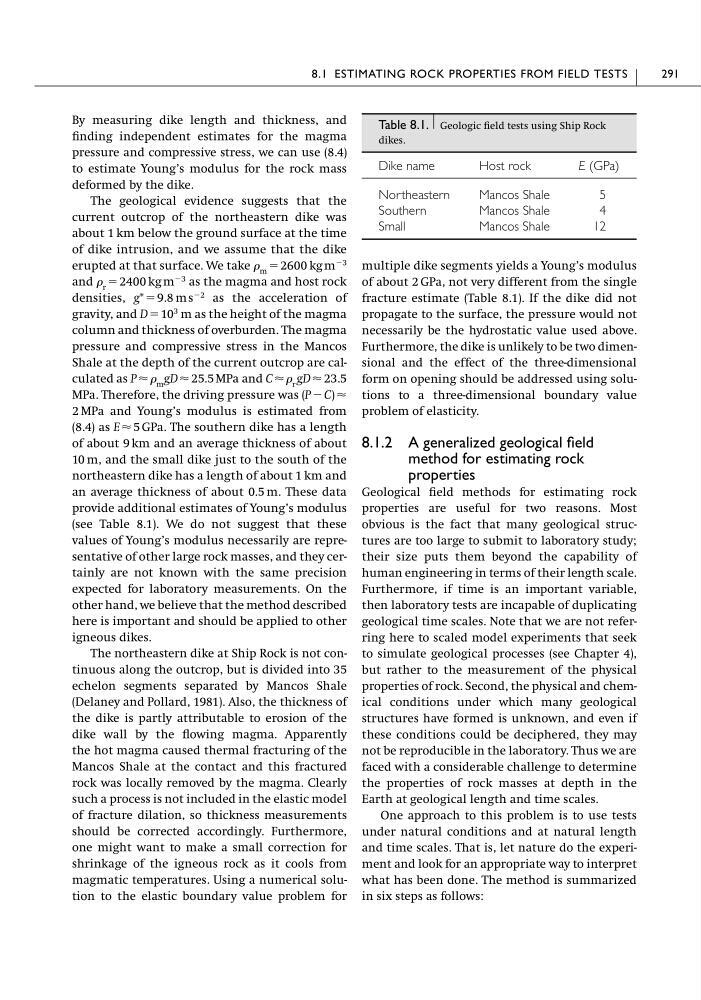
(8.4) as E Ϸ 5 GPa. The southern dike has a length
of about 9 km and an average thickness of about
10 m, and the small dike just to the south of the
northeastern dike has a length of about 1 km and
an average thickness of about 0.5 m. These data
provide additional estimates of Young’s modulus
(see Table 8.1). We do not suggest that these
values of Young’s modulus necessarily are representative of other large rock masses, and they certainly are not known with the same precision
expected for laboratory measurements. On the
other hand, we believe that the method described
here is important and should be applied to other
igneous dikes.
The northeastern dike at Ship Rock is not continuous along the outcrop, but is divided into 35
echelon segments separated by Mancos Shale
(Delaney and Pollard, 1981). Also, the thickness of
the dike is partly attributable to erosion of the
dike wall by the flowing magma. Apparently
the hot magma caused thermal fracturing of the
Mancos Shale at the contact and this fractured
rock was locally removed by the magma. Clearly
such a process is not included in the elastic model
of fracture dilation, so thickness measurements
should be corrected accordingly. Furthermore,
one might want to make a small correction for
shrinkage of the igneous rock as it cools from
magmatic temperatures. Using a numerical solution to the elastic boundary value problem for
multiple dike segments yields a Young’s modulus
of about 2 GPa, not very different from the single
fracture estimate (Table 8.1). If the dike did not
propagate to the surface, the pressure would not
necessarily be the hydrostatic value used above.
Furthermore, the dike is unlikely to be two dimensional and the effect of the three-dimensional
form on opening should be addressed using solutions to a three-dimensional boundary value
problem of elasticity.
8.1.2 A generalized geological field
method for estimating rock
properties
Geological field methods for estimating rock
properties are useful for two reasons. Most
obvious is the fact that many geological structures are too large to submit to laboratory study;
their size puts them beyond the capability of
human engineering in terms of their length scale.
Furthermore, if time is an important variable,
then laboratory tests are incapable of duplicating
geological time scales. Note that we are not referring here to scaled model experiments that seek
to simulate geological processes (see Chapter 4),
but rather to the measurement of the physical
properties of rock. Second, the physical and chemical conditions under which many geological
structures have formed is unknown, and even if
these conditions could be deciphered, they may
not be reproducible in the laboratory. Thus we are
faced with a considerable challenge to determine
the properties of rock masses at depth in the
Earth at geological length and time scales.
One approach to this problem is to use tests
under natural conditions and at natural length
and time scales. That is, let nature do the experiment and look for an appropriate way to interpret
what has been done. The method is summarized
in six steps as follows:
8.1 ESTIMATING ROCK PROPERTIES FROM FIELD TESTS
291
Table 8.1. Geologic field tests using Ship Rock
dikes.
Dike name
Host rock
E (GPa)
Northeastern
Mancos Shale
5
Southern
Mancos Shale
4
Small
Mancos Shale
12
finding independent estimates for the magma
pressure and compressive stress, we can use (8.4)
to estimate Young’s modulus for the rock mass
deformed by the dike.
The geological evidence suggests that the
current outcrop of the northeastern dike was
about 1 km below the ground surface at the time
of dike intrusion, and we assume that the dike
erupted at that surface. We take m ϭ 2600 kg m
Ϫ3
and r ϭ 2400 kg m
Ϫ3 as the magma and host rock
densities, g* ϭ 9.8 m s
Ϫ2 as the acceleration of
gravity, and D ϭ 10
3 m as the height of the magma
column and thickness of overburden. The magma
pressure and compressive stress in the Mancos
Shale at the depth of the current outcrop are calculated as P Ϸ m gD Ϸ 25.5 MPa and C Ϸ r gD Ϸ 23.5
MPa. Therefore, the driving pressure was (P Ϫ C) Ϸ
2 MPa and Young’s modulus is estimated from
(8.4) as E Ϸ 5 GPa. The southern dike has a length
of about 9 km and an average thickness of about
10 m, and the small dike just to the south of the
northeastern dike has a length of about 1 km and
an average thickness of about 0.5 m. These data
provide additional estimates of Young’s modulus
(see Table 8.1). We do not suggest that these
values of Young’s modulus necessarily are representative of other large rock masses, and they certainly are not known with the same precision
expected for laboratory measurements. On the
other hand, we believe that the method described
here is important and should be applied to other
igneous dikes.
The northeastern dike at Ship Rock is not continuous along the outcrop, but is divided into 35
echelon segments separated by Mancos Shale
(Delaney and Pollard, 1981). Also, the thickness of
the dike is partly attributable to erosion of the
dike wall by the flowing magma. Apparently
the hot magma caused thermal fracturing of the
Mancos Shale at the contact and this fractured
rock was locally removed by the magma. Clearly
such a process is not included in the elastic model
of fracture dilation, so thickness measurements
should be corrected accordingly. Furthermore,
one might want to make a small correction for
shrinkage of the igneous rock as it cools from
magmatic temperatures. Using a numerical solution to the elastic boundary value problem for
multiple dike segments yields a Young’s modulus
of about 2 GPa, not very different from the single
fracture estimate (Table 8.1). If the dike did not
propagate to the surface, the pressure would not
necessarily be the hydrostatic value used above.
Furthermore, the dike is unlikely to be two dimensional and the effect of the three-dimensional
form on opening should be addressed using solutions to a three-dimensional boundary value
problem of elasticity.
8.1.2 A generalized geological field
method for estimating rock
properties
Geological field methods for estimating rock
properties are useful for two reasons. Most
obvious is the fact that many geological structures are too large to submit to laboratory study;
their size puts them beyond the capability of
human engineering in terms of their length scale.
Furthermore, if time is an important variable,
then laboratory tests are incapable of duplicating
geological time scales. Note that we are not referring here to scaled model experiments that seek
to simulate geological processes (see Chapter 4),
but rather to the measurement of the physical
properties of rock. Second, the physical and chemical conditions under which many geological
structures have formed is unknown, and even if
these conditions could be deciphered, they may
not be reproducible in the laboratory. Thus we are
faced with a considerable challenge to determine
the properties of rock masses at depth in the
Earth at geological length and time scales.
One approach to this problem is to use tests
under natural conditions and at natural length
and time scales. That is, let nature do the experiment and look for an appropriate way to interpret
what has been done. The method is summarized
in six steps as follows:
8.1 ESTIMATING ROCK PROPERTIES FROM FIELD TESTS
291
Table 8.1. Geologic field tests using Ship Rock
dikes.
Dike name
Host rock
E (GPa)
Northeastern
Mancos Shale
5
Southern
Mancos Shale
4
Small
Mancos Shale
12