

divergence of the velocity may be interpreted as
the rate of change of density of the particle at the
point x because the material in the vicinity of
this particle is stretching in one or more of the
coordinate directions, and this stretch is not
exactly compensated for by a contraction in the
other coordinate directions. Here it is understood
that the spatial derivatives of the velocity components are evaluated at the current position
and time.
Perhaps the most common postulate employed
in setting up models in structural geology involving viscous fluid mechanics is that the rock is
incompressible. This means that the density in the
infinitesimal element surrounding any particle
does not change with time, so the right-hand side
of (7.81) is identically zero:
(7.82)
In other words the divergence of the velocity
vector field is zero. Near any particle in the material continuum and for all relevant times the velocity gradients are constrained such that a stretch in
one coordinate direction is compensated exactly
by contractions in the other coordinate directions.
Equation (7.82) assures conservation of mass
for the incompressible but deformable material
continuum.
It follows from (7.81) and (7.82) that the material time derivative of density is zero for the incompressible material, D/Dt ϭ 0. For a body that is
homogeneous with respect to density and incompressible:
(7.83)
These are the most constrained conditions for the
material continuum subject to conservation of
mass: the mass density is uniform in space and
constant in time.
7.3.3 Conservation of linear momentum:
the equations of motion
Conservation of linear momentum for the rigid
body is described by (7.20). Here we derive the
Ѩ
Ѩx
ϭ
Ѩ
Ѩy
ϭ
Ѩ
Ѩz
ϭ 0, and
Ѩ
Ѩt
ϭ 0
Ѩv x
Ѩx
ϩ
Ѩv y
Ѩy
ϩ
Ѩv z
Ѩz
ϭ ٌ · v ϭ 0
analogous equation for a deformable material
continuum by adopting the spatial description of
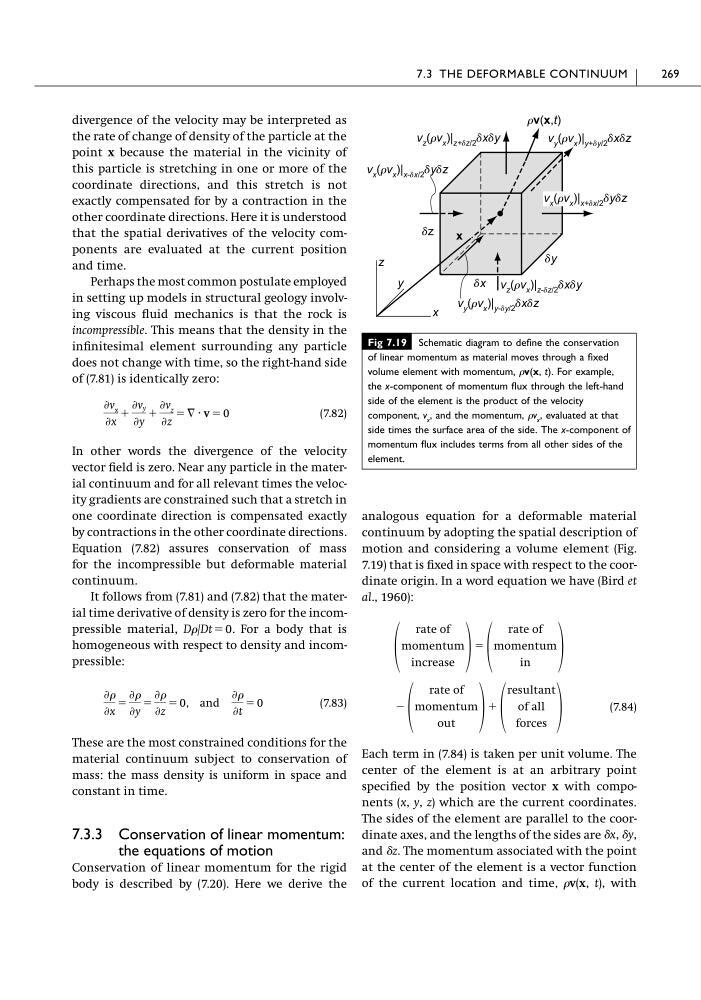
motion and considering a volume element (Fig.
7.19) that is fixed in space with respect to the coordinate origin. In a word equation we have (Bird et
al., 1960):
(7.84)
Each term in (7.84) is taken per unit volume. The
center of the element is at an arbitrary point
specified by the position vector x with components (x, y, z) which are the current coordinates.
The sides of the element are parallel to the coordinate axes, and the lengths of the sides are ␦x, ␦y,
and ␦z. The momentum associated with the point
at the center of the element is a vector function
of the current location and time, v(x, t), with
ϩ
resultant
of all
forces
Ϫ
rate of
momentum
out
rate of
momentum
increase
ϭ
rate of
momentum
in
7.3 THE DEFORMABLE CONTINUUM
269
Fig 7.19 Schematic diagram to define the conservation
of linear momentum as material moves through a fixed
volume element with momentum, v(x, t). For example,
the x-component of momentum flux through the left-hand
side of the element is the product of the velocity
component, v x , and the momentum, v x , evaluated at that
side times the surface area of the side. The x-component of
momentum flux includes terms from all other sides of the
element.
x
y
z
v(x,t)
v x (v x )| x-␦x/2 ␦y␦z
␦y
x
␦z
v x (v x )| x+␦x/2 ␦y␦z
␦x
v y (v x )| y-␦y/2 ␦x␦z
v z (v x )| z+␦z/2 ␦x␦y
v z (v x )| z-␦z/2 ␦x␦y
v y (v x )| y+␦y/2 ␦x␦z
the rate of change of density of the particle at the
point x because the material in the vicinity of
this particle is stretching in one or more of the
coordinate directions, and this stretch is not
exactly compensated for by a contraction in the
other coordinate directions. Here it is understood
that the spatial derivatives of the velocity components are evaluated at the current position
and time.
Perhaps the most common postulate employed
in setting up models in structural geology involving viscous fluid mechanics is that the rock is
incompressible. This means that the density in the
infinitesimal element surrounding any particle
does not change with time, so the right-hand side
of (7.81) is identically zero:
(7.82)
In other words the divergence of the velocity
vector field is zero. Near any particle in the material continuum and for all relevant times the velocity gradients are constrained such that a stretch in
one coordinate direction is compensated exactly
by contractions in the other coordinate directions.
Equation (7.82) assures conservation of mass
for the incompressible but deformable material
continuum.
It follows from (7.81) and (7.82) that the material time derivative of density is zero for the incompressible material, D/Dt ϭ 0. For a body that is
homogeneous with respect to density and incompressible:
(7.83)
These are the most constrained conditions for the
material continuum subject to conservation of
mass: the mass density is uniform in space and
constant in time.
7.3.3 Conservation of linear momentum:
the equations of motion
Conservation of linear momentum for the rigid
body is described by (7.20). Here we derive the
Ѩ
Ѩx
ϭ
Ѩ
Ѩy
ϭ
Ѩ
Ѩz
ϭ 0, and
Ѩ
Ѩt
ϭ 0
Ѩv x
Ѩx
ϩ
Ѩv y
Ѩy
ϩ
Ѩv z
Ѩz
ϭ ٌ · v ϭ 0
analogous equation for a deformable material
continuum by adopting the spatial description of
motion and considering a volume element (Fig.
7.19) that is fixed in space with respect to the coordinate origin. In a word equation we have (Bird et
al., 1960):
(7.84)
Each term in (7.84) is taken per unit volume. The
center of the element is at an arbitrary point
specified by the position vector x with components (x, y, z) which are the current coordinates.
The sides of the element are parallel to the coordinate axes, and the lengths of the sides are ␦x, ␦y,
and ␦z. The momentum associated with the point
at the center of the element is a vector function
of the current location and time, v(x, t), with
ϩ
resultant
of all
forces
Ϫ
rate of
momentum
out
rate of
momentum
increase
ϭ
rate of
momentum
in
7.3 THE DEFORMABLE CONTINUUM
269
Fig 7.19 Schematic diagram to define the conservation
of linear momentum as material moves through a fixed
volume element with momentum, v(x, t). For example,
the x-component of momentum flux through the left-hand
side of the element is the product of the velocity
component, v x , and the momentum, v x , evaluated at that
side times the surface area of the side. The x-component of
momentum flux includes terms from all other sides of the
element.
x
y
z
v(x,t)
v x (v x )| x-␦x/2 ␦y␦z
␦y
x
␦z
v x (v x )| x+␦x/2 ␦y␦z
␦x
v y (v x )| y-␦y/2 ␦x␦z
v z (v x )| z+␦z/2 ␦x␦y
v z (v x )| z-␦z/2 ␦x␦y
v y (v x )| y+␦y/2 ␦x␦z