

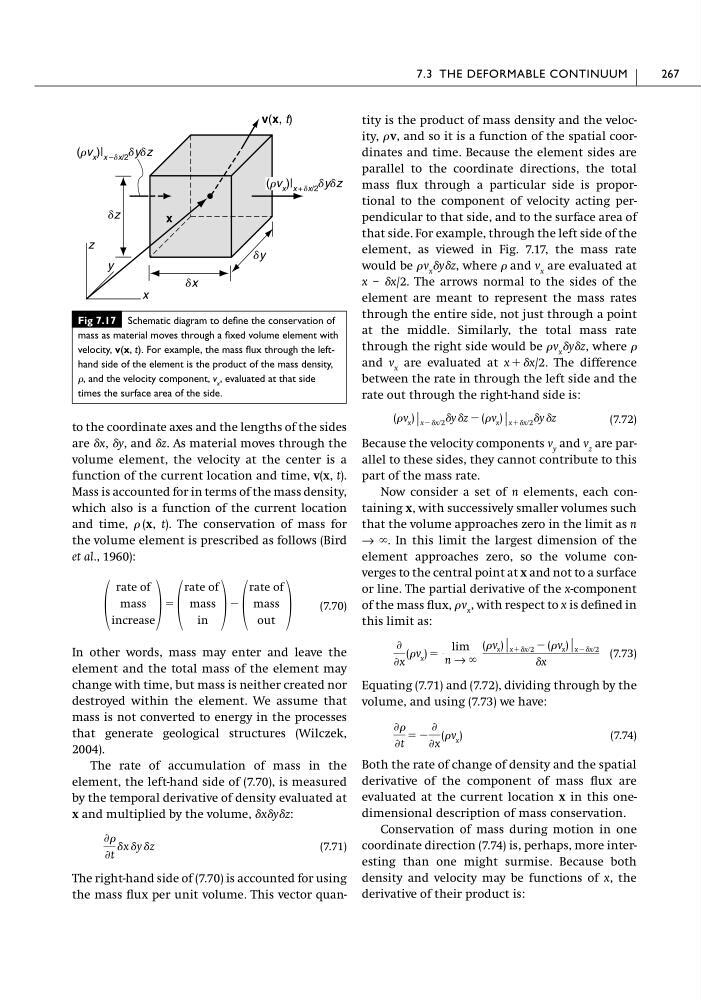
to the coordinate axes and the lengths of the sides
are ␦x, ␦y, and ␦z. As material moves through the
volume element, the velocity at the center is a
function of the current location and time, v(x, t).
Mass is accounted for in terms of the mass density,
which also is a function of the current location
and time, (x, t). The conservation of mass for
the volume element is prescribed as follows (Bird
et al., 1960):
(7.70)
In other words, mass may enter and leave the
element and the total mass of the element may
change with time, but mass is neither created nor
destroyed within the element. We assume that
mass is not converted to energy in the processes
that generate geological structures (Wilczek,
2004).
The rate of accumulation of mass in the
element, the left-hand side of (7.70), is measured
by the temporal derivative of density evaluated at
x and multiplied by the volume, ␦x␦y␦z:
(7.71)
The right-hand side of (7.70) is accounted for using
the mass flux per unit volume. This vector quanѨ
Ѩt
␦x ␦y ␦z
rate of
mass
increase
ϭ
rate of
mass
in
Ϫ
rate of
mass
out
tity is the product of mass density and the velocity, v, and so it is a function of the spatial coordinates and time. Because the element sides are
parallel to the coordinate directions, the total
mass flux through a particular side is proportional to the component of velocity acting perpendicular to that side, and to the surface area of
that side. For example, through the left side of the
element, as viewed in Fig. 7.17, the mass rate
would be v x ␦y␦z, where and v x are evaluated at
x – ␦x/2. The arrows normal to the sides of the
element are meant to represent the mass rates
through the entire side, not just through a point
at the middle. Similarly, the total mass rate
through the right side would be v x ␦y␦z, where
and v x are evaluated at x ϩ ␦x/2. The difference
between the rate in through the left side and the
rate out through the right-hand side is:
(7.72)
Because the velocity components v y and v z are parallel to these sides, they cannot contribute to this
part of the mass rate.
Now consider a set of n elements, each containing x, with successively smaller volumes such
that the volume approaches zero in the limit as n
→ ϱ. In this limit the largest dimension of the
element approaches zero, so the volume converges to the central point at x and not to a surface
or line. The partial derivative of the x-component
of the mass flux, v x , with respect to x is defined in
this limit as:
(7.73)
Equating (7.71) and (7.72), dividing through by the
volume, and using (7.73) we have:
(7.74)
Both the rate of change of density and the spatial
derivative of the component of mass flux are
evaluated at the current location x in this onedimensional description of mass conservation.
Conservation of mass during motion in one
coordinate direction (7.74) is, perhaps, more interesting than one might surmise. Because both
density and velocity may be functions of x, the
derivative of their product is:
Ѩ
Ѩt
ϭ Ϫ
Ѩ
Ѩx
(v x )
(v x ) | xϩ␦xր2 Ϫ (v x ) | xϪ␦xր2
␦x
lim
n → ϱ
Ѩ
Ѩx
(v x ) ϭ
(v x ) | xϪ␦xր2 ␦y ␦z Ϫ (v x ) | xϩ␦xր2 ␦y ␦z
7.3 THE DEFORMABLE CONTINUUM
267
Fig 7.17 Schematic diagram to define the conservation of
mass as material moves through a fixed volume element with
velocity, v(x, t). For example, the mass flux through the lefthand side of the element is the product of the mass density,
, and the velocity component, v x , evaluated at that side
times the surface area of the side.
x
y
z
v(x, t)
(rv x )| x – dx/2 dydz
dy
dx
x
dz
(rv x )| x + dx/2 dydz
are ␦x, ␦y, and ␦z. As material moves through the
volume element, the velocity at the center is a
function of the current location and time, v(x, t).
Mass is accounted for in terms of the mass density,
which also is a function of the current location
and time, (x, t). The conservation of mass for
the volume element is prescribed as follows (Bird
et al., 1960):
(7.70)
In other words, mass may enter and leave the
element and the total mass of the element may
change with time, but mass is neither created nor
destroyed within the element. We assume that
mass is not converted to energy in the processes
that generate geological structures (Wilczek,
2004).
The rate of accumulation of mass in the
element, the left-hand side of (7.70), is measured
by the temporal derivative of density evaluated at
x and multiplied by the volume, ␦x␦y␦z:
(7.71)
The right-hand side of (7.70) is accounted for using
the mass flux per unit volume. This vector quanѨ
Ѩt
␦x ␦y ␦z
rate of
mass
increase
ϭ
rate of
mass
in
Ϫ
rate of
mass
out
tity is the product of mass density and the velocity, v, and so it is a function of the spatial coordinates and time. Because the element sides are
parallel to the coordinate directions, the total
mass flux through a particular side is proportional to the component of velocity acting perpendicular to that side, and to the surface area of
that side. For example, through the left side of the
element, as viewed in Fig. 7.17, the mass rate
would be v x ␦y␦z, where and v x are evaluated at
x – ␦x/2. The arrows normal to the sides of the
element are meant to represent the mass rates
through the entire side, not just through a point
at the middle. Similarly, the total mass rate
through the right side would be v x ␦y␦z, where
and v x are evaluated at x ϩ ␦x/2. The difference
between the rate in through the left side and the
rate out through the right-hand side is:
(7.72)
Because the velocity components v y and v z are parallel to these sides, they cannot contribute to this
part of the mass rate.
Now consider a set of n elements, each containing x, with successively smaller volumes such
that the volume approaches zero in the limit as n
→ ϱ. In this limit the largest dimension of the
element approaches zero, so the volume converges to the central point at x and not to a surface
or line. The partial derivative of the x-component
of the mass flux, v x , with respect to x is defined in
this limit as:
(7.73)
Equating (7.71) and (7.72), dividing through by the
volume, and using (7.73) we have:
(7.74)
Both the rate of change of density and the spatial
derivative of the component of mass flux are
evaluated at the current location x in this onedimensional description of mass conservation.
Conservation of mass during motion in one
coordinate direction (7.74) is, perhaps, more interesting than one might surmise. Because both
density and velocity may be functions of x, the
derivative of their product is:
Ѩ
Ѩt
ϭ Ϫ
Ѩ
Ѩx
(v x )
(v x ) | xϩ␦xր2 Ϫ (v x ) | xϪ␦xր2
␦x
lim
n → ϱ
Ѩ
Ѩx
(v x ) ϭ
(v x ) | xϪ␦xր2 ␦y ␦z Ϫ (v x ) | xϩ␦xր2 ␦y ␦z
7.3 THE DEFORMABLE CONTINUUM
267
Fig 7.17 Schematic diagram to define the conservation of
mass as material moves through a fixed volume element with
velocity, v(x, t). For example, the mass flux through the lefthand side of the element is the product of the mass density,
, and the velocity component, v x , evaluated at that side
times the surface area of the side.
x
y
z
v(x, t)
(rv x )| x – dx/2 dydz
dy
dx
x
dz
(rv x )| x + dx/2 dydz