

strain, and in the context of a flowing fluid the
stress is associated with the rate of deformation.
The boundary conditions on the solid and on the
fluid may be described in terms of the tractions
distributed over the bounding surfaces, both
external and internal to the body under investigation. The structural geologist concerned with
deformation of the brittle crust might ask: what
stress drop across a fault produced a certain strain
measured at Earth’s surface using geodetic instruments? Or, the structural geologist concerned
with flow in a ductile shear zone might ask: what
stress state produced a certain rate of deformation? In this chapter we have described the attributes of the traction vector and the stress tensor
and shown how to manipulate these quantities.
Occasionally structural geologists have claimed
that the kinematic quantities (displacement,
velocity, acceleration, strain, rate of deformation,
etc.) are more central to problem solving in structural geology and this has led others to claim that
the dynamic quantities (force, traction, stress) are
more central. Neither claim is defensible because
both sets of quantities are required to solve problems. Both appear in the equations of motion
described in Chapter 7 and they are inextricably
linked to one another by constitutive laws
described in Chapters 8, 10, and 11.
242
FORCE, TRACTION, AND STRESS
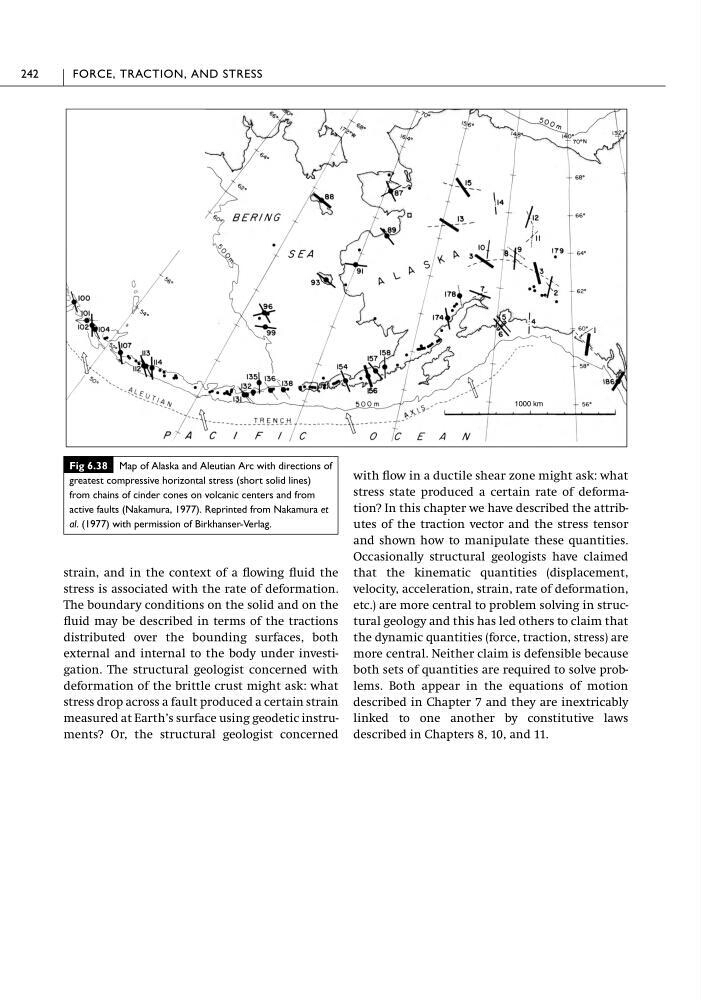
Fig 6.38 Map of Alaska and Aleutian Arc with directions of
greatest compressive horizontal stress (short solid lines)
from chains of cinder cones on volcanic centers and from
active faults (Nakamura, 1977). Reprinted from Nakamura et
al. (1977) with permission of Birkhanser-Verlag.
1000 km
stress is associated with the rate of deformation.
The boundary conditions on the solid and on the
fluid may be described in terms of the tractions
distributed over the bounding surfaces, both
external and internal to the body under investigation. The structural geologist concerned with
deformation of the brittle crust might ask: what
stress drop across a fault produced a certain strain
measured at Earth’s surface using geodetic instruments? Or, the structural geologist concerned
with flow in a ductile shear zone might ask: what
stress state produced a certain rate of deformation? In this chapter we have described the attributes of the traction vector and the stress tensor
and shown how to manipulate these quantities.
Occasionally structural geologists have claimed
that the kinematic quantities (displacement,
velocity, acceleration, strain, rate of deformation,
etc.) are more central to problem solving in structural geology and this has led others to claim that
the dynamic quantities (force, traction, stress) are
more central. Neither claim is defensible because
both sets of quantities are required to solve problems. Both appear in the equations of motion
described in Chapter 7 and they are inextricably
linked to one another by constitutive laws
described in Chapters 8, 10, and 11.
242
FORCE, TRACTION, AND STRESS
Fig 6.38 Map of Alaska and Aleutian Arc with directions of
greatest compressive horizontal stress (short solid lines)
from chains of cinder cones on volcanic centers and from
active faults (Nakamura, 1977). Reprinted from Nakamura et
al. (1977) with permission of Birkhanser-Verlag.
1000 km