

Scholz, 1992; Dawers et al., 1993; Bürgmann et al.,
1994; Muller et al., 2003).
1.2 Radar lineaments on Venus
In his book The Assayer Galileo Galilei apparently
wrote the following:
The Universe, which stands continually open to our
gaze, cannot be understood unless one first learns to
comprehend the language and read the letters in
which it is composed. It is written in the language of
mathematics . . . (Gregory, 1990).
Today the power of modern telescopes and satellite exploration of the planets provides countless
opportunities to investigate structures in rock
beyond Earth.
The Magellan mission to Venus produced radar
images of much of the planet’s surface and many
of the structures observed on these images apparently are related to volcanism (Head et al., 1992).
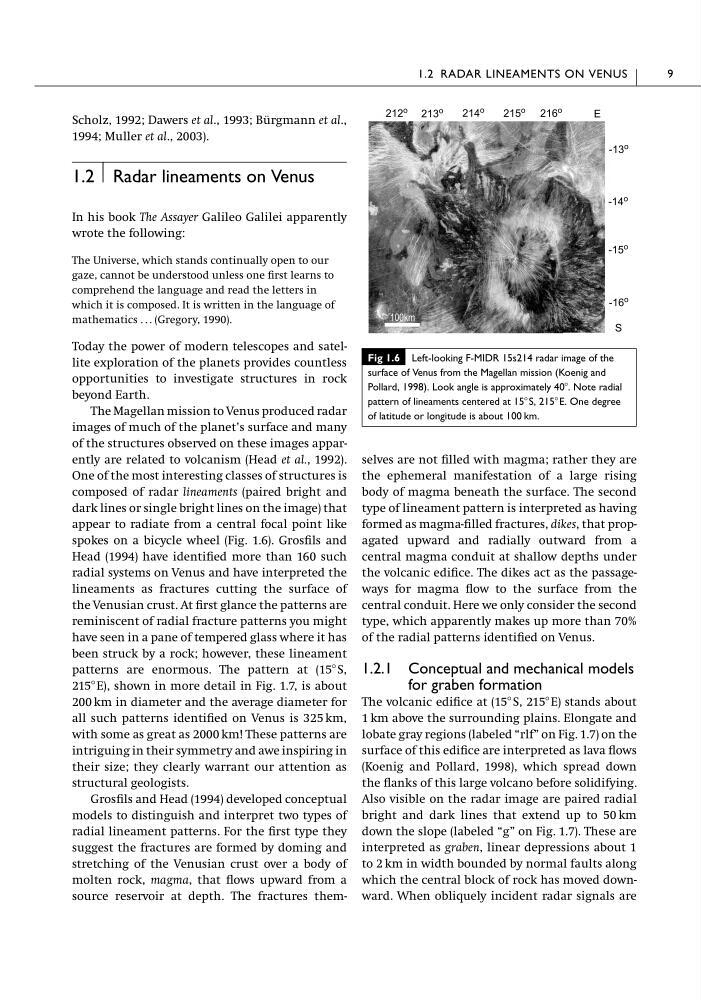
One of the most interesting classes of structures is
composed of radar lineaments (paired bright and
dark lines or single bright lines on the image) that
appear to radiate from a central focal point like
spokes on a bicycle wheel (Fig. 1.6). Grosfils and
Head (1994) have identified more than 160 such
radial systems on Venus and have interpreted the
lineaments as fractures cutting the surface of
the Venusian crust. At first glance the patterns are
reminiscent of radial fracture patterns you might
have seen in a pane of tempered glass where it has
been struck by a rock; however, these lineament
patterns are enormous. The pattern at (15ЊS,
215ЊE), shown in more detail in Fig. 1.7, is about
200 km in diameter and the average diameter for
all such patterns identified on Venus is 325 km,
with some as great as 2000 km! These patterns are
intriguing in their symmetry and awe inspiring in
their size; they clearly warrant our attention as
structural geologists.
Grosfils and Head (1994) developed conceptual
models to distinguish and interpret two types of
radial lineament patterns. For the first type they
suggest the fractures are formed by doming and
stretching of the Venusian crust over a body of
molten rock, magma, that flows upward from a
source reservoir at depth. The fractures themselves are not filled with magma; rather they are
the ephemeral manifestation of a large rising
body of magma beneath the surface. The second
type of lineament pattern is interpreted as having
formed as magma-filled fractures, dikes, that propagated upward and radially outward from a
central magma conduit at shallow depths under
the volcanic edifice. The dikes act as the passageways for magma flow to the surface from the
central conduit. Here we only consider the second
type, which apparently makes up more than 70%
of the radial patterns identified on Venus.
1.2.1 Conceptual and mechanical models
for graben formation
The volcanic edifice at (15ЊS, 215ЊE) stands about
1 km above the surrounding plains. Elongate and
lobate gray regions (labeled “rlf” on Fig. 1.7) on the
surface of this edifice are interpreted as lava flows
(Koenig and Pollard, 1998), which spread down
the flanks of this large volcano before solidifying.
Also visible on the radar image are paired radial
bright and dark lines that extend up to 50 km
down the slope (labeled “g” on Fig. 1.7). These are
interpreted as graben, linear depressions about 1
to 2 km in width bounded by normal faults along
which the central block of rock has moved downward. When obliquely incident radar signals are
1.2 RADAR LINEAMENTS ON VENUS
9
100km
-14 o
-13
o
-16 o
-15 o
S
216 o
215
o
214
o
213 o
E
212
o
Fig 1.6 Left-looking F-MIDR 15s214 radar image of the
surface of Venus from the Magellan mission (Koenig and
Pollard, 1998). Look angle is approximately 40Њ. Note radial
pattern of lineaments centered at 15ЊS, 215ЊE. One degree
of latitude or longitude is about 100 km.
1994; Muller et al., 2003).
1.2 Radar lineaments on Venus
In his book The Assayer Galileo Galilei apparently
wrote the following:
The Universe, which stands continually open to our
gaze, cannot be understood unless one first learns to
comprehend the language and read the letters in
which it is composed. It is written in the language of
mathematics . . . (Gregory, 1990).
Today the power of modern telescopes and satellite exploration of the planets provides countless
opportunities to investigate structures in rock
beyond Earth.
The Magellan mission to Venus produced radar
images of much of the planet’s surface and many
of the structures observed on these images apparently are related to volcanism (Head et al., 1992).
One of the most interesting classes of structures is
composed of radar lineaments (paired bright and
dark lines or single bright lines on the image) that
appear to radiate from a central focal point like
spokes on a bicycle wheel (Fig. 1.6). Grosfils and
Head (1994) have identified more than 160 such
radial systems on Venus and have interpreted the
lineaments as fractures cutting the surface of
the Venusian crust. At first glance the patterns are
reminiscent of radial fracture patterns you might
have seen in a pane of tempered glass where it has
been struck by a rock; however, these lineament
patterns are enormous. The pattern at (15ЊS,
215ЊE), shown in more detail in Fig. 1.7, is about
200 km in diameter and the average diameter for
all such patterns identified on Venus is 325 km,
with some as great as 2000 km! These patterns are
intriguing in their symmetry and awe inspiring in
their size; they clearly warrant our attention as
structural geologists.
Grosfils and Head (1994) developed conceptual
models to distinguish and interpret two types of
radial lineament patterns. For the first type they
suggest the fractures are formed by doming and
stretching of the Venusian crust over a body of
molten rock, magma, that flows upward from a
source reservoir at depth. The fractures themselves are not filled with magma; rather they are
the ephemeral manifestation of a large rising
body of magma beneath the surface. The second
type of lineament pattern is interpreted as having
formed as magma-filled fractures, dikes, that propagated upward and radially outward from a
central magma conduit at shallow depths under
the volcanic edifice. The dikes act as the passageways for magma flow to the surface from the
central conduit. Here we only consider the second
type, which apparently makes up more than 70%
of the radial patterns identified on Venus.
1.2.1 Conceptual and mechanical models
for graben formation
The volcanic edifice at (15ЊS, 215ЊE) stands about
1 km above the surrounding plains. Elongate and
lobate gray regions (labeled “rlf” on Fig. 1.7) on the
surface of this edifice are interpreted as lava flows
(Koenig and Pollard, 1998), which spread down
the flanks of this large volcano before solidifying.
Also visible on the radar image are paired radial
bright and dark lines that extend up to 50 km
down the slope (labeled “g” on Fig. 1.7). These are
interpreted as graben, linear depressions about 1
to 2 km in width bounded by normal faults along
which the central block of rock has moved downward. When obliquely incident radar signals are
1.2 RADAR LINEAMENTS ON VENUS
9
100km
-14 o
-13
o
-16 o
-15 o
S
216 o
215
o
214
o
213 o
E
212
o
Fig 1.6 Left-looking F-MIDR 15s214 radar image of the
surface of Venus from the Magellan mission (Koenig and
Pollard, 1998). Look angle is approximately 40Њ. Note radial
pattern of lineaments centered at 15ЊS, 215ЊE. One degree
of latitude or longitude is about 100 km.