

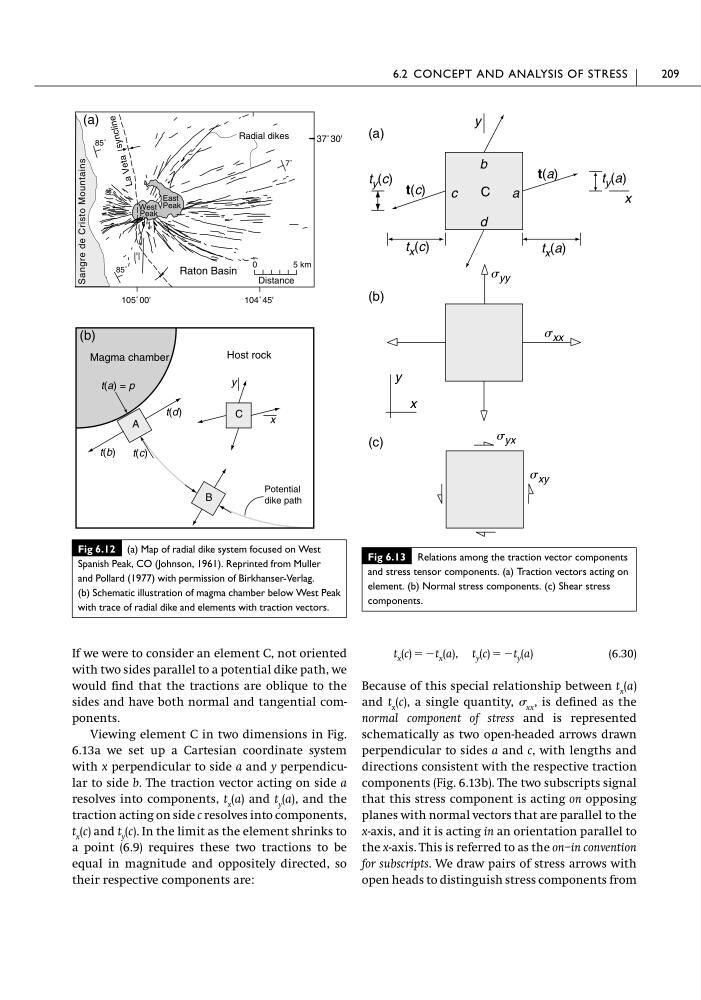
If we were to consider an element C, not oriented
with two sides parallel to a potential dike path, we
would find that the tractions are oblique to the
sides and have both normal and tangential components.
Viewing element C in two dimensions in Fig.
6.13a we set up a Cartesian coordinate system
with x perpendicular to side a and y perpendicular to side b. The traction vector acting on side a
resolves into components, t x (a) and t y (a), and the
traction acting on side c resolves into components,
t x (c) and t y (c). In the limit as the element shrinks to
a point (6.9) requires these two tractions to be
equal in magnitude and oppositely directed, so
their respective components are:
(6.30)
Because of this special relationship between t x (a)
and t x (c), a single quantity, xx , is defined as the
normal component of stress and is represented
schematically as two open-headed arrows drawn
perpendicular to sides a and c, with lengths and
directions consistent with the respective traction
components (Fig. 6.13b). The two subscripts signal
that this stress component is acting on opposing
planes with normal vectors that are parallel to the
x-axis, and it is acting in an orientation parallel to
the x-axis. This is referred to as the on–in convention
for subscripts. We draw pairs of stress arrows with
open heads to distinguish stress components from
t x (c) ϭ Ϫt x (a),t y (c) ϭ Ϫt y (a)
6.2 CONCEPT AND ANALYSIS OF STRESS
209
Fig 6.12 (a) Map of radial dike system focused on West
Spanish Peak, CO (Johnson, 1961). Reprinted from Muller
and Pollard (1977) with permission of Birkhanser-Verlag.
(b) Schematic illustration of magma chamber below West Peak
with trace of radial dike and elements with traction vectors.
Radial dikes
Distance
0
5 km
105˚00'
104˚ 45'
East
Peak
West
Peak
85˚
7˚
85˚
La
Ve
ta
sy
nc
lin
e
Raton Basin
(a)
(b)
t(a) = p
t(b)
t(d)
t(c)
A
B
C
y
x
Magma chamber
Host rock
37˚30'
Sangre de Cristo Mountains
Potential
dike path
Fig 6.13 Relations among the traction vector components
and stress tensor components. (a) Traction vectors acting on
element. (b) Normal stress components. (c) Shear stress
components.
(a)
y
x
a
b
c
d
(b)
y
x
(c)
C
t y (a)
t(a)
t x (a)
s yy
s xx
t y (c) t(c)
t x (c)
s yx
s xy
with two sides parallel to a potential dike path, we
would find that the tractions are oblique to the
sides and have both normal and tangential components.
Viewing element C in two dimensions in Fig.
6.13a we set up a Cartesian coordinate system
with x perpendicular to side a and y perpendicular to side b. The traction vector acting on side a
resolves into components, t x (a) and t y (a), and the
traction acting on side c resolves into components,
t x (c) and t y (c). In the limit as the element shrinks to
a point (6.9) requires these two tractions to be
equal in magnitude and oppositely directed, so
their respective components are:
(6.30)
Because of this special relationship between t x (a)
and t x (c), a single quantity, xx , is defined as the
normal component of stress and is represented
schematically as two open-headed arrows drawn
perpendicular to sides a and c, with lengths and
directions consistent with the respective traction
components (Fig. 6.13b). The two subscripts signal
that this stress component is acting on opposing
planes with normal vectors that are parallel to the
x-axis, and it is acting in an orientation parallel to
the x-axis. This is referred to as the on–in convention
for subscripts. We draw pairs of stress arrows with
open heads to distinguish stress components from
t x (c) ϭ Ϫt x (a),t y (c) ϭ Ϫt y (a)
6.2 CONCEPT AND ANALYSIS OF STRESS
209
Fig 6.12 (a) Map of radial dike system focused on West
Spanish Peak, CO (Johnson, 1961). Reprinted from Muller
and Pollard (1977) with permission of Birkhanser-Verlag.
(b) Schematic illustration of magma chamber below West Peak
with trace of radial dike and elements with traction vectors.
Radial dikes
Distance
0
5 km
105˚00'
104˚ 45'
East
Peak
West
Peak
85˚
7˚
85˚
La
Ve
ta
sy
nc
lin
e
Raton Basin
(a)
(b)
t(a) = p
t(b)
t(d)
t(c)
A
B
C
y
x
Magma chamber
Host rock
37˚30'
Sangre de Cristo Mountains
Potential
dike path
Fig 6.13 Relations among the traction vector components
and stress tensor components. (a) Traction vectors acting on
element. (b) Normal stress components. (c) Shear stress
components.
(a)
y
x
a
b
c
d
(b)
y
x
(c)
C
t y (a)
t(a)
t x (a)
s yy
s xx
t y (c) t(c)
t x (c)
s yx
s xy