

6.1 Concepts of force and traction
In the context of rock masses that behave as
deformable solids or fluids two classes of forces
are recognized: body forces act on volume elements
within the rock mass and surface forces act on
surface elements, either the actual surface of the
rock mass or imaginary surfaces within it.
Common examples of body forces are those due to
gravity and magnetic attraction, both of which
act “at a distance” rather than through the direct
contact to two objects. In contrast surface forces
are those due to the direct contact of one object
with another. For an imaginary surface within a
rock mass one can think of the surface force due
to the rock mass on one side of that surface in
contact with the rock mass on the other side.
Because rock is a porous material one has to consider the nature of such a contact and the
definition of surface forces with some care. Body
and surface forces are defined at arbitrary points
in the continuous medium that we take as a
model for the rock mass. In this section we consider body and surface forces and the traction
vector; in the next section we take up the stress
tensor.
6.1.1 Body force
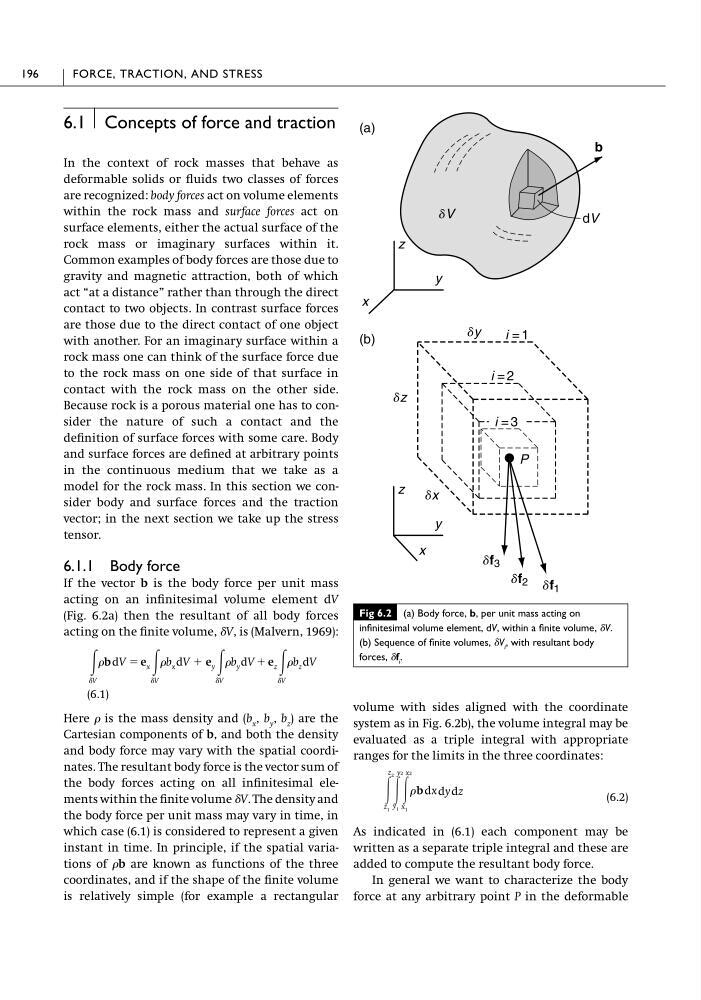
If the vector b is the body force per unit mass
acting on an infinitesimal volume element dV
(Fig. 6.2a) then the resultant of all body forces
acting on the finite volume, ␦V, is (Malvern, 1969):
(6.1)
Here is the mass density and (b x , b y , b z ) are the
Cartesian components of b, and both the density
and body force may vary with the spatial coordinates. The resultant body force is the vector sum of
the body forces acting on all infinitesimal elements within the finite volume ␦V. The density and
the body force per unit mass may vary in time, in
which case (6.1) is considered to represent a given
instant in time. In principle, if the spatial variations of b are known as functions of the three
coordinates, and if the shape of the finite volume
is relatively simple (for example a rectangular
͵
␦V
b dV ϭ e x ͵
␦V
b x dV ϩ e y ͵
␦V
b y dV ϩ e z ͵
␦V
b z dV
volume with sides aligned with the coordinate
system as in Fig. 6.2b), the volume integral may be
evaluated as a triple integral with appropriate
ranges for the limits in the three coordinates:
(6.2)
As indicated in (6.1) each component may be
written as a separate triple integral and these are
added to compute the resultant body force.
In general we want to characterize the body
force at any arbitrary point P in the deformable
Ύ
z 2
z 1
Ύ
y2
y 1
Ύ
x2
x 1
b dx dy dz
196
FORCE, TRACTION, AND STRESS
Fig 6.2 (a) Body force, b, per unit mass acting on
infinitesimal volume element, dV, within a finite volume, ␦V.
(b) Sequence of finite volumes, ␦V i , with resultant body
forces, ␦f i .
(b)
(a)
dV
dV
b
x
y
z
x
y
z
i = 1
i = 2
P
df 1
df 3
df 2
i = 3
dz
dy
dx
In the context of rock masses that behave as
deformable solids or fluids two classes of forces
are recognized: body forces act on volume elements
within the rock mass and surface forces act on
surface elements, either the actual surface of the
rock mass or imaginary surfaces within it.
Common examples of body forces are those due to
gravity and magnetic attraction, both of which
act “at a distance” rather than through the direct
contact to two objects. In contrast surface forces
are those due to the direct contact of one object
with another. For an imaginary surface within a
rock mass one can think of the surface force due
to the rock mass on one side of that surface in
contact with the rock mass on the other side.
Because rock is a porous material one has to consider the nature of such a contact and the
definition of surface forces with some care. Body
and surface forces are defined at arbitrary points
in the continuous medium that we take as a
model for the rock mass. In this section we consider body and surface forces and the traction
vector; in the next section we take up the stress
tensor.
6.1.1 Body force
If the vector b is the body force per unit mass
acting on an infinitesimal volume element dV
(Fig. 6.2a) then the resultant of all body forces
acting on the finite volume, ␦V, is (Malvern, 1969):
(6.1)
Here is the mass density and (b x , b y , b z ) are the
Cartesian components of b, and both the density
and body force may vary with the spatial coordinates. The resultant body force is the vector sum of
the body forces acting on all infinitesimal elements within the finite volume ␦V. The density and
the body force per unit mass may vary in time, in
which case (6.1) is considered to represent a given
instant in time. In principle, if the spatial variations of b are known as functions of the three
coordinates, and if the shape of the finite volume
is relatively simple (for example a rectangular
͵
␦V
b dV ϭ e x ͵
␦V
b x dV ϩ e y ͵
␦V
b y dV ϩ e z ͵
␦V
b z dV
volume with sides aligned with the coordinate
system as in Fig. 6.2b), the volume integral may be
evaluated as a triple integral with appropriate
ranges for the limits in the three coordinates:
(6.2)
As indicated in (6.1) each component may be
written as a separate triple integral and these are
added to compute the resultant body force.
In general we want to characterize the body
force at any arbitrary point P in the deformable
Ύ
z 2
z 1
Ύ
y2
y 1
Ύ
x2
x 1
b dx dy dz
196
FORCE, TRACTION, AND STRESS
Fig 6.2 (a) Body force, b, per unit mass acting on
infinitesimal volume element, dV, within a finite volume, ␦V.
(b) Sequence of finite volumes, ␦V i , with resultant body
forces, ␦f i .
(b)
(a)
dV
dV
b
x
y
z
x
y
z
i = 1
i = 2
P
df 1
df 3
df 2
i = 3
dz
dy
dx