

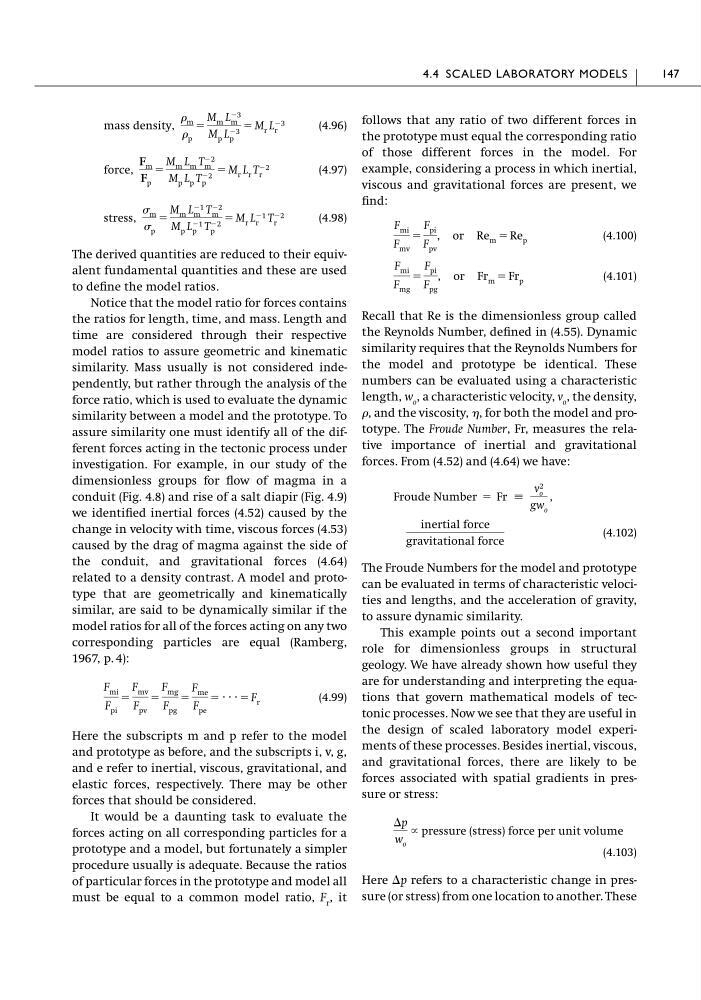
(4.96)
(4.97)
(4.98)
The derived quantities are reduced to their equivalent fundamental quantities and these are used
to define the model ratios.
Notice that the model ratio for forces contains
the ratios for length, time, and mass. Length and
time are considered through their respective
model ratios to assure geometric and kinematic
similarity. Mass usually is not considered independently, but rather through the analysis of the
force ratio, which is used to evaluate the dynamic
similarity between a model and the prototype. To
assure similarity one must identify all of the different forces acting in the tectonic process under
investigation. For example, in our study of the
dimensionless groups for flow of magma in a
conduit (Fig. 4.8) and rise of a salt diapir (Fig. 4.9)
we identified inertial forces (4.52) caused by the
change in velocity with time, viscous forces (4.53)
caused by the drag of magma against the side of
the conduit, and gravitational forces (4.64)
related to a density contrast. A model and prototype that are geometrically and kinematically
similar, are said to be dynamically similar if the
model ratios for all of the forces acting on any two
corresponding particles are equal (Ramberg,
1967, p. 4):
(4.99)
Here the subscripts m and p refer to the model
and prototype as before, and the subscripts i, v, g,
and e refer to inertial, viscous, gravitational, and
elastic forces, respectively. There may be other
forces that should be considered.
It would be a daunting task to evaluate the
forces acting on all corresponding particles for a
prototype and a model, but fortunately a simpler
procedure usually is adequate. Because the ratios
of particular forces in the prototype and model all
must be equal to a common model ratio, F r , it
F mi
F pi
ϭ
F mv
F pv
ϭ
F mg
F pg
ϭ
F me
F pe
ϭ · · · ϭ F r
stress,
m
p
ϭ
M m L Ϫ1
m T Ϫ2
m
M p L Ϫ1
p T Ϫ2
p
ϭ M r L Ϫ1
r T Ϫ2
r
force,
F m
F p
ϭ
M m L m T Ϫ2
m
M p L p T Ϫ2
p
ϭ M r L r T Ϫ2
r
mass density,
m
p
ϭ
M m L Ϫ3
m
M p L Ϫ3
p
ϭ M r L Ϫ3
r
follows that any ratio of two different forces in
the prototype must equal the corresponding ratio
of those different forces in the model. For
example, considering a process in which inertial,
viscous and gravitational forces are present, we
find:
(4.100)
(4.101)
Recall that Re is the dimensionless group called
the Reynolds Number, defined in (4.55). Dynamic
similarity requires that the Reynolds Numbers for
the model and prototype be identical. These
numbers can be evaluated using a characteristic
length, w o , a characteristic velocity, v o , the density,
, and the viscosity, , for both the model and prototype. The Froude Number, Fr, measures the relative importance of inertial and gravitational
forces. From (4.52) and (4.64) we have:
(4.102)
The Froude Numbers for the model and prototype
can be evaluated in terms of characteristic velocities and lengths, and the acceleration of gravity,
to assure dynamic similarity.
This example points out a second important
role for dimensionless groups in structural
geology. We have already shown how useful they
are for understanding and interpreting the equations that govern mathematical models of tectonic processes. Now we see that they are useful in
the design of scaled laboratory model experiments of these processes. Besides inertial, viscous,
and gravitational forces, there are likely to be
forces associated with spatial gradients in pressure or stress:
(4.103)
Here ⌬p refers to a characteristic change in pressure (or stress) from one location to another. These
per unit volume
⌬p
w o
ϰ pressure (stress) force
inertial force
gravitational force
Froude Number ϭ Fr ϵ
v 2
o
gw o
,
F mi
F mg
ϭ
F pi
F pg
, or Fr m ϭ Fr p
F mi
F mv
ϭ
F pi
F pv
, or Re m ϭ Re p
4.4 SCALED LABORATORY MODELS
147
(4.97)
(4.98)
The derived quantities are reduced to their equivalent fundamental quantities and these are used
to define the model ratios.
Notice that the model ratio for forces contains
the ratios for length, time, and mass. Length and
time are considered through their respective
model ratios to assure geometric and kinematic
similarity. Mass usually is not considered independently, but rather through the analysis of the
force ratio, which is used to evaluate the dynamic
similarity between a model and the prototype. To
assure similarity one must identify all of the different forces acting in the tectonic process under
investigation. For example, in our study of the
dimensionless groups for flow of magma in a
conduit (Fig. 4.8) and rise of a salt diapir (Fig. 4.9)
we identified inertial forces (4.52) caused by the
change in velocity with time, viscous forces (4.53)
caused by the drag of magma against the side of
the conduit, and gravitational forces (4.64)
related to a density contrast. A model and prototype that are geometrically and kinematically
similar, are said to be dynamically similar if the
model ratios for all of the forces acting on any two
corresponding particles are equal (Ramberg,
1967, p. 4):
(4.99)
Here the subscripts m and p refer to the model
and prototype as before, and the subscripts i, v, g,
and e refer to inertial, viscous, gravitational, and
elastic forces, respectively. There may be other
forces that should be considered.
It would be a daunting task to evaluate the
forces acting on all corresponding particles for a
prototype and a model, but fortunately a simpler
procedure usually is adequate. Because the ratios
of particular forces in the prototype and model all
must be equal to a common model ratio, F r , it
F mi
F pi
ϭ
F mv
F pv
ϭ
F mg
F pg
ϭ
F me
F pe
ϭ · · · ϭ F r
stress,
m
p
ϭ
M m L Ϫ1
m T Ϫ2
m
M p L Ϫ1
p T Ϫ2
p
ϭ M r L Ϫ1
r T Ϫ2
r
force,
F m
F p
ϭ
M m L m T Ϫ2
m
M p L p T Ϫ2
p
ϭ M r L r T Ϫ2
r
mass density,
m
p
ϭ
M m L Ϫ3
m
M p L Ϫ3
p
ϭ M r L Ϫ3
r
follows that any ratio of two different forces in
the prototype must equal the corresponding ratio
of those different forces in the model. For
example, considering a process in which inertial,
viscous and gravitational forces are present, we
find:
(4.100)
(4.101)
Recall that Re is the dimensionless group called
the Reynolds Number, defined in (4.55). Dynamic
similarity requires that the Reynolds Numbers for
the model and prototype be identical. These
numbers can be evaluated using a characteristic
length, w o , a characteristic velocity, v o , the density,
, and the viscosity, , for both the model and prototype. The Froude Number, Fr, measures the relative importance of inertial and gravitational
forces. From (4.52) and (4.64) we have:
(4.102)
The Froude Numbers for the model and prototype
can be evaluated in terms of characteristic velocities and lengths, and the acceleration of gravity,
to assure dynamic similarity.
This example points out a second important
role for dimensionless groups in structural
geology. We have already shown how useful they
are for understanding and interpreting the equations that govern mathematical models of tectonic processes. Now we see that they are useful in
the design of scaled laboratory model experiments of these processes. Besides inertial, viscous,
and gravitational forces, there are likely to be
forces associated with spatial gradients in pressure or stress:
(4.103)
Here ⌬p refers to a characteristic change in pressure (or stress) from one location to another. These
per unit volume
⌬p
w o
ϰ pressure (stress) force
inertial force
gravitational force
Froude Number ϭ Fr ϵ
v 2
o
gw o
,
F mi
F mg
ϭ
F pi
F pg
, or Fr m ϭ Fr p
F mi
F mv
ϭ
F pi
F pv
, or Re m ϭ Re p
4.4 SCALED LABORATORY MODELS
147