

to laboratory models. In this section the constraints imposed by building a model with much
smaller length scale and much shorter time scale
are examined, and rules are described to ensure
similarity between the natural process and the
model process.
M. King Hubbert (1937) wrote one of the earliest papers that advocates a laboratory modeling
approach to problems in structural geology and
points out the requirements for scaling a model.
These activities continue today and, indeed, the
number, range, and sophistication of such experiments have increased greatly in the last few
decades, with several multi-investigator laboratories active. For example, researchers at the
Applied Geodynamics Laboratory of the Bureau of
Economic Geology, University of Texas, have
studied the rise of salt domes and salt withdrawal
(Vendeville et al., 1995; Ge and Jackson, 1998).
Those at the Fault Dynamics Project at Royal
Holloway, University of London, have studied a
variety of structural styles and faulting mechanisms in extensional tectonic settings (McClay et
al., 1991; McClay and White, 1995). Researchers in
France at Université Rennes are using laboratory
models to study the development of growth fault
systems (Manduit and Brun, 1998), while others at
Université de Montpellier are investigating faulting in accretionary wedges (Gutscher et al., 1998).
Researchers in Canada at the Experimental
Tectonics Laboratory at Queen’s University are
investigating fold–fault relationships and the
influence of stratigraphic heterogeneities on
faulting (Liu and Dixon, 1990, 1991). Despite the
difficulty of mimicking the behavior of rock over
geological time with sand and putty on a laboratory bench, laboratory model studies can provide
important quantitative insight, and in most
instances they record interesting relationships
between the applied loading conditions and the
development of structures that appear similar to
those in the Earth. In some cases model experiments have been performed on actual rock
samples at elevated pressures to investigate faulting (Patton et al., 1998) or folding (Couples and
Lewis, 1998).
Laboratory experiments are termed analog or
physical models whereas computational or numerical models are performed usually on a computer
and rarely on a piece of paper. These two types of
experiments have something in common: both
types obey the fundamental laws of mechanics.
The theoretical models do this by design, whereas
the laboratory models do this because they are
part of the natural world from which those laws
were derived. The same dimensionless groups of
physical quantities that appear in the governing
equations for a particular process in the Earth
should be used to scale the laboratory models of
this process.
4.4.1 Geometric and kinematic similarity
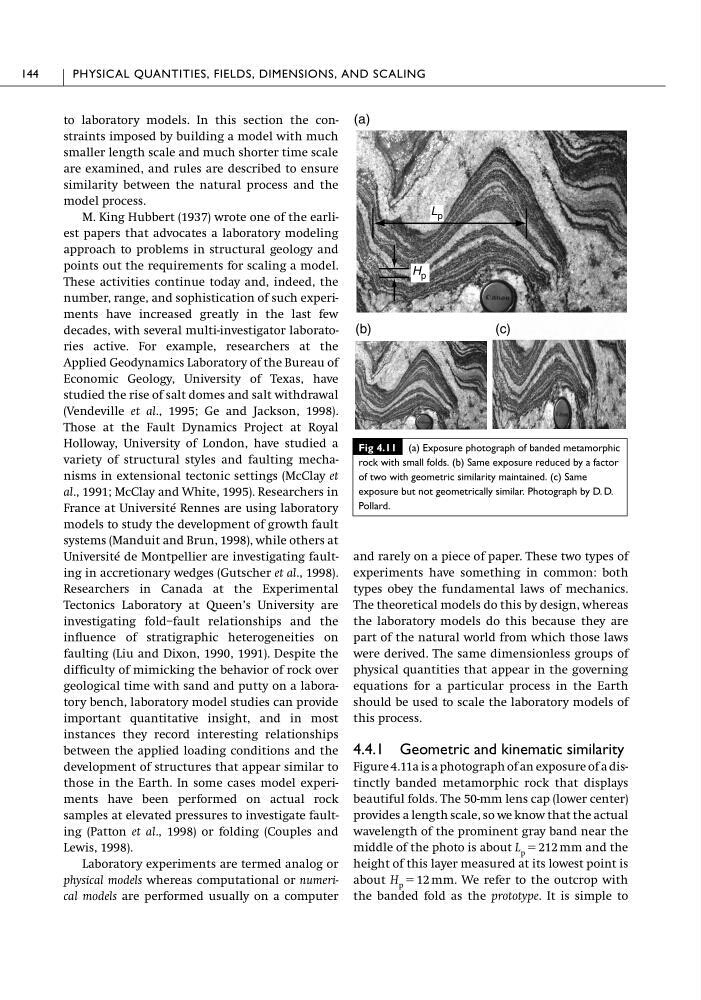
Figure 4.11a is a photograph of an exposure of a distinctly banded metamorphic rock that displays
beautiful folds. The 50-mm lens cap (lower center)
provides a length scale, so we know that the actual
wavelength of the prominent gray band near the
middle of the photo is about L p ϭ 212 mm and the
height of this layer measured at its lowest point is
about H p ϭ 12 mm. We refer to the outcrop with
the banded fold as the prototype. It is simple to
144
PHYSICAL QUANTITIES, FIELDS, DIMENSIONS, AND SCALING
Fig 4.11 (a) Exposure photograph of banded metamorphic
rock with small folds. (b) Same exposure reduced by a factor
of two with geometric similarity maintained. (c) Same
exposure but not geometrically similar. Photograph by D. D.
Pollard.
(a)
(b)
(c)
L p
H p
smaller length scale and much shorter time scale
are examined, and rules are described to ensure
similarity between the natural process and the
model process.
M. King Hubbert (1937) wrote one of the earliest papers that advocates a laboratory modeling
approach to problems in structural geology and
points out the requirements for scaling a model.
These activities continue today and, indeed, the
number, range, and sophistication of such experiments have increased greatly in the last few
decades, with several multi-investigator laboratories active. For example, researchers at the
Applied Geodynamics Laboratory of the Bureau of
Economic Geology, University of Texas, have
studied the rise of salt domes and salt withdrawal
(Vendeville et al., 1995; Ge and Jackson, 1998).
Those at the Fault Dynamics Project at Royal
Holloway, University of London, have studied a
variety of structural styles and faulting mechanisms in extensional tectonic settings (McClay et
al., 1991; McClay and White, 1995). Researchers in
France at Université Rennes are using laboratory
models to study the development of growth fault
systems (Manduit and Brun, 1998), while others at
Université de Montpellier are investigating faulting in accretionary wedges (Gutscher et al., 1998).
Researchers in Canada at the Experimental
Tectonics Laboratory at Queen’s University are
investigating fold–fault relationships and the
influence of stratigraphic heterogeneities on
faulting (Liu and Dixon, 1990, 1991). Despite the
difficulty of mimicking the behavior of rock over
geological time with sand and putty on a laboratory bench, laboratory model studies can provide
important quantitative insight, and in most
instances they record interesting relationships
between the applied loading conditions and the
development of structures that appear similar to
those in the Earth. In some cases model experiments have been performed on actual rock
samples at elevated pressures to investigate faulting (Patton et al., 1998) or folding (Couples and
Lewis, 1998).
Laboratory experiments are termed analog or
physical models whereas computational or numerical models are performed usually on a computer
and rarely on a piece of paper. These two types of
experiments have something in common: both
types obey the fundamental laws of mechanics.
The theoretical models do this by design, whereas
the laboratory models do this because they are
part of the natural world from which those laws
were derived. The same dimensionless groups of
physical quantities that appear in the governing
equations for a particular process in the Earth
should be used to scale the laboratory models of
this process.
4.4.1 Geometric and kinematic similarity
Figure 4.11a is a photograph of an exposure of a distinctly banded metamorphic rock that displays
beautiful folds. The 50-mm lens cap (lower center)
provides a length scale, so we know that the actual
wavelength of the prominent gray band near the
middle of the photo is about L p ϭ 212 mm and the
height of this layer measured at its lowest point is
about H p ϭ 12 mm. We refer to the outcrop with
the banded fold as the prototype. It is simple to
144
PHYSICAL QUANTITIES, FIELDS, DIMENSIONS, AND SCALING
Fig 4.11 (a) Exposure photograph of banded metamorphic
rock with small folds. (b) Same exposure reduced by a factor
of two with geometric similarity maintained. (c) Same
exposure but not geometrically similar. Photograph by D. D.
Pollard.
(a)
(b)
(c)
L p
H p