

the arbitrary variable k. As h and k vary, the sum
of these terms defines vectors that cover the
tangent plane, P.
The tangent plane plays an important role in
describing any curved surface. Furthermore, any
geological surface observed at exposure is approximated locally with planar elements whose orientations are measured using angles such as the
strike, ␣ s , and dip, d . These planar elements are
tangent planes to the geological surface at the
point of measurement and would be described
quantitatively by (3.63) if a parametric representation of the geological surface were known.
Now we are in a position to bring the concepts
of the curved line and curved surface together to
understand the geometry of an arbitrary curved
line lying on a particular surface. This concept is
necessary because the curvature at a point on a
surface may vary with direction, and these directions are defined in terms of curves passing
through the point and lying on the curved surface.
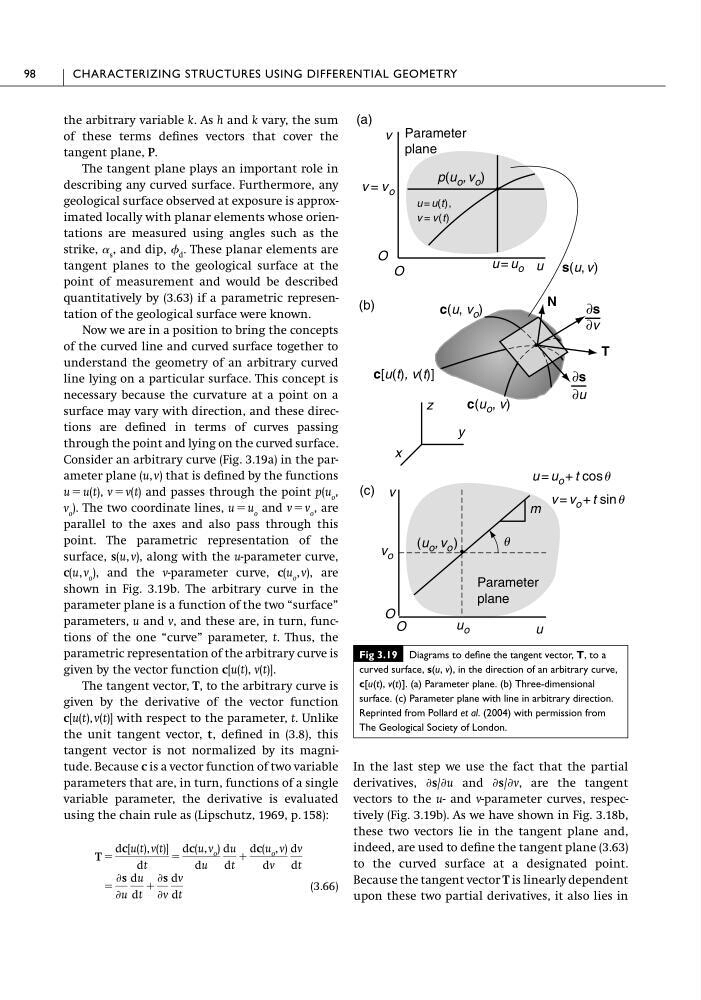
Consider an arbitrary curve (Fig. 3.19a) in the parameter plane (u, v) that is defined by the functions
u ϭ u(t), v ϭ v(t) and passes through the point p(u o ,
v o ). The two coordinate lines, u ϭ u o and v ϭ v o , are
parallel to the axes and also pass through this
point. The parametric representation of the
surface, s(u, v), along with the u-parameter curve,
c(u, v o ), and the v-parameter curve, c(u o , v), are
shown in Fig. 3.19b. The arbitrary curve in the
parameter plane is a function of the two “surface”
parameters, u and v, and these are, in turn, functions of the one “curve” parameter, t. Thus, the
parametric representation of the arbitrary curve is
given by the vector function c[u(t), v(t)].
The tangent vector, T, to the arbitrary curve is
given by the derivative of the vector function
c[u(t), v(t)] with respect to the parameter, t. Unlike
the unit tangent vector, t, defined in (3.8), this
tangent vector is not normalized by its magnitude. Because c is a vector function of two variable
parameters that are, in turn, functions of a single
variable parameter, the derivative is evaluated
using the chain rule as (Lipschutz, 1969, p. 158):
(3.66)
ϭ
Ѩs
Ѩu
du
dt
ϩ
Ѩs
Ѩv
dv
dt
ϩ
dc(u o , v)
dv
dv
dt
T ϭ
dc[u(t), v(t)]
dt
ϭ
dc(u, v o )
du
du
dt
In the last step we use the fact that the partial
derivatives, Ѩs/Ѩu and Ѩs/Ѩv, are the tangent
vectors to the u- and v-parameter curves, respectively (Fig. 3.19b). As we have shown in Fig. 3.18b,
these two vectors lie in the tangent plane and,
indeed, are used to define the tangent plane (3.63)
to the curved surface at a designated point.
Because the tangent vector T is linearly dependent
upon these two partial derivatives, it also lies in
98
CHARACTERIZING STRUCTURES USING DIFFERENTIAL GEOMETRY
Fig 3.19 Diagrams to define the tangent vector, T, to a
curved surface, s(u, v), in the direction of an arbitrary curve,
c[u(t), v(t)]. (a) Parameter plane. (b) Three-dimensional
surface. (c) Parameter plane with line in arbitrary direction.
Reprinted from Pollard et al. (2004) with permission from
The Geological Society of London.
y
z
x
(b)
(a)
u
v
O
Parameter
plane
O
∂u
∂s
(c)
∂v
∂s
N
T
u
v
O
Parameter
plane
v o
u o
O
m
u
p(u o , v o )
u = u(t),
v = v(t)
u = u o
s(u, v)
c(u, v o )
c(u o , v)
c[u(t), v(t)]
u = u o + t cos U
v = v o + t sin U
(u o , v o )
v = v o
of these terms defines vectors that cover the
tangent plane, P.
The tangent plane plays an important role in
describing any curved surface. Furthermore, any
geological surface observed at exposure is approximated locally with planar elements whose orientations are measured using angles such as the
strike, ␣ s , and dip, d . These planar elements are
tangent planes to the geological surface at the
point of measurement and would be described
quantitatively by (3.63) if a parametric representation of the geological surface were known.
Now we are in a position to bring the concepts
of the curved line and curved surface together to
understand the geometry of an arbitrary curved
line lying on a particular surface. This concept is
necessary because the curvature at a point on a
surface may vary with direction, and these directions are defined in terms of curves passing
through the point and lying on the curved surface.
Consider an arbitrary curve (Fig. 3.19a) in the parameter plane (u, v) that is defined by the functions
u ϭ u(t), v ϭ v(t) and passes through the point p(u o ,
v o ). The two coordinate lines, u ϭ u o and v ϭ v o , are
parallel to the axes and also pass through this
point. The parametric representation of the
surface, s(u, v), along with the u-parameter curve,
c(u, v o ), and the v-parameter curve, c(u o , v), are
shown in Fig. 3.19b. The arbitrary curve in the
parameter plane is a function of the two “surface”
parameters, u and v, and these are, in turn, functions of the one “curve” parameter, t. Thus, the
parametric representation of the arbitrary curve is
given by the vector function c[u(t), v(t)].
The tangent vector, T, to the arbitrary curve is
given by the derivative of the vector function
c[u(t), v(t)] with respect to the parameter, t. Unlike
the unit tangent vector, t, defined in (3.8), this
tangent vector is not normalized by its magnitude. Because c is a vector function of two variable
parameters that are, in turn, functions of a single
variable parameter, the derivative is evaluated
using the chain rule as (Lipschutz, 1969, p. 158):
(3.66)
ϭ
Ѩs
Ѩu
du
dt
ϩ
Ѩs
Ѩv
dv
dt
ϩ
dc(u o , v)
dv
dv
dt
T ϭ
dc[u(t), v(t)]
dt
ϭ
dc(u, v o )
du
du
dt
In the last step we use the fact that the partial
derivatives, Ѩs/Ѩu and Ѩs/Ѩv, are the tangent
vectors to the u- and v-parameter curves, respectively (Fig. 3.19b). As we have shown in Fig. 3.18b,
these two vectors lie in the tangent plane and,
indeed, are used to define the tangent plane (3.63)
to the curved surface at a designated point.
Because the tangent vector T is linearly dependent
upon these two partial derivatives, it also lies in
98
CHARACTERIZING STRUCTURES USING DIFFERENTIAL GEOMETRY
Fig 3.19 Diagrams to define the tangent vector, T, to a
curved surface, s(u, v), in the direction of an arbitrary curve,
c[u(t), v(t)]. (a) Parameter plane. (b) Three-dimensional
surface. (c) Parameter plane with line in arbitrary direction.
Reprinted from Pollard et al. (2004) with permission from
The Geological Society of London.
y
z
x
(b)
(a)
u
v
O
Parameter
plane
O
∂u
∂s
(c)
∂v
∂s
N
T
u
v
O
Parameter
plane
v o
u o
O
m
u
p(u o , v o )
u = u(t),
v = v(t)
u = u o
s(u, v)
c(u, v o )
c(u o , v)
c[u(t), v(t)]
u = u o + t cos U
v = v o + t sin U
(u o , v o )
v = v o