

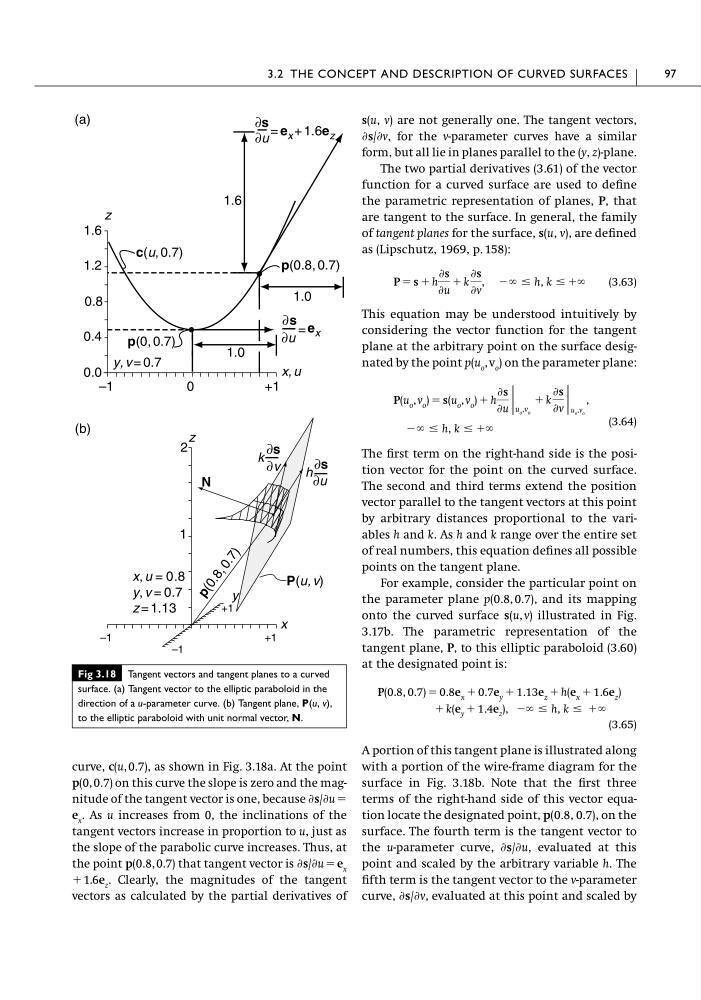
curve, c(u, 0.7), as shown in Fig. 3.18a. At the point
p(0, 0.7) on this curve the slope is zero and the magnitude of the tangent vector is one, because Ѩs/Ѩu ϭ
e x . As u increases from 0, the inclinations of the
tangent vectors increase in proportion to u, just as
the slope of the parabolic curve increases. Thus, at
the point p(0.8, 0.7) that tangent vector is Ѩs/Ѩu ϭ e x
ϩ 1.6e z . Clearly, the magnitudes of the tangent
vectors as calculated by the partial derivatives of
s(u, v) are not generally one. The tangent vectors,
Ѩs/Ѩv, for the v-parameter curves have a similar
form, but all lie in planes parallel to the (y, z)-plane.
The two partial derivatives (3.61) of the vector
function for a curved surface are used to define
the parametric representation of planes, P, that
are tangent to the surface. In general, the family
of tangent planes for the surface, s(u, v), are defined
as (Lipschutz, 1969, p. 158):
(3.63)
This equation may be understood intuitively by
considering the vector function for the tangent
plane at the arbitrary point on the surface designated by the point p(u o ,v o ) on the parameter plane:
(3.64)
The first term on the right-hand side is the position vector for the point on the curved surface.
The second and third terms extend the position
vector parallel to the tangent vectors at this point
by arbitrary distances proportional to the variables h and k. As h and k range over the entire set
of real numbers, this equation defines all possible
points on the tangent plane.
For example, consider the particular point on
the parameter plane p(0.8, 0.7), and its mapping
onto the curved surface s(u, v) illustrated in Fig.
3.17b. The parametric representation of the
tangent plane, P, to this elliptic paraboloid (3.60)
at the designated point is:
(3.65)
A portion of this tangent plane is illustrated along
with a portion of the wire-frame diagram for the
surface in Fig. 3.18b. Note that the first three
terms of the right-hand side of this vector equation locate the designated point, p(0.8, 0.7), on the
surface. The fourth term is the tangent vector to
the u-parameter curve, Ѩs/Ѩu, evaluated at this
point and scaled by the arbitrary variable h. The
fifth term is the tangent vector to the v-parameter
curve, Ѩs/Ѩv, evaluated at this point and scaled by
ϩ k(e y ϩ 1.4e z ), Ϫϱ Յ h, k Յ ϩϱ
ϩ h(e x ϩ 1.6e z )
P(0.8, 0.7) ϭ 0.8e x ϩ 0.7e y ϩ 1.13e z
Ϫϱ Յ h, k Յ ϩϱ
ϩ k
Ѩs
Ѩv | u o ,v o
,
P(u o , v o ) ϭ s(u o , v o ) ϩ h
Ѩs
Ѩu | u o ,v o
P ϭ s ϩ h
Ѩs
Ѩu
ϩ k
Ѩs
Ѩv
, Ϫϱ Յ h, k Յ ϩϱ
3.2 THE CONCEPT AND DESCRIPTION OF CURVED SURFACES
97
Fig 3.18 Tangent vectors and tangent planes to a curved
surface. (a) Tangent vector to the elliptic paraboloid in the
direction of a u-parameter curve. (b) Tangent plane, P(u, v),
to the elliptic paraboloid with unit normal vector, N.
–1
0
+1
0.0
1.2
1.6
0.8
0.4
z
x, u
(a)
1.0
1.0
∂u
∂s
1.6
1
2
–1
+1
–1
+1
p(0.8, 0.7)
z
y
x
(b)
p(0, 0.7)
∂u
∂s = e x
∂u
∂s
h
∂v
∂s
k
N
= e x + 1.6e z
c(u, 0.7)
y, v = 0.7
P(u, v)
p ( 0 . 8 , 0 . 7 )
x, u = 0.8
y, v = 0.7
z = 1.13
p(0, 0.7) on this curve the slope is zero and the magnitude of the tangent vector is one, because Ѩs/Ѩu ϭ
e x . As u increases from 0, the inclinations of the
tangent vectors increase in proportion to u, just as
the slope of the parabolic curve increases. Thus, at
the point p(0.8, 0.7) that tangent vector is Ѩs/Ѩu ϭ e x
ϩ 1.6e z . Clearly, the magnitudes of the tangent
vectors as calculated by the partial derivatives of
s(u, v) are not generally one. The tangent vectors,
Ѩs/Ѩv, for the v-parameter curves have a similar
form, but all lie in planes parallel to the (y, z)-plane.
The two partial derivatives (3.61) of the vector
function for a curved surface are used to define
the parametric representation of planes, P, that
are tangent to the surface. In general, the family
of tangent planes for the surface, s(u, v), are defined
as (Lipschutz, 1969, p. 158):
(3.63)
This equation may be understood intuitively by
considering the vector function for the tangent
plane at the arbitrary point on the surface designated by the point p(u o ,v o ) on the parameter plane:
(3.64)
The first term on the right-hand side is the position vector for the point on the curved surface.
The second and third terms extend the position
vector parallel to the tangent vectors at this point
by arbitrary distances proportional to the variables h and k. As h and k range over the entire set
of real numbers, this equation defines all possible
points on the tangent plane.
For example, consider the particular point on
the parameter plane p(0.8, 0.7), and its mapping
onto the curved surface s(u, v) illustrated in Fig.
3.17b. The parametric representation of the
tangent plane, P, to this elliptic paraboloid (3.60)
at the designated point is:
(3.65)
A portion of this tangent plane is illustrated along
with a portion of the wire-frame diagram for the
surface in Fig. 3.18b. Note that the first three
terms of the right-hand side of this vector equation locate the designated point, p(0.8, 0.7), on the
surface. The fourth term is the tangent vector to
the u-parameter curve, Ѩs/Ѩu, evaluated at this
point and scaled by the arbitrary variable h. The
fifth term is the tangent vector to the v-parameter
curve, Ѩs/Ѩv, evaluated at this point and scaled by
ϩ k(e y ϩ 1.4e z ), Ϫϱ Յ h, k Յ ϩϱ
ϩ h(e x ϩ 1.6e z )
P(0.8, 0.7) ϭ 0.8e x ϩ 0.7e y ϩ 1.13e z
Ϫϱ Յ h, k Յ ϩϱ
ϩ k
Ѩs
Ѩv | u o ,v o
,
P(u o , v o ) ϭ s(u o , v o ) ϩ h
Ѩs
Ѩu | u o ,v o
P ϭ s ϩ h
Ѩs
Ѩu
ϩ k
Ѩs
Ѩv
, Ϫϱ Յ h, k Յ ϩϱ
3.2 THE CONCEPT AND DESCRIPTION OF CURVED SURFACES
97
Fig 3.18 Tangent vectors and tangent planes to a curved
surface. (a) Tangent vector to the elliptic paraboloid in the
direction of a u-parameter curve. (b) Tangent plane, P(u, v),
to the elliptic paraboloid with unit normal vector, N.
–1
0
+1
0.0
1.2
1.6
0.8
0.4
z
x, u
(a)
1.0
1.0
∂u
∂s
1.6
1
2
–1
+1
–1
+1
p(0.8, 0.7)
z
y
x
(b)
p(0, 0.7)
∂u
∂s = e x
∂u
∂s
h
∂v
∂s
k
N
= e x + 1.6e z
c(u, 0.7)
y, v = 0.7
P(u, v)
p ( 0 . 8 , 0 . 7 )
x, u = 0.8
y, v = 0.7
z = 1.13