

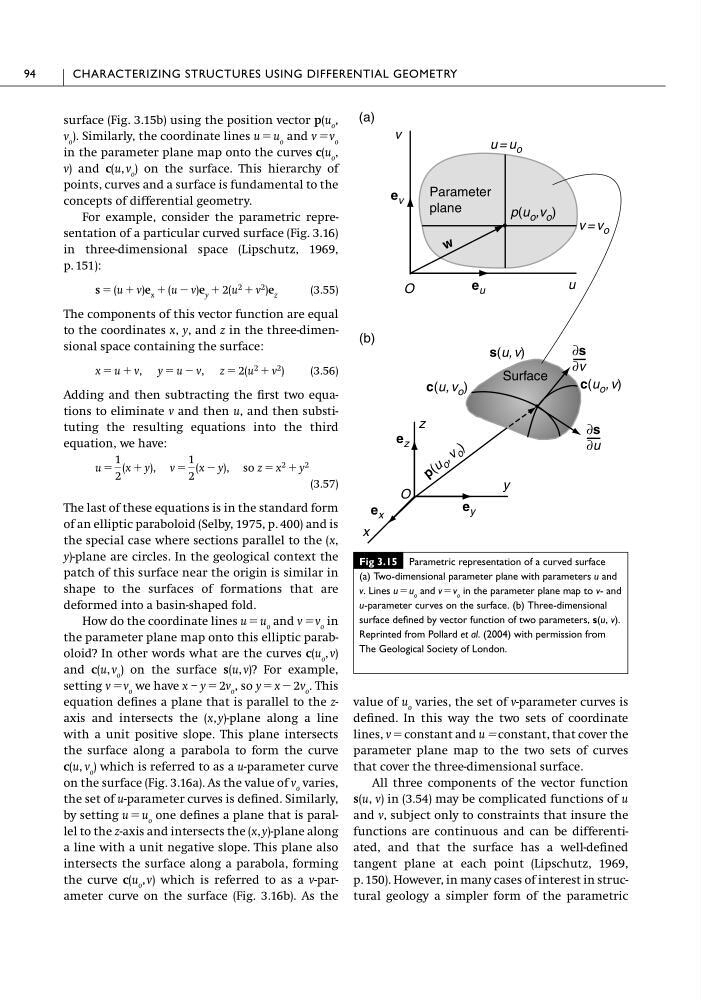
surface (Fig. 3.15b) using the position vector p(u o ,
v o ). Similarly, the coordinate lines u ϭ u o and vϭv o
in the parameter plane map onto the curves c(u o ,
v) and c(u, v o ) on the surface. This hierarchy of
points, curves and a surface is fundamental to the
concepts of differential geometry.
For example, consider the parametric representation of a particular curved surface (Fig. 3.16)
in three-dimensional space (Lipschutz, 1969,
p. 151):
(3.55)
The components of this vector function are equal
to the coordinates x, y, and z in the three-dimensional space containing the surface:
(3.56)
Adding and then subtracting the first two equations to eliminate v and then u, and then substituting the resulting equations into the third
equation, we have:
(3.57)
The last of these equations is in the standard form
of an elliptic paraboloid (Selby, 1975, p. 400) and is
the special case where sections parallel to the (x,
y)-plane are circles. In the geological context the
patch of this surface near the origin is similar in
shape to the surfaces of formations that are
deformed into a basin-shaped fold.
How do the coordinate lines u ϭ u o and vϭv o in
the parameter plane map onto this elliptic paraboloid? In other words what are the curves c(u o , v)
and c(u, v o ) on the surface s(u, v)? For example,
setting vϭv o we have x – y ϭ 2v o , so y ϭ x Ϫ 2v o . This
equation defines a plane that is parallel to the zaxis and intersects the (x, y)-plane along a line
with a unit positive slope. This plane intersects
the surface along a parabola to form the curve
c(u, v o ) which is referred to as a u-parameter curve
on the surface (Fig. 3.16a). As the value of v o varies,
the set of u-parameter curves is defined. Similarly,
by setting u ϭ u o one defines a plane that is parallel to the z-axis and intersects the (x, y)-plane along
a line with a unit negative slope. This plane also
intersects the surface along a parabola, forming
the curve c(u o , v) which is referred to as a v-parameter curve on the surface (Fig. 3.16b). As the
u ϭ
1
2
(x ϩ y), v ϭ
1
2
(x Ϫ y), so z ϭ x 2 ϩ y 2
x ϭ u ϩ v, y ϭ u Ϫ v, z ϭ 2(u 2 ϩ v 2 )
s ϭ (u ϩ v)e x ϩ (u Ϫ v)e y ϩ 2(u 2 ϩ v 2 )e z
value of u o varies, the set of v-parameter curves is
defined. In this way the two sets of coordinate
lines, v ϭ constant and uϭconstant, that cover the
parameter plane map to the two sets of curves
that cover the three-dimensional surface.
All three components of the vector function
s(u, v) in (3.54) may be complicated functions of u
and v, subject only to constraints that insure the
functions are continuous and can be differentiated, and that the surface has a well-defined
tangent plane at each point (Lipschutz, 1969,
p. 150). However, in many cases of interest in structural geology a simpler form of the parametric
94
CHARACTERIZING STRUCTURES USING DIFFERENTIAL GEOMETRY
Fig 3.15 Parametric representation of a curved surface
(a) Two-dimensional parameter plane with parameters u and
v. Lines uϭu o and vϭv o in the parameter plane map to v- and
u-parameter curves on the surface. (b) Three-dimensional
surface defined by vector function of two parameters, s(u, v).
Reprinted from Pollard et al. (2004) with permission from
The Geological Society of London.
y
z
Surface
x
(b)
O
(a)
u
v
O
w
u = u o
e v
v = v o
Parameter
plane
p(u o ,v o )
e u
s(u, v)
∂s
∂v
c(u o , v)
∂s
∂u
c(u, v o )
p ( u o , v o
)
e z
e x
e y
v o ). Similarly, the coordinate lines u ϭ u o and vϭv o
in the parameter plane map onto the curves c(u o ,
v) and c(u, v o ) on the surface. This hierarchy of
points, curves and a surface is fundamental to the
concepts of differential geometry.
For example, consider the parametric representation of a particular curved surface (Fig. 3.16)
in three-dimensional space (Lipschutz, 1969,
p. 151):
(3.55)
The components of this vector function are equal
to the coordinates x, y, and z in the three-dimensional space containing the surface:
(3.56)
Adding and then subtracting the first two equations to eliminate v and then u, and then substituting the resulting equations into the third
equation, we have:
(3.57)
The last of these equations is in the standard form
of an elliptic paraboloid (Selby, 1975, p. 400) and is
the special case where sections parallel to the (x,
y)-plane are circles. In the geological context the
patch of this surface near the origin is similar in
shape to the surfaces of formations that are
deformed into a basin-shaped fold.
How do the coordinate lines u ϭ u o and vϭv o in
the parameter plane map onto this elliptic paraboloid? In other words what are the curves c(u o , v)
and c(u, v o ) on the surface s(u, v)? For example,
setting vϭv o we have x – y ϭ 2v o , so y ϭ x Ϫ 2v o . This
equation defines a plane that is parallel to the zaxis and intersects the (x, y)-plane along a line
with a unit positive slope. This plane intersects
the surface along a parabola to form the curve
c(u, v o ) which is referred to as a u-parameter curve
on the surface (Fig. 3.16a). As the value of v o varies,
the set of u-parameter curves is defined. Similarly,
by setting u ϭ u o one defines a plane that is parallel to the z-axis and intersects the (x, y)-plane along
a line with a unit negative slope. This plane also
intersects the surface along a parabola, forming
the curve c(u o , v) which is referred to as a v-parameter curve on the surface (Fig. 3.16b). As the
u ϭ
1
2
(x ϩ y), v ϭ
1
2
(x Ϫ y), so z ϭ x 2 ϩ y 2
x ϭ u ϩ v, y ϭ u Ϫ v, z ϭ 2(u 2 ϩ v 2 )
s ϭ (u ϩ v)e x ϩ (u Ϫ v)e y ϩ 2(u 2 ϩ v 2 )e z
value of u o varies, the set of v-parameter curves is
defined. In this way the two sets of coordinate
lines, v ϭ constant and uϭconstant, that cover the
parameter plane map to the two sets of curves
that cover the three-dimensional surface.
All three components of the vector function
s(u, v) in (3.54) may be complicated functions of u
and v, subject only to constraints that insure the
functions are continuous and can be differentiated, and that the surface has a well-defined
tangent plane at each point (Lipschutz, 1969,
p. 150). However, in many cases of interest in structural geology a simpler form of the parametric
94
CHARACTERIZING STRUCTURES USING DIFFERENTIAL GEOMETRY
Fig 3.15 Parametric representation of a curved surface
(a) Two-dimensional parameter plane with parameters u and
v. Lines uϭu o and vϭv o in the parameter plane map to v- and
u-parameter curves on the surface. (b) Three-dimensional
surface defined by vector function of two parameters, s(u, v).
Reprinted from Pollard et al. (2004) with permission from
The Geological Society of London.
y
z
Surface
x
(b)
O
(a)
u
v
O
w
u = u o
e v
v = v o
Parameter
plane
p(u o ,v o )
e u
s(u, v)
∂s
∂v
c(u o , v)
∂s
∂u
c(u, v o )
p ( u o , v o
)
e z
e x
e y