

284
facilitate the prevention, detection, investigation, and prosecution of the offences
related to terrorist financing. This body also ensures that corporations remain legally
accountable for their conduct.
18.4.4 Commonalities and Differences
The analysis shows there is limited corporate understanding of external accountability as a mechanism to respond for impacts on the environment and the communities. Accountability is a major issue in selected cases, with 63%, 46%, and 42% of
companies not displaying external accountability mechanisms in RoK, Myanmar,
and Sri Lanka, respectively. Internal accountability is therefore the most predominant approach among reviewed companies. External accountability is poorly exercised mainly through social media (e.g., Facebook, websites). Companies operating
in RoK seem to be the most critical case with 63% of companies not exercising fully
external accountability.
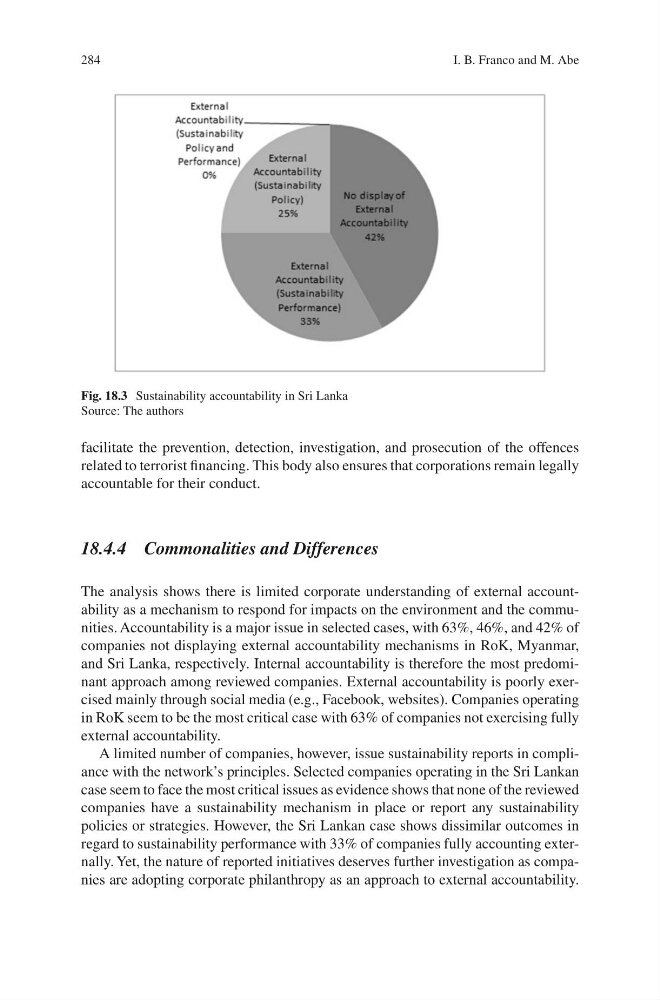
A limited number of companies, however, issue sustainability reports in compliance with the network’s principles. Selected companies operating in the Sri Lankan
case seem to face the most critical issues as evidence shows that none of the reviewed
companies have a sustainability mechanism in place or report any sustainability
policies or strategies. However, the Sri Lankan case shows dissimilar outcomes in
regard to sustainability performance with 33% of companies fully accounting externally. Yet, the nature of reported initiatives deserves further investigation as companies are adopting corporate philanthropy as an approach to external accountability.
Fig. 18.3 Sustainability accountability in Sri Lanka
Source: The authors
I. B. Franco and M. Abe
facilitate the prevention, detection, investigation, and prosecution of the offences
related to terrorist financing. This body also ensures that corporations remain legally
accountable for their conduct.
18.4.4 Commonalities and Differences
The analysis shows there is limited corporate understanding of external accountability as a mechanism to respond for impacts on the environment and the communities. Accountability is a major issue in selected cases, with 63%, 46%, and 42% of
companies not displaying external accountability mechanisms in RoK, Myanmar,
and Sri Lanka, respectively. Internal accountability is therefore the most predominant approach among reviewed companies. External accountability is poorly exercised mainly through social media (e.g., Facebook, websites). Companies operating
in RoK seem to be the most critical case with 63% of companies not exercising fully
external accountability.
A limited number of companies, however, issue sustainability reports in compliance with the network’s principles. Selected companies operating in the Sri Lankan
case seem to face the most critical issues as evidence shows that none of the reviewed
companies have a sustainability mechanism in place or report any sustainability
policies or strategies. However, the Sri Lankan case shows dissimilar outcomes in
regard to sustainability performance with 33% of companies fully accounting externally. Yet, the nature of reported initiatives deserves further investigation as companies are adopting corporate philanthropy as an approach to external accountability.
Fig. 18.3 Sustainability accountability in Sri Lanka
Source: The authors
I. B. Franco and M. Abe