

202
The research identified three factors that are the main determinants of the inappropriateness of community wellbeing approaches in Antioquia: overinvestment in
irrelevant initiatives, limited understanding of entrepreneurship for community
wellbeing as an approach to development and approaches that do not reach the
broader community but only the mining industry’s current and potential employees.
These aspects have led to the escalation of social problems such as discontent and
resentment amongst locals. More importantly, it has also had adverse implications
for local economic development.
There is overinvestment in poorly focused initiatives in the Antioquia case region.
Communities have been equipped with training and education in areas they find do
not help them realise their entrepreneurship potential or access gainful employment
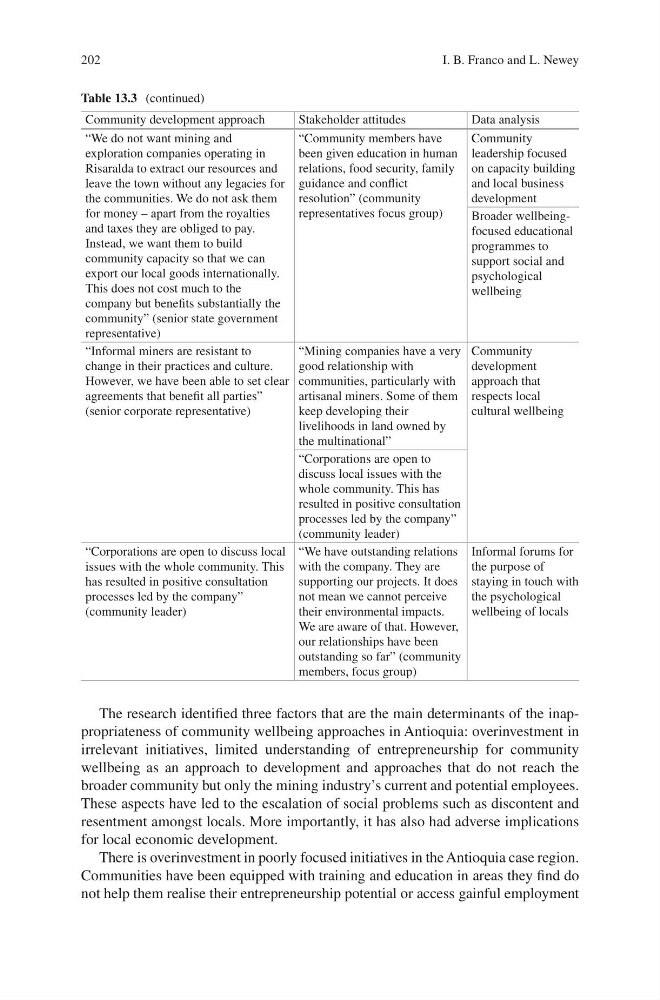
Table 13.3 (continued)
Community development approach
Stakeholder attitudes
Data analysis
“We do not want mining and
exploration companies operating in
Risaralda to extract our resources and
leave the town without any legacies for
the communities. We do not ask them
for money – apart from the royalties
and taxes they are obliged to pay.
Instead, we want them to build
community capacity so that we can
export our local goods internationally.
This does not cost much to the
company but benefits substantially the
community” (senior state government
representative)
“Community members have
been given education in human
relations, food security, family
guidance and conflict
resolution” (community
representatives focus group)
Community
leadership focused
on capacity building
and local business
development
Broader wellbeingfocused educational
programmes to
support social and
psychological
wellbeing
“Informal miners are resistant to
change in their practices and culture.
However, we have been able to set clear
agreements that benefit all parties”
(senior corporate representative)
“Mining companies have a very
good relationship with
communities, particularly with
artisanal miners. Some of them
keep developing their
livelihoods in land owned by
the multinational”
Community
development
approach that
respects local
cultural wellbeing
“Corporations are open to
discuss local issues with the
whole community. This has
resulted in positive consultation
processes led by the company”
(community leader)
“Corporations are open to discuss local
issues with the whole community. This
has resulted in positive consultation
processes led by the company”
(community leader)
“We have outstanding relations
with the company. They are
supporting our projects. It does
not mean we cannot perceive
their environmental impacts.
We are aware of that. However,
our relationships have been
outstanding so far” (community
members, focus group)
Informal forums for
the purpose of
staying in touch with
the psychological
wellbeing of locals
I. B. Franco and L. Newey
The research identified three factors that are the main determinants of the inappropriateness of community wellbeing approaches in Antioquia: overinvestment in
irrelevant initiatives, limited understanding of entrepreneurship for community
wellbeing as an approach to development and approaches that do not reach the
broader community but only the mining industry’s current and potential employees.
These aspects have led to the escalation of social problems such as discontent and
resentment amongst locals. More importantly, it has also had adverse implications
for local economic development.
There is overinvestment in poorly focused initiatives in the Antioquia case region.
Communities have been equipped with training and education in areas they find do
not help them realise their entrepreneurship potential or access gainful employment
Table 13.3 (continued)
Community development approach
Stakeholder attitudes
Data analysis
“We do not want mining and
exploration companies operating in
Risaralda to extract our resources and
leave the town without any legacies for
the communities. We do not ask them
for money – apart from the royalties
and taxes they are obliged to pay.
Instead, we want them to build
community capacity so that we can
export our local goods internationally.
This does not cost much to the
company but benefits substantially the
community” (senior state government
representative)
“Community members have
been given education in human
relations, food security, family
guidance and conflict
resolution” (community
representatives focus group)
Community
leadership focused
on capacity building
and local business
development
Broader wellbeingfocused educational
programmes to
support social and
psychological
wellbeing
“Informal miners are resistant to
change in their practices and culture.
However, we have been able to set clear
agreements that benefit all parties”
(senior corporate representative)
“Mining companies have a very
good relationship with
communities, particularly with
artisanal miners. Some of them
keep developing their
livelihoods in land owned by
the multinational”
Community
development
approach that
respects local
cultural wellbeing
“Corporations are open to
discuss local issues with the
whole community. This has
resulted in positive consultation
processes led by the company”
(community leader)
“Corporations are open to discuss local
issues with the whole community. This
has resulted in positive consultation
processes led by the company”
(community leader)
“We have outstanding relations
with the company. They are
supporting our projects. It does
not mean we cannot perceive
their environmental impacts.
We are aware of that. However,
our relationships have been
outstanding so far” (community
members, focus group)
Informal forums for
the purpose of
staying in touch with
the psychological
wellbeing of locals
I. B. Franco and L. Newey