

95
tricity, 0.44% from diesel, and > 0.01% from gas. The highest electricity, gas, and
diesel energy consumed in alluvial mining are exhausted in the “clearing and stripping” stage 39.43%, “drying and separation” stage 100%, and “mineral excavation”
stage 74.20% of total consumption of the entire process. The highest loss of energy
is presented in the “clearing and stripping” stage with a first law efficiency equal to
90%. However, this mining system has installed their own run- of- river hydroelectric
plant, in which 1.46E+18 kJ is generated annually, contrary to open-pit mining
where all consumed electricity is generated off-site.
7.4.1.2 Renewable Resources in Mining Activity (Water Consumption)
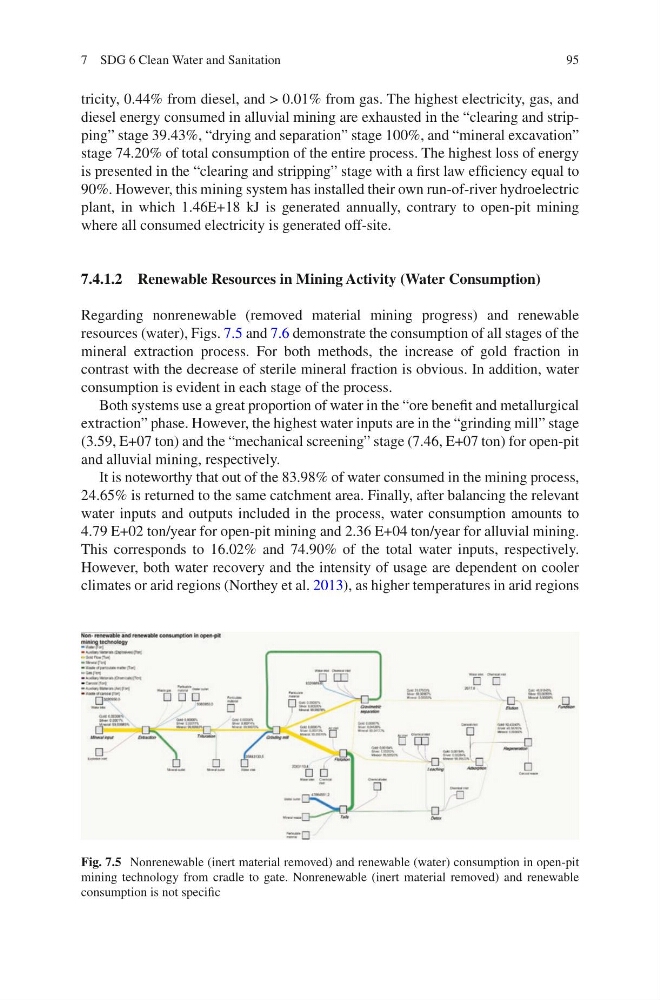
Regarding nonrenewable (removed material mining progress) and renewable
resources (water), Figs. 7.5 and 7.6 demonstrate the consumption of all stages of the
mineral extraction process. For both methods, the increase of gold fraction in
contrast with the decrease of sterile mineral fraction is obvious. In addition, water
consumption is evident in each stage of the process.
Both systems use a great proportion of water in the “ore benefit and metallurgical
extraction” phase. However, the highest water inputs are in the “grinding mill” stage
(3.59, E+07 ton) and the “mechanical screening” stage (7.46, E+07 ton) for open-pit
and alluvial mining, respectively.
It is noteworthy that out of the 83.98% of water consumed in the mining process,
24.65% is returned to the same catchment area. Finally, after balancing the relevant
water inputs and outputs included in the process, water consumption amounts to
4.79 E+02 ton/year for open-pit mining and 2.36 E+04 ton/year for alluvial mining.
This corresponds to 16.02% and 74.90% of the total water inputs, respectively.
However, both water recovery and the intensity of usage are dependent on cooler
climates or arid regions (Northey et al. 2013), as higher temperatures in arid regions
Fig. 7.5 Nonrenewable (inert material removed) and renewable (water) consumption in open-pit
mining technology from cradle to gate. Nonrenewable (inert material removed) and renewable
consumption is not specific
7 SDG 6 Clean Water and Sanitation
tricity, 0.44% from diesel, and > 0.01% from gas. The highest electricity, gas, and
diesel energy consumed in alluvial mining are exhausted in the “clearing and stripping” stage 39.43%, “drying and separation” stage 100%, and “mineral excavation”
stage 74.20% of total consumption of the entire process. The highest loss of energy
is presented in the “clearing and stripping” stage with a first law efficiency equal to
90%. However, this mining system has installed their own run- of- river hydroelectric
plant, in which 1.46E+18 kJ is generated annually, contrary to open-pit mining
where all consumed electricity is generated off-site.
7.4.1.2 Renewable Resources in Mining Activity (Water Consumption)
Regarding nonrenewable (removed material mining progress) and renewable
resources (water), Figs. 7.5 and 7.6 demonstrate the consumption of all stages of the
mineral extraction process. For both methods, the increase of gold fraction in
contrast with the decrease of sterile mineral fraction is obvious. In addition, water
consumption is evident in each stage of the process.
Both systems use a great proportion of water in the “ore benefit and metallurgical
extraction” phase. However, the highest water inputs are in the “grinding mill” stage
(3.59, E+07 ton) and the “mechanical screening” stage (7.46, E+07 ton) for open-pit
and alluvial mining, respectively.
It is noteworthy that out of the 83.98% of water consumed in the mining process,
24.65% is returned to the same catchment area. Finally, after balancing the relevant
water inputs and outputs included in the process, water consumption amounts to
4.79 E+02 ton/year for open-pit mining and 2.36 E+04 ton/year for alluvial mining.
This corresponds to 16.02% and 74.90% of the total water inputs, respectively.
However, both water recovery and the intensity of usage are dependent on cooler
climates or arid regions (Northey et al. 2013), as higher temperatures in arid regions
Fig. 7.5 Nonrenewable (inert material removed) and renewable (water) consumption in open-pit
mining technology from cradle to gate. Nonrenewable (inert material removed) and renewable
consumption is not specific
7 SDG 6 Clean Water and Sanitation