

3 Causes and Effects of Water Pollution in Romania
85
Agriculture leads to water pollution through three components: pastures, vegetable
and animal production. Diffuse pollution resulting from agricultural crops is mainly
caused by nutrients, heavy metals and salts from chemical fertilizers and organic
chemicals used to protect crops. Animal growth generates both increased amounts of
faeces, urine and grassland degradation through erosion processes, the main agents
threatening water quality are nutrients, often accompanied by heavy metals and
minerals, their environmental impact being very negative [16, 18, 23, 31, 137].
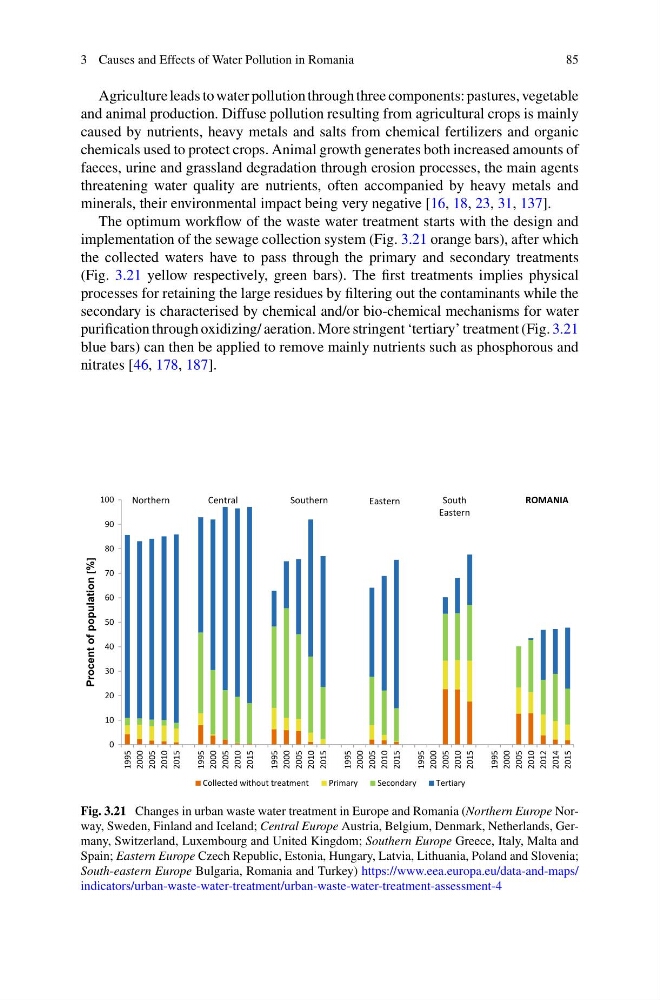
The optimum workflow of the waste water treatment starts with the design and
implementation of the sewage collection system (Fig. 3.21 orange bars), after which
the collected waters have to pass through the primary and secondary treatments
(Fig. 3.21 yellow respectively, green bars). The first treatments implies physical
processes for retaining the large residues by filtering out the contaminants while the
secondary is characterised by chemical and/or bio-chemical mechanisms for water
purification through oxidizing/ aeration. More stringent ‘tertiary’ treatment (Fig. 3.21
blue bars) can then be applied to remove mainly nutrients such as phosphorous and
nitrates [46, 178, 187].
0
10
20
30
40
50
60
70
80
90
100
1995
2000
2005
2010
2015
1995
2000
2005
2010
2015
1995
2000
2005
2010
2015
1995
2000
2005
2010
2015
1995
2000
2005
2010
2015
1995
2000
2005
2010
2012
2014
2015
Procent of population [%]
Collected without treatment
Primary
Secondary
Tertiary
Eastern
South
Southern
Central
Northern
Eastern
ROMANIA
Fig. 3.21 Changes in urban waste water treatment in Europe and Romania (Northern Europe Norway, Sweden, Finland and Iceland; Central Europe Austria, Belgium, Denmark, Netherlands, Germany, Switzerland, Luxembourg and United Kingdom; Southern Europe Greece, Italy, Malta and
Spain; Eastern Europe Czech Republic, Estonia, Hungary, Latvia, Lithuania, Poland and Slovenia;
South-eastern Europe Bulgaria, Romania and Turkey) https://www.eea.europa.eu/data-and-maps/
indicators/urban-waste-water-treatment/urban-waste-water-treatment-assessment-4
85
Agriculture leads to water pollution through three components: pastures, vegetable
and animal production. Diffuse pollution resulting from agricultural crops is mainly
caused by nutrients, heavy metals and salts from chemical fertilizers and organic
chemicals used to protect crops. Animal growth generates both increased amounts of
faeces, urine and grassland degradation through erosion processes, the main agents
threatening water quality are nutrients, often accompanied by heavy metals and
minerals, their environmental impact being very negative [16, 18, 23, 31, 137].
The optimum workflow of the waste water treatment starts with the design and
implementation of the sewage collection system (Fig. 3.21 orange bars), after which
the collected waters have to pass through the primary and secondary treatments
(Fig. 3.21 yellow respectively, green bars). The first treatments implies physical
processes for retaining the large residues by filtering out the contaminants while the
secondary is characterised by chemical and/or bio-chemical mechanisms for water
purification through oxidizing/ aeration. More stringent ‘tertiary’ treatment (Fig. 3.21
blue bars) can then be applied to remove mainly nutrients such as phosphorous and
nitrates [46, 178, 187].
0
10
20
30
40
50
60
70
80
90
100
1995
2000
2005
2010
2015
1995
2000
2005
2010
2015
1995
2000
2005
2010
2015
1995
2000
2005
2010
2015
1995
2000
2005
2010
2015
1995
2000
2005
2010
2012
2014
2015
Procent of population [%]
Collected without treatment
Primary
Secondary
Tertiary
Eastern
South
Southern
Central
Northern
Eastern
ROMANIA
Fig. 3.21 Changes in urban waste water treatment in Europe and Romania (Northern Europe Norway, Sweden, Finland and Iceland; Central Europe Austria, Belgium, Denmark, Netherlands, Germany, Switzerland, Luxembourg and United Kingdom; Southern Europe Greece, Italy, Malta and
Spain; Eastern Europe Czech Republic, Estonia, Hungary, Latvia, Lithuania, Poland and Slovenia;
South-eastern Europe Bulgaria, Romania and Turkey) https://www.eea.europa.eu/data-and-maps/
indicators/urban-waste-water-treatment/urban-waste-water-treatment-assessment-4