

84
I. G. Breaban and A. I. Breaban
3.3.1.2 Pathogens
Pathogens are microbes of very small size that cause diseases, bacteria, viruses, fungi
and parasites being the main representatives. Pathogenic contamination of water and
associated diseases is a major concern for water quality worldwide. Contaminant
infection is a serious problem for almost all types of water bodies, which makes
recognition and understanding essential [194].
Microbial contamination of water is often from feces related to humans
(wastewater treatment plants, non-collective sewage systems, combined wastewater overflow sewers), domestic animals (manure spreading, garbage overloading) or
wildlife [88].
The main origins of microbial contamination of natural aquatic resources are
discharges from water treatment plants, decontamination stations, hospitals, industries regarded as point sources, etc. On the other hand, diffuse sources (suspensions,
manure, and sludge) can also be considered. Two of the most known pathogenic
bacteria are coliform and E. coli bacteria. Coliforms are normally present in the
environment in safety rank and can actually be used to detect other pathogens in
water. If coliforms increase in number, become dangerous for the environmental
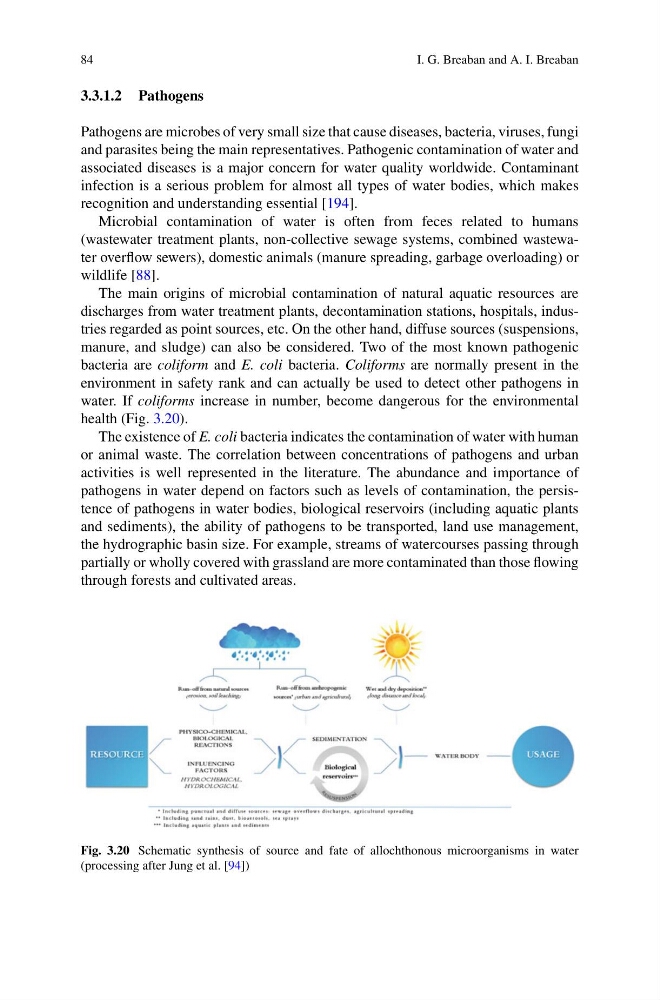
health (Fig. 3.20).
The existence of E. coli bacteria indicates the contamination of water with human
or animal waste. The correlation between concentrations of pathogens and urban
activities is well represented in the literature. The abundance and importance of
pathogens in water depend on factors such as levels of contamination, the persistence of pathogens in water bodies, biological reservoirs (including aquatic plants
and sediments), the ability of pathogens to be transported, land use management,
the hydrographic basin size. For example, streams of watercourses passing through
partially or wholly covered with grassland are more contaminated than those flowing
through forests and cultivated areas.
Fig. 3.20 Schematic synthesis of source and fate of allochthonous microorganisms in water
(processing after Jung et al. [94])
I. G. Breaban and A. I. Breaban
3.3.1.2 Pathogens
Pathogens are microbes of very small size that cause diseases, bacteria, viruses, fungi
and parasites being the main representatives. Pathogenic contamination of water and
associated diseases is a major concern for water quality worldwide. Contaminant
infection is a serious problem for almost all types of water bodies, which makes
recognition and understanding essential [194].
Microbial contamination of water is often from feces related to humans
(wastewater treatment plants, non-collective sewage systems, combined wastewater overflow sewers), domestic animals (manure spreading, garbage overloading) or
wildlife [88].
The main origins of microbial contamination of natural aquatic resources are
discharges from water treatment plants, decontamination stations, hospitals, industries regarded as point sources, etc. On the other hand, diffuse sources (suspensions,
manure, and sludge) can also be considered. Two of the most known pathogenic
bacteria are coliform and E. coli bacteria. Coliforms are normally present in the
environment in safety rank and can actually be used to detect other pathogens in
water. If coliforms increase in number, become dangerous for the environmental
health (Fig. 3.20).
The existence of E. coli bacteria indicates the contamination of water with human
or animal waste. The correlation between concentrations of pathogens and urban
activities is well represented in the literature. The abundance and importance of
pathogens in water depend on factors such as levels of contamination, the persistence of pathogens in water bodies, biological reservoirs (including aquatic plants
and sediments), the ability of pathogens to be transported, land use management,
the hydrographic basin size. For example, streams of watercourses passing through
partially or wholly covered with grassland are more contaminated than those flowing
through forests and cultivated areas.
Fig. 3.20 Schematic synthesis of source and fate of allochthonous microorganisms in water
(processing after Jung et al. [94])