

3 Causes and Effects of Water Pollution in Romania
69
(1) high; (2) good; (3) moderate; (4) poor and (5) bad. For classes 3–5 imposing
actions are mandatory to improve the state to what is stipulated by WFD.
In WFD, heavily modified and artificial waters differ from natural water bodies; those in the first category either have been artificially created or have undergone
changes to a level that no longer allows for a “good environmental status” without significantly affecting the use of those waters. In this case, the environmental objective
of a “good environmental potential” requires improvements in hydromorphological
pressures without affecting the use of non-substitutable water.
Another component of the WFD objective, “good chemical status”, applies to
all types of water bodies (natural, artificial and heavily modified), being determined
by compliance with environmental quality standards for a series of pollutants with
significant impact at European level. Moreover, along with BQE, QE are assessed:
River Basin Pollutants (RBSP), Physical-Chemical QE (temperature, oxygen, pH,
nutrient conditions) and Hydrological QE. These supplementary QEs are classified
as “good” or “less good”, according to well-defined limits that have been defined for
most of these QEs for different types of water bodies in each water category. The
requirements for obtaining a “good environmental status” are:
(i) that all BQEs must achieve “good status” (Class 2 or better);
(ii) all (“good”) quality values should not be exceeded; and
(iii) for other physicochemical substances, support for QE and hydromorphology
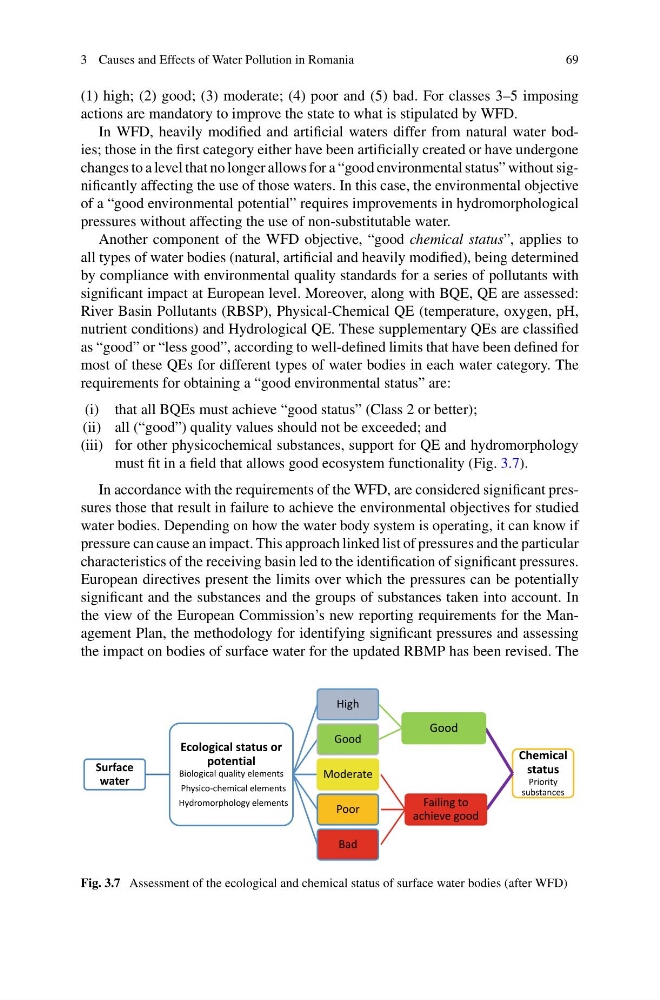
must fit in a field that allows good ecosystem functionality (Fig. 3.7).
In accordance with the requirements of the WFD, are considered significant pressures those that result in failure to achieve the environmental objectives for studied
water bodies. Depending on how the water body system is operating, it can know if
pressure can cause an impact. This approach linked list of pressures and the particular
characteristics of the receiving basin led to the identification of significant pressures.
European directives present the limits over which the pressures can be potentially
significant and the substances and the groups of substances taken into account. In
the view of the European Commission’s new reporting requirements for the Management Plan, the methodology for identifying significant pressures and assessing
the impact on bodies of surface water for the updated RBMP has been revised. The
Surface
water
Ecological status or
potential
Biological quality elements
Physico-chemical elements
Hydromorphology elements
High
Good
Moderate
Poor
Bad
Chemical
status
Priority
substances
Good
Failing to
achieve good
Fig. 3.7 Assessment of the ecological and chemical status of surface water bodies (after WFD)
69
(1) high; (2) good; (3) moderate; (4) poor and (5) bad. For classes 3–5 imposing
actions are mandatory to improve the state to what is stipulated by WFD.
In WFD, heavily modified and artificial waters differ from natural water bodies; those in the first category either have been artificially created or have undergone
changes to a level that no longer allows for a “good environmental status” without significantly affecting the use of those waters. In this case, the environmental objective
of a “good environmental potential” requires improvements in hydromorphological
pressures without affecting the use of non-substitutable water.
Another component of the WFD objective, “good chemical status”, applies to
all types of water bodies (natural, artificial and heavily modified), being determined
by compliance with environmental quality standards for a series of pollutants with
significant impact at European level. Moreover, along with BQE, QE are assessed:
River Basin Pollutants (RBSP), Physical-Chemical QE (temperature, oxygen, pH,
nutrient conditions) and Hydrological QE. These supplementary QEs are classified
as “good” or “less good”, according to well-defined limits that have been defined for
most of these QEs for different types of water bodies in each water category. The
requirements for obtaining a “good environmental status” are:
(i) that all BQEs must achieve “good status” (Class 2 or better);
(ii) all (“good”) quality values should not be exceeded; and
(iii) for other physicochemical substances, support for QE and hydromorphology
must fit in a field that allows good ecosystem functionality (Fig. 3.7).
In accordance with the requirements of the WFD, are considered significant pressures those that result in failure to achieve the environmental objectives for studied
water bodies. Depending on how the water body system is operating, it can know if
pressure can cause an impact. This approach linked list of pressures and the particular
characteristics of the receiving basin led to the identification of significant pressures.
European directives present the limits over which the pressures can be potentially
significant and the substances and the groups of substances taken into account. In
the view of the European Commission’s new reporting requirements for the Management Plan, the methodology for identifying significant pressures and assessing
the impact on bodies of surface water for the updated RBMP has been revised. The
Surface
water
Ecological status or
potential
Biological quality elements
Physico-chemical elements
Hydromorphology elements
High
Good
Moderate
Poor
Bad
Chemical
status
Priority
substances
Good
Failing to
achieve good
Fig. 3.7 Assessment of the ecological and chemical status of surface water bodies (after WFD)