

16 Water Resources from Apuseni Mountains …
531
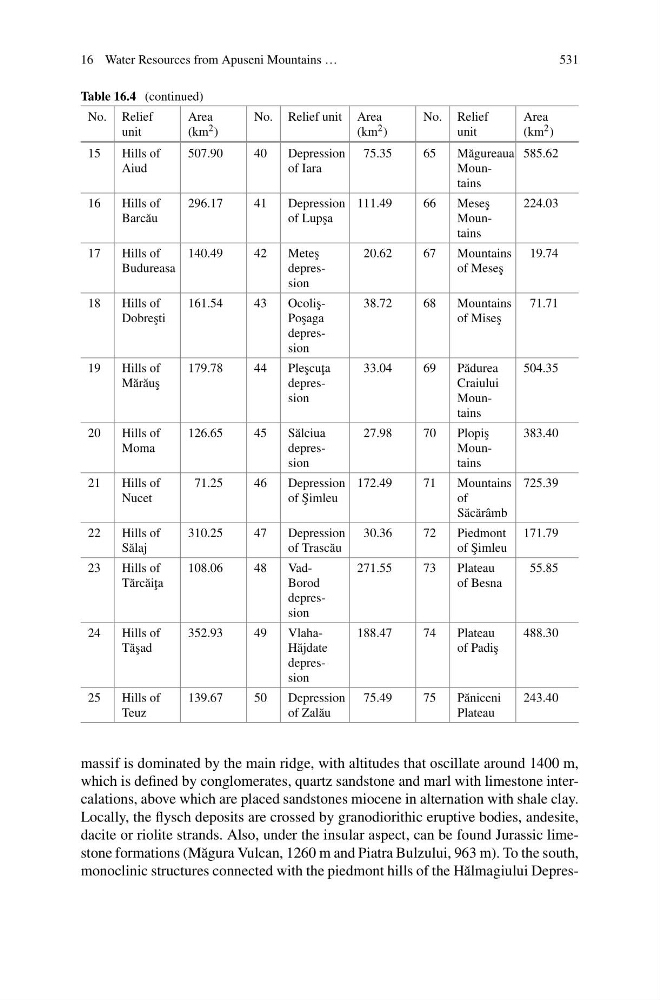
Table 16.4 (continued)
No. Relief
unit
Area
(km 2 )
No. Relief unit Area
(km 2 )
No. Relief
unit
Area
(km 2 )
15
Hills of
Aiud
507.90
40
Depression
of Iara
75.35
65
M˘ agureaua
Mountains
585.62
16
Hills of
Barc˘ au
296.17
41
Depression
of Lup¸ sa
111.49
66
Mese¸ s
Mountains
224.03
17
Hills of
Budureasa
140.49
42
Mete¸ s
depression
20.62
67
Mountains
of Mese¸ s
19.74
18
Hills of
Dobre¸ sti
161.54
43
Ocoli¸ sPo¸ saga
depression
38.72
68
Mountains
of Mise¸ s
71.71
19
Hills of
M˘ ar˘ au¸ s
179.78
44
Ple¸ scu¸ ta
depression
33.04
69
P˘ adurea
Craiului
Mountains
504.35
20
Hills of
Moma
126.65
45
S˘ alciua
depression
27.98
70
Plopi¸ s
Mountains
383.40
21
Hills of
Nucet
71.25
46
Depression
of ¸
Simleu
172.49
71
Mountains
of
S˘ ac˘ arâmb
725.39
22
Hills of
S˘ alaj
310.25
47
Depression
of Trasc˘ au
30.36
72
Piedmont
of ¸
Simleu
171.79
23
Hills of
T˘ arc˘ ai¸ ta
108.06
48
VadBorod
depression
271.55
73
Plateau
of Besna
55.85
24
Hills of
T˘ a¸ sad
352.93
49
VlahaH˘ ajdate
depression
188.47
74
Plateau
of Padi¸ s
488.30
25
Hills of
Teuz
139.67
50
Depression
of Zal˘ au
75.49
75
P˘ aniceni
Plateau
243.40
massif is dominated by the main ridge, with altitudes that oscillate around 1400 m,
which is defined by conglomerates, quartz sandstone and marl with limestone intercalations, above which are placed sandstones miocene in alternation with shale clay.
Locally, the flysch deposits are crossed by granodiorithic eruptive bodies, andesite,
dacite or riolite strands. Also, under the insular aspect, can be found Jurassic limestone formations (M˘ agura Vulcan, 1260 m and Piatra Bulzului, 963 m). To the south,
monoclinic structures connected with the piedmont hills of the H˘ almagiului Depres-
531
Table 16.4 (continued)
No. Relief
unit
Area
(km 2 )
No. Relief unit Area
(km 2 )
No. Relief
unit
Area
(km 2 )
15
Hills of
Aiud
507.90
40
Depression
of Iara
75.35
65
M˘ agureaua
Mountains
585.62
16
Hills of
Barc˘ au
296.17
41
Depression
of Lup¸ sa
111.49
66
Mese¸ s
Mountains
224.03
17
Hills of
Budureasa
140.49
42
Mete¸ s
depression
20.62
67
Mountains
of Mese¸ s
19.74
18
Hills of
Dobre¸ sti
161.54
43
Ocoli¸ sPo¸ saga
depression
38.72
68
Mountains
of Mise¸ s
71.71
19
Hills of
M˘ ar˘ au¸ s
179.78
44
Ple¸ scu¸ ta
depression
33.04
69
P˘ adurea
Craiului
Mountains
504.35
20
Hills of
Moma
126.65
45
S˘ alciua
depression
27.98
70
Plopi¸ s
Mountains
383.40
21
Hills of
Nucet
71.25
46
Depression
of ¸
Simleu
172.49
71
Mountains
of
S˘ ac˘ arâmb
725.39
22
Hills of
S˘ alaj
310.25
47
Depression
of Trasc˘ au
30.36
72
Piedmont
of ¸
Simleu
171.79
23
Hills of
T˘ arc˘ ai¸ ta
108.06
48
VadBorod
depression
271.55
73
Plateau
of Besna
55.85
24
Hills of
T˘ a¸ sad
352.93
49
VlahaH˘ ajdate
depression
188.47
74
Plateau
of Padi¸ s
488.30
25
Hills of
Teuz
139.67
50
Depression
of Zal˘ au
75.49
75
P˘ aniceni
Plateau
243.40
massif is dominated by the main ridge, with altitudes that oscillate around 1400 m,
which is defined by conglomerates, quartz sandstone and marl with limestone intercalations, above which are placed sandstones miocene in alternation with shale clay.
Locally, the flysch deposits are crossed by granodiorithic eruptive bodies, andesite,
dacite or riolite strands. Also, under the insular aspect, can be found Jurassic limestone formations (M˘ agura Vulcan, 1260 m and Piatra Bulzului, 963 m). To the south,
monoclinic structures connected with the piedmont hills of the H˘ almagiului Depres-