

14 Assessment of Some Diurnal Streamwater Profiles in Western …
469
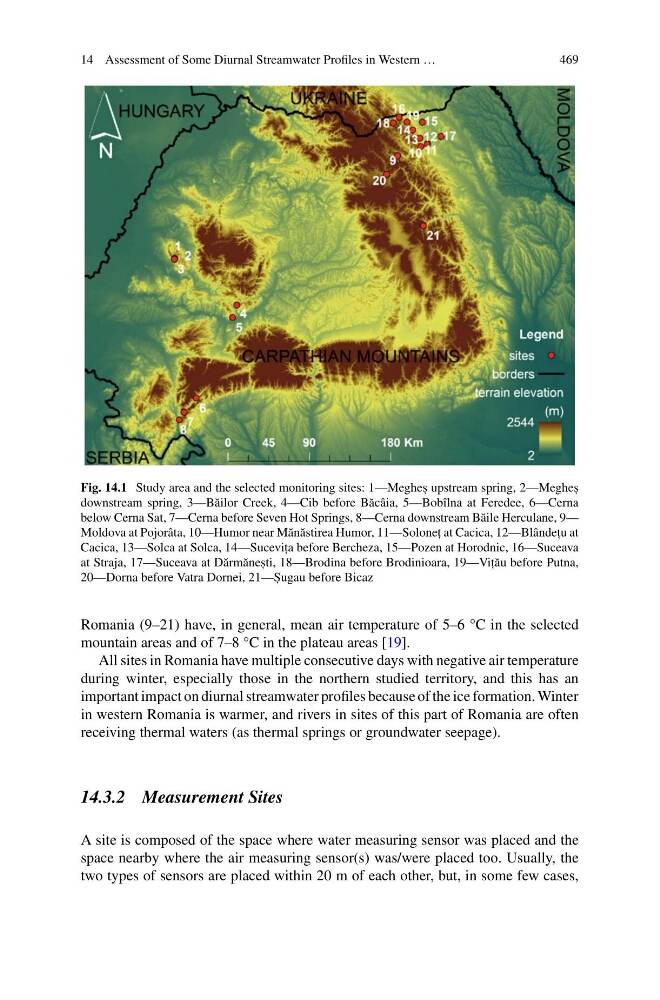
Fig. 14.1 Study area and the selected monitoring sites: 1—Meghes , upstream spring, 2—Meghes ,
downstream spring, 3—B˘ ailor Creek, 4—Cib before B˘ acâia, 5—Bobîlna at Feredee, 6—Cerna
below Cerna Sat, 7—Cerna before Seven Hot Springs, 8—Cerna downstream B˘ aile Herculane, 9—
Moldova at Pojorâta, 10—Humor near M˘ an˘ astirea Humor, 11—Solonet , at Cacica, 12—Blândet , u at
Cacica, 13—Solca at Solca, 14—Sucevit , a before Bercheza, 15—Pozen at Horodnic, 16—Suceava
at Straja, 17—Suceava at D˘ arm˘ anes , ti, 18—Brodina before Brodinioara, 19—Vit , ˘
au before Putna,
20—Dorna before Vatra Dornei, 21—S , ugau before Bicaz
Romania (9–21) have, in general, mean air temperature of 5–6 °C in the selected
mountain areas and of 7–8 °C in the plateau areas [19].
All sites in Romania have multiple consecutive days with negative air temperature
during winter, especially those in the northern studied territory, and this has an
important impact on diurnal streamwater profiles because of the ice formation. Winter
in western Romania is warmer, and rivers in sites of this part of Romania are often
receiving thermal waters (as thermal springs or groundwater seepage).
14.3.2 Measurement Sites
A site is composed of the space where water measuring sensor was placed and the
space nearby where the air measuring sensor(s) was/were placed too. Usually, the
two types of sensors are placed within 20 m of each other, but, in some few cases,
469
Fig. 14.1 Study area and the selected monitoring sites: 1—Meghes , upstream spring, 2—Meghes ,
downstream spring, 3—B˘ ailor Creek, 4—Cib before B˘ acâia, 5—Bobîlna at Feredee, 6—Cerna
below Cerna Sat, 7—Cerna before Seven Hot Springs, 8—Cerna downstream B˘ aile Herculane, 9—
Moldova at Pojorâta, 10—Humor near M˘ an˘ astirea Humor, 11—Solonet , at Cacica, 12—Blândet , u at
Cacica, 13—Solca at Solca, 14—Sucevit , a before Bercheza, 15—Pozen at Horodnic, 16—Suceava
at Straja, 17—Suceava at D˘ arm˘ anes , ti, 18—Brodina before Brodinioara, 19—Vit , ˘
au before Putna,
20—Dorna before Vatra Dornei, 21—S , ugau before Bicaz
Romania (9–21) have, in general, mean air temperature of 5–6 °C in the selected
mountain areas and of 7–8 °C in the plateau areas [19].
All sites in Romania have multiple consecutive days with negative air temperature
during winter, especially those in the northern studied territory, and this has an
important impact on diurnal streamwater profiles because of the ice formation. Winter
in western Romania is warmer, and rivers in sites of this part of Romania are often
receiving thermal waters (as thermal springs or groundwater seepage).
14.3.2 Measurement Sites
A site is composed of the space where water measuring sensor was placed and the
space nearby where the air measuring sensor(s) was/were placed too. Usually, the
two types of sensors are placed within 20 m of each other, but, in some few cases,