

13 Particularities of Drain Liquid in the Small Wetland of Braila …
455
expected to be far-reaching—for example, biodiversity loss for species, habitats, and
functions of ecosystems and services.
In this context, given the hydrological regime and the physical-geographic characteristics of the studied area, it was desired to identify water reservoirs capable of
storing a significant volume of water that could be used in extinguishing vegetation fires. Choosing the locations of the reservoirs necessary for the extinction of
the vegetation fire has taken into account the physical-geographical features of the
terrain (the type of combustible forest material, the type of soil, the position of the
underground waters, the direction of their flow as well as the position of the surface
water, the slope, the access paths and the restrictions given by the fact that the studied
area has been declared a Natural Park) [51, 52].
13.4.1 Distance to Roads and Accessibility
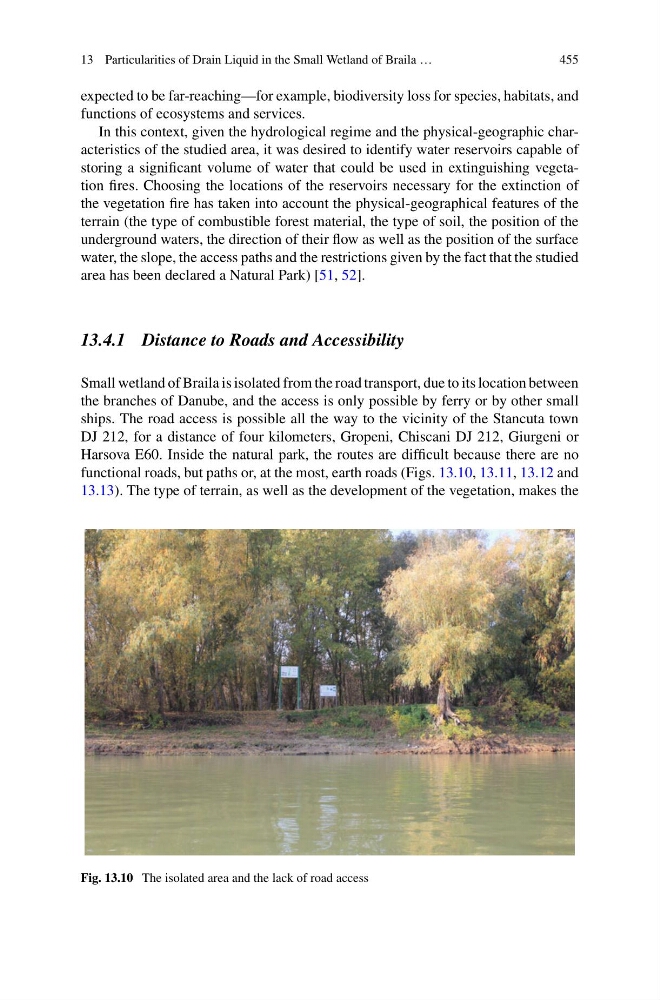
Small wetland of Braila is isolated from the road transport, due to its location between
the branches of Danube, and the access is only possible by ferry or by other small
ships. The road access is possible all the way to the vicinity of the Stancuta town
DJ 212, for a distance of four kilometers, Gropeni, Chiscani DJ 212, Giurgeni or
Harsova E60. Inside the natural park, the routes are difficult because there are no
functional roads, but paths or, at the most, earth roads (Figs. 13.10, 13.11, 13.12 and
13.13). The type of terrain, as well as the development of the vegetation, makes the
Fig. 13.10 The isolated area and the lack of road access
455
expected to be far-reaching—for example, biodiversity loss for species, habitats, and
functions of ecosystems and services.
In this context, given the hydrological regime and the physical-geographic characteristics of the studied area, it was desired to identify water reservoirs capable of
storing a significant volume of water that could be used in extinguishing vegetation fires. Choosing the locations of the reservoirs necessary for the extinction of
the vegetation fire has taken into account the physical-geographical features of the
terrain (the type of combustible forest material, the type of soil, the position of the
underground waters, the direction of their flow as well as the position of the surface
water, the slope, the access paths and the restrictions given by the fact that the studied
area has been declared a Natural Park) [51, 52].
13.4.1 Distance to Roads and Accessibility
Small wetland of Braila is isolated from the road transport, due to its location between
the branches of Danube, and the access is only possible by ferry or by other small
ships. The road access is possible all the way to the vicinity of the Stancuta town
DJ 212, for a distance of four kilometers, Gropeni, Chiscani DJ 212, Giurgeni or
Harsova E60. Inside the natural park, the routes are difficult because there are no
functional roads, but paths or, at the most, earth roads (Figs. 13.10, 13.11, 13.12 and
13.13). The type of terrain, as well as the development of the vegetation, makes the
Fig. 13.10 The isolated area and the lack of road access