

316
L. Zaharia et al.
temperature during 1981–2013 when compared to the reference period 1961–1990,
were noticed in January–February (1 °C) and in June–August (0.9–1.2 °C), while in
autumn months and in December, the modifications were statistically not significant
[127] (Fig. 10.2b). The warming tendencies were confirmed by the trends in the
annual thermal extremes, in the number of summer days, as well as by other thermal
indices, a warming signal being consistent throughout the country. These results are
consistent with those found by Busuioc et al. [123] for the period 1961–2010, which
detected significant increasing trends for the temperature extremes in all seasons,
except for autumn, with the highest increasing rate in summer and the lowest in
spring.
In the Carpathian area, general warming was detected, proved by positive trends in
warm-related indices and negative trends in cold-related indices. Significant positive
trends of air temperature were detected in all seasons, except for autumn which seems
to be thermally stable [124–126, 130].
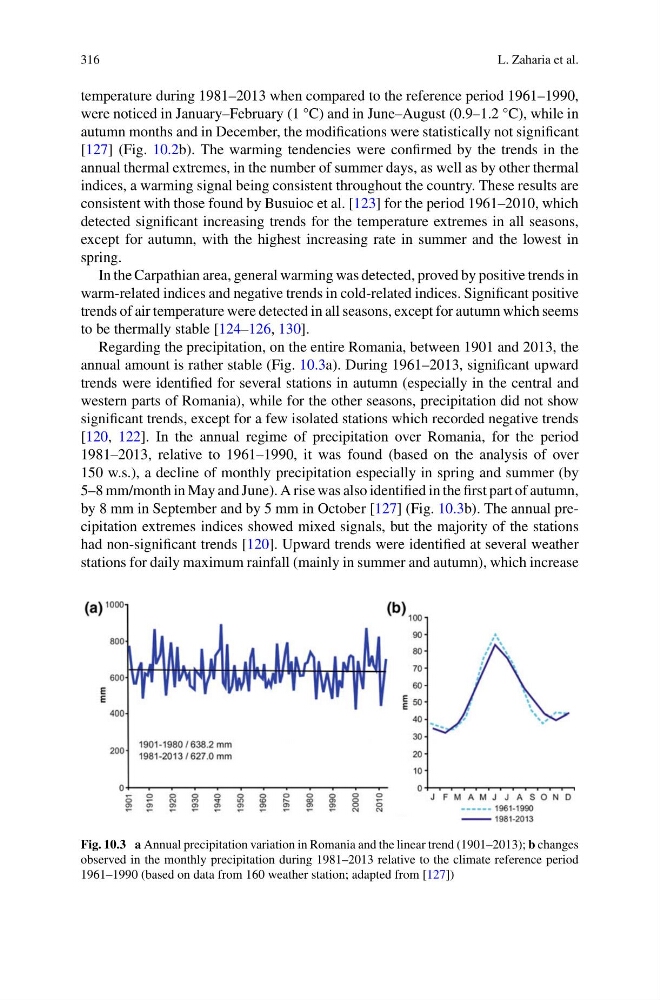
Regarding the precipitation, on the entire Romania, between 1901 and 2013, the
annual amount is rather stable (Fig. 10.3a). During 1961–2013, significant upward
trends were identified for several stations in autumn (especially in the central and
western parts of Romania), while for the other seasons, precipitation did not show
significant trends, except for a few isolated stations which recorded negative trends
[120, 122]. In the annual regime of precipitation over Romania, for the period
1981–2013, relative to 1961–1990, it was found (based on the analysis of over
150 w.s.), a decline of monthly precipitation especially in spring and summer (by
5–8 mm/month in May and June). A rise was also identified in the first part of autumn,
by 8 mm in September and by 5 mm in October [127] (Fig. 10.3b). The annual precipitation extremes indices showed mixed signals, but the majority of the stations
had non-significant trends [120]. Upward trends were identified at several weather
stations for daily maximum rainfall (mainly in summer and autumn), which increase
Fig. 10.3 a Annual precipitation variation in Romania and the linear trend (1901–2013); b changes
observed in the monthly precipitation during 1981–2013 relative to the climate reference period
1961–1990 (based on data from 160 weather station; adapted from [127])
L. Zaharia et al.
temperature during 1981–2013 when compared to the reference period 1961–1990,
were noticed in January–February (1 °C) and in June–August (0.9–1.2 °C), while in
autumn months and in December, the modifications were statistically not significant
[127] (Fig. 10.2b). The warming tendencies were confirmed by the trends in the
annual thermal extremes, in the number of summer days, as well as by other thermal
indices, a warming signal being consistent throughout the country. These results are
consistent with those found by Busuioc et al. [123] for the period 1961–2010, which
detected significant increasing trends for the temperature extremes in all seasons,
except for autumn, with the highest increasing rate in summer and the lowest in
spring.
In the Carpathian area, general warming was detected, proved by positive trends in
warm-related indices and negative trends in cold-related indices. Significant positive
trends of air temperature were detected in all seasons, except for autumn which seems
to be thermally stable [124–126, 130].
Regarding the precipitation, on the entire Romania, between 1901 and 2013, the
annual amount is rather stable (Fig. 10.3a). During 1961–2013, significant upward
trends were identified for several stations in autumn (especially in the central and
western parts of Romania), while for the other seasons, precipitation did not show
significant trends, except for a few isolated stations which recorded negative trends
[120, 122]. In the annual regime of precipitation over Romania, for the period
1981–2013, relative to 1961–1990, it was found (based on the analysis of over
150 w.s.), a decline of monthly precipitation especially in spring and summer (by
5–8 mm/month in May and June). A rise was also identified in the first part of autumn,
by 8 mm in September and by 5 mm in October [127] (Fig. 10.3b). The annual precipitation extremes indices showed mixed signals, but the majority of the stations
had non-significant trends [120]. Upward trends were identified at several weather
stations for daily maximum rainfall (mainly in summer and autumn), which increase
Fig. 10.3 a Annual precipitation variation in Romania and the linear trend (1901–2013); b changes
observed in the monthly precipitation during 1981–2013 relative to the climate reference period
1961–1990 (based on data from 160 weather station; adapted from [127])