

8 Romanian Danube River Floodplain …
253
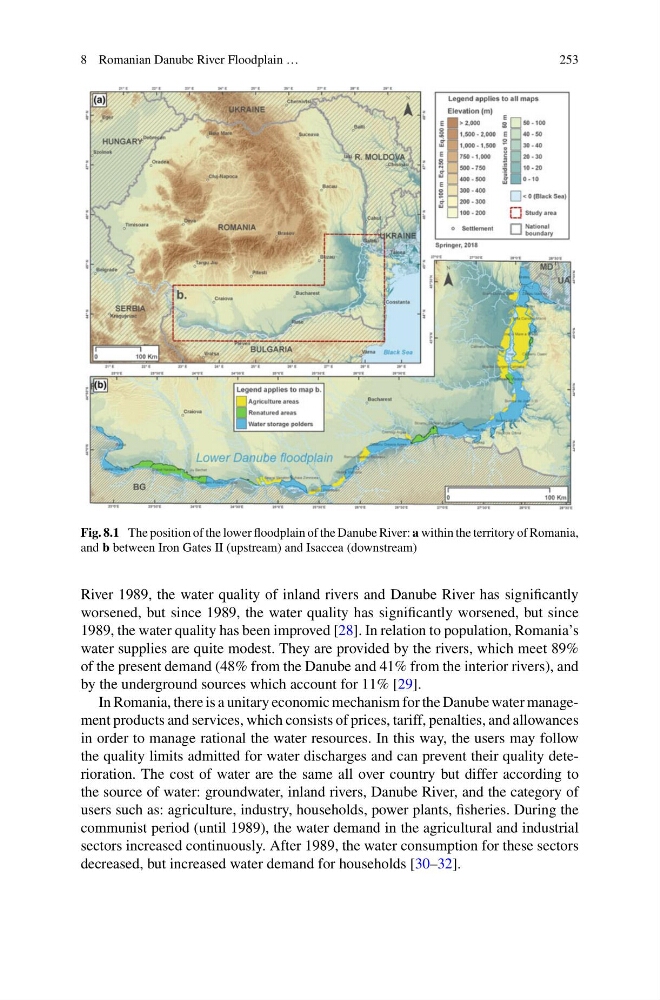
Fig. 8.1 The position of the lower floodplain of the Danube River: a within the territory of Romania,
and b between Iron Gates II (upstream) and Isaccea (downstream)
River 1989, the water quality of inland rivers and Danube River has significantly
worsened, but since 1989, the water quality has significantly worsened, but since
1989, the water quality has been improved [28]. In relation to population, Romania’s
water supplies are quite modest. They are provided by the rivers, which meet 89%
of the present demand (48% from the Danube and 41% from the interior rivers), and
by the underground sources which account for 11% [29].
In Romania, there is a unitary economic mechanism for the Danube water management products and services, which consists of prices, tariff, penalties, and allowances
in order to manage rational the water resources. In this way, the users may follow
the quality limits admitted for water discharges and can prevent their quality deterioration. The cost of water are the same all over country but differ according to
the source of water: groundwater, inland rivers, Danube River, and the category of
users such as: agriculture, industry, households, power plants, fisheries. During the
communist period (until 1989), the water demand in the agricultural and industrial
sectors increased continuously. After 1989, the water consumption for these sectors
decreased, but increased water demand for households [30–32].
253
Fig. 8.1 The position of the lower floodplain of the Danube River: a within the territory of Romania,
and b between Iron Gates II (upstream) and Isaccea (downstream)
River 1989, the water quality of inland rivers and Danube River has significantly
worsened, but since 1989, the water quality has significantly worsened, but since
1989, the water quality has been improved [28]. In relation to population, Romania’s
water supplies are quite modest. They are provided by the rivers, which meet 89%
of the present demand (48% from the Danube and 41% from the interior rivers), and
by the underground sources which account for 11% [29].
In Romania, there is a unitary economic mechanism for the Danube water management products and services, which consists of prices, tariff, penalties, and allowances
in order to manage rational the water resources. In this way, the users may follow
the quality limits admitted for water discharges and can prevent their quality deterioration. The cost of water are the same all over country but differ according to
the source of water: groundwater, inland rivers, Danube River, and the category of
users such as: agriculture, industry, households, power plants, fisheries. During the
communist period (until 1989), the water demand in the agricultural and industrial
sectors increased continuously. After 1989, the water consumption for these sectors
decreased, but increased water demand for households [30–32].