

6 Drinking Water Supply Systems—Evolution Towards Efficiency
201
– supplying drinking water at high-rise residential buildings especially in some
newly built districts of Cluj-Napoca;
– building new water main for pressure balancing, 5 km long and 1400 mm diameter;
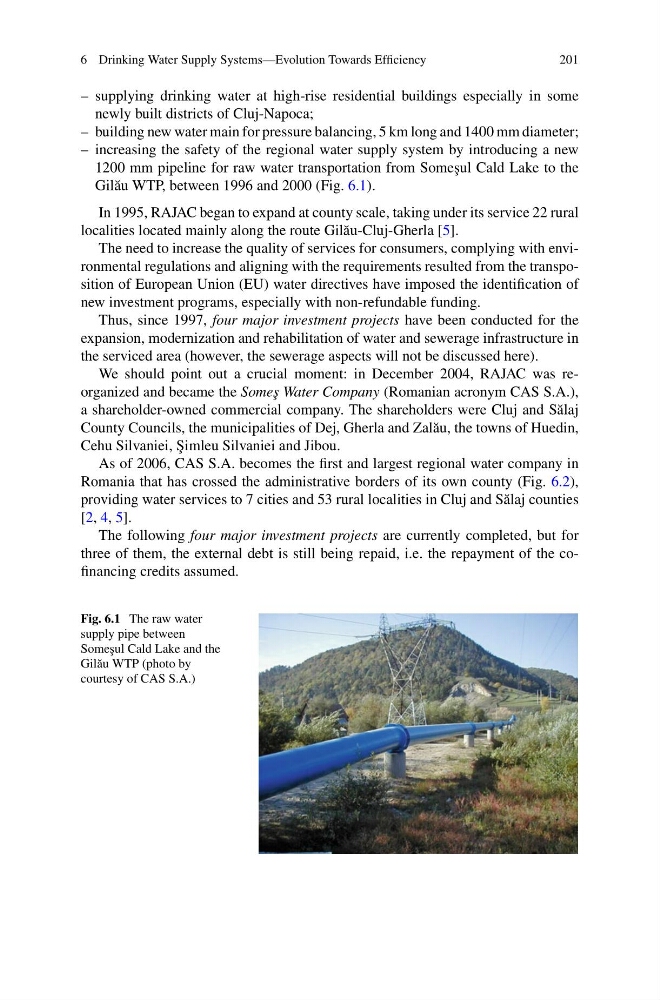
– increasing the safety of the regional water supply system by introducing a new
1200 mm pipeline for raw water transportation from Some¸ sul Cald Lake to the
Gil˘ au WTP, between 1996 and 2000 (Fig. 6.1).
In 1995, RAJAC began to expand at county scale, taking under its service 22 rural
localities located mainly along the route Gil˘ au-Cluj-Gherla [5].
The need to increase the quality of services for consumers, complying with environmental regulations and aligning with the requirements resulted from the transposition of European Union (EU) water directives have imposed the identification of
new investment programs, especially with non-refundable funding.
Thus, since 1997, four major investment projects have been conducted for the
expansion, modernization and rehabilitation of water and sewerage infrastructure in
the serviced area (however, the sewerage aspects will not be discussed here).
We should point out a crucial moment: in December 2004, RAJAC was reorganized and became the Some¸ s Water Company (Romanian acronym CAS S.A.),
a shareholder-owned commercial company. The shareholders were Cluj and S˘ alaj
County Councils, the municipalities of Dej, Gherla and Zal˘ au, the towns of Huedin,
Cehu Silvaniei, ¸
Simleu Silvaniei and Jibou.
As of 2006, CAS S.A. becomes the first and largest regional water company in
Romania that has crossed the administrative borders of its own county (Fig. 6.2),
providing water services to 7 cities and 53 rural localities in Cluj and S˘ alaj counties
[2, 4, 5].
The following four major investment projects are currently completed, but for
three of them, the external debt is still being repaid, i.e. the repayment of the cofinancing credits assumed.
Fig. 6.1 The raw water
supply pipe between
Some¸ sul Cald Lake and the
Gil˘ au WTP (photo by
courtesy of CAS S.A.)
201
– supplying drinking water at high-rise residential buildings especially in some
newly built districts of Cluj-Napoca;
– building new water main for pressure balancing, 5 km long and 1400 mm diameter;
– increasing the safety of the regional water supply system by introducing a new
1200 mm pipeline for raw water transportation from Some¸ sul Cald Lake to the
Gil˘ au WTP, between 1996 and 2000 (Fig. 6.1).
In 1995, RAJAC began to expand at county scale, taking under its service 22 rural
localities located mainly along the route Gil˘ au-Cluj-Gherla [5].
The need to increase the quality of services for consumers, complying with environmental regulations and aligning with the requirements resulted from the transposition of European Union (EU) water directives have imposed the identification of
new investment programs, especially with non-refundable funding.
Thus, since 1997, four major investment projects have been conducted for the
expansion, modernization and rehabilitation of water and sewerage infrastructure in
the serviced area (however, the sewerage aspects will not be discussed here).
We should point out a crucial moment: in December 2004, RAJAC was reorganized and became the Some¸ s Water Company (Romanian acronym CAS S.A.),
a shareholder-owned commercial company. The shareholders were Cluj and S˘ alaj
County Councils, the municipalities of Dej, Gherla and Zal˘ au, the towns of Huedin,
Cehu Silvaniei, ¸
Simleu Silvaniei and Jibou.
As of 2006, CAS S.A. becomes the first and largest regional water company in
Romania that has crossed the administrative borders of its own county (Fig. 6.2),
providing water services to 7 cities and 53 rural localities in Cluj and S˘ alaj counties
[2, 4, 5].
The following four major investment projects are currently completed, but for
three of them, the external debt is still being repaid, i.e. the repayment of the cofinancing credits assumed.
Fig. 6.1 The raw water
supply pipe between
Some¸ sul Cald Lake and the
Gil˘ au WTP (photo by
courtesy of CAS S.A.)