

60
the conservation of ecosystems and resulting social benefits of SES; these practices
are currently emerging in Europe (the EU Water Framework Directive), in England
and Wales (Abstraction Management Strategies), and in some parts of America
(Hiscock et al. 2002; Wang and Wu 2006).
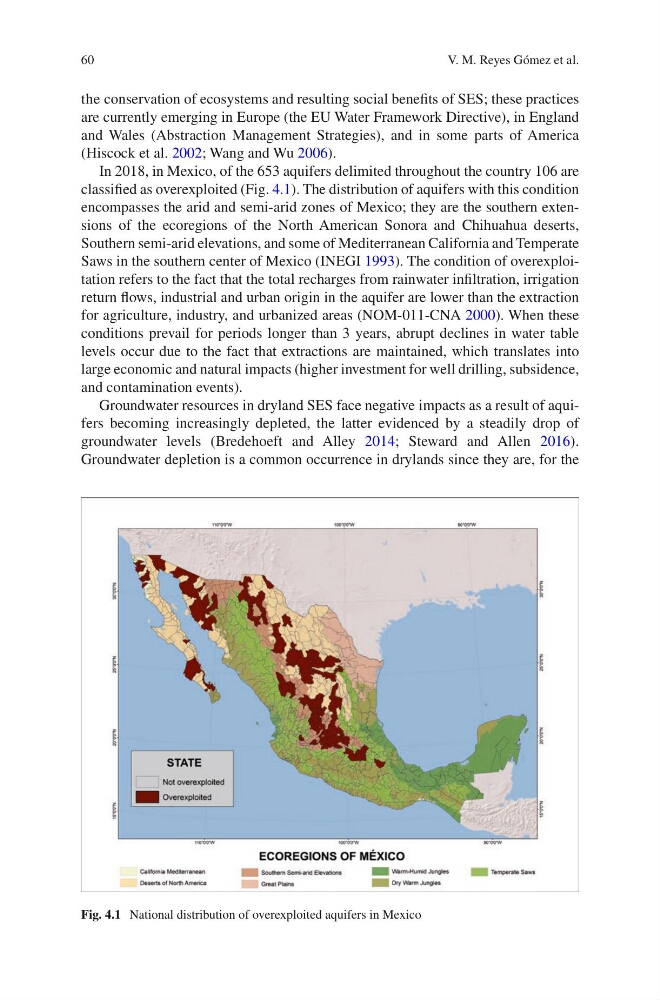
In 2018, in Mexico, of the 653 aquifers delimited throughout the country 106 are
classified as overexploited (Fig. 4.1). The distribution of aquifers with this condition
encompasses the arid and semi-arid zones of Mexico; they are the southern extensions of the ecoregions of the North American Sonora and Chihuahua deserts,
Southern semi-arid elevations, and some of Mediterranean California and Temperate
Saws in the southern center of Mexico (INEGI 1993). The condition of overexploitation refers to the fact that the total recharges from rainwater infiltration, irrigation
return flows, industrial and urban origin in the aquifer are lower than the extraction
for agriculture, industry, and urbanized areas (NOM-011-CNA 2000). When these
conditions prevail for periods longer than 3 years, abrupt declines in water table
levels occur due to the fact that extractions are maintained, which translates into
large economic and natural impacts (higher investment for well drilling, subsidence,
and contamination events).
Groundwater resources in dryland SES face negative impacts as a result of aquifers becoming increasingly depleted, the latter evidenced by a steadily drop of
groundwater levels (Bredehoeft and Alley 2014; Steward and Allen 2016).
Groundwater depletion is a common occurrence in drylands since they are, for the
Fig. 4.1 National distribution of overexploited aquifers in Mexico
V. M. Reyes Gómez et al.
the conservation of ecosystems and resulting social benefits of SES; these practices
are currently emerging in Europe (the EU Water Framework Directive), in England
and Wales (Abstraction Management Strategies), and in some parts of America
(Hiscock et al. 2002; Wang and Wu 2006).
In 2018, in Mexico, of the 653 aquifers delimited throughout the country 106 are
classified as overexploited (Fig. 4.1). The distribution of aquifers with this condition
encompasses the arid and semi-arid zones of Mexico; they are the southern extensions of the ecoregions of the North American Sonora and Chihuahua deserts,
Southern semi-arid elevations, and some of Mediterranean California and Temperate
Saws in the southern center of Mexico (INEGI 1993). The condition of overexploitation refers to the fact that the total recharges from rainwater infiltration, irrigation
return flows, industrial and urban origin in the aquifer are lower than the extraction
for agriculture, industry, and urbanized areas (NOM-011-CNA 2000). When these
conditions prevail for periods longer than 3 years, abrupt declines in water table
levels occur due to the fact that extractions are maintained, which translates into
large economic and natural impacts (higher investment for well drilling, subsidence,
and contamination events).
Groundwater resources in dryland SES face negative impacts as a result of aquifers becoming increasingly depleted, the latter evidenced by a steadily drop of
groundwater levels (Bredehoeft and Alley 2014; Steward and Allen 2016).
Groundwater depletion is a common occurrence in drylands since they are, for the
Fig. 4.1 National distribution of overexploited aquifers in Mexico
V. M. Reyes Gómez et al.