

51
Challenges and Way Forward
The SDGs offer an ambitious and innovative template for development particularly
for drylands. However, simply mentioning “pastoralist” in the SDGs does not mean
that development will flow to them and that the rangelands will continue delivering
ecosystem goods and services. The Millennium Development Goals (MDG) did
little to achieve sustainable development among pastoralists (WISP 2006), and the
SDGs run the same risk. Rangelands and pastoralists are a very significant section
of both terrestrial ecosystems and global population. By not addressing their needs,
the SDGs are missing a very large piece of the global puzzle.
A major problem is how policies have largely failed to disaggregate “the livestock sector.” In so doing, policies have focused on intensification of the sector
(confined large-scale systems, feed production), rather than supporting the diverse
nature-based smallholder systems. The way most countries subsidize their livestock
sector helps the intensive sector to the detriment of the nature-based systems. The
popular opinion against meat consumption fails to distinguish the positive benefits
of nature-based rangeland ecosystems and smallholder pastoralism from the negative effects of intensive, confined large-scale livestock systems.
Researchers have also failed to focus on rangelands and pastoralism as socioecological systems, with only 0.1% of all research publications in SCOPUS since
the year 2000 being on rangelands and/or pastoralists—although the trend is increasing (Johnsen et al. 2019). Another problem is that the SDGs largely evade the question of the informal economy—and pastoralists make up a large part of that economy
in many countries (McGahey et al. 2014). Despite many arguments to recognize the
informal economy, the final compromise on the SDGs focused on language that
refers primarily to formal employment (for example, see Goal 8). The general lack
of relevance of many of the targets and indicators of the SDGs, and the lack of disaggregation of data for monitoring the SDG indicators may mean that pastoralists,
their culturally rich livelihoods, and their fundamental role as rangeland stewards
and thus managers of ecosystem goods and services to millions of people will once
again be left behind. However, the SDGs demand that new and better national indicators be developed (indicator 17.18.1 specifically calls for this), and therefore,
efforts must be strengthened to develop indicators that are relevant to pastoralists
and rangelands in the appropriate socio-cultural and political contexts.
Past experience with implementing integrated approaches needs to be studied
carefully. For example, not enough attention has been given to addressing the root
causes of an issue, and most projects focus only on the symptoms. This is largely
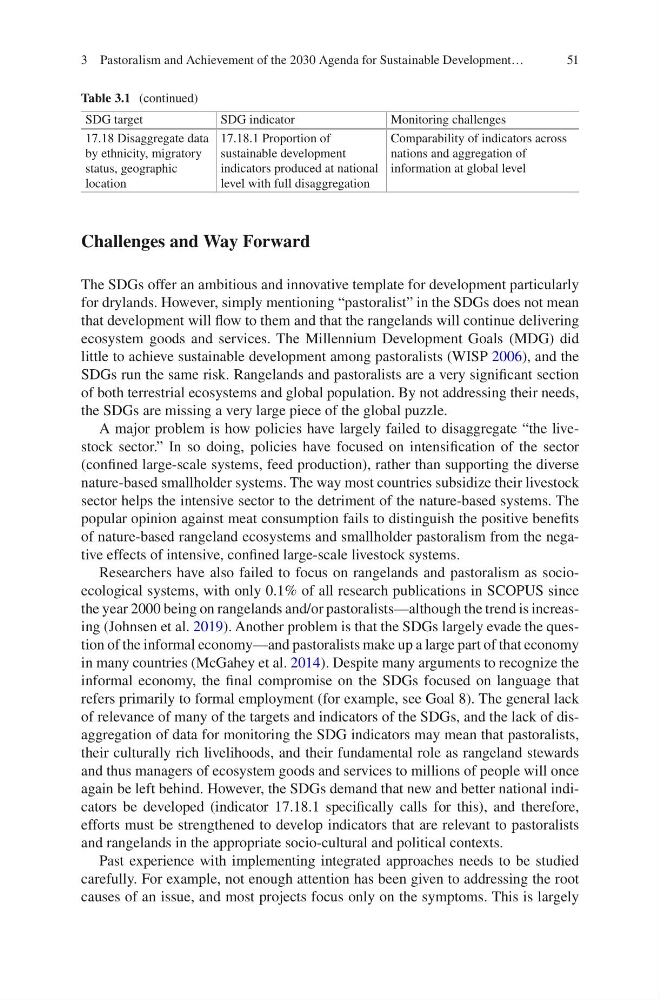
Table 3.1 (continued)
SDG target
SDG indicator
Monitoring challenges
17.18 Disaggregate data
by ethnicity, migratory
status, geographic
location
17.18.1 Proportion of
sustainable development
indicators produced at national
level with full disaggregation
Comparability of indicators across
nations and aggregation of
information at global level
3 Pastoralism and Achievement of the 2030 Agenda for Sustainable Development…
Challenges and Way Forward
The SDGs offer an ambitious and innovative template for development particularly
for drylands. However, simply mentioning “pastoralist” in the SDGs does not mean
that development will flow to them and that the rangelands will continue delivering
ecosystem goods and services. The Millennium Development Goals (MDG) did
little to achieve sustainable development among pastoralists (WISP 2006), and the
SDGs run the same risk. Rangelands and pastoralists are a very significant section
of both terrestrial ecosystems and global population. By not addressing their needs,
the SDGs are missing a very large piece of the global puzzle.
A major problem is how policies have largely failed to disaggregate “the livestock sector.” In so doing, policies have focused on intensification of the sector
(confined large-scale systems, feed production), rather than supporting the diverse
nature-based smallholder systems. The way most countries subsidize their livestock
sector helps the intensive sector to the detriment of the nature-based systems. The
popular opinion against meat consumption fails to distinguish the positive benefits
of nature-based rangeland ecosystems and smallholder pastoralism from the negative effects of intensive, confined large-scale livestock systems.
Researchers have also failed to focus on rangelands and pastoralism as socioecological systems, with only 0.1% of all research publications in SCOPUS since
the year 2000 being on rangelands and/or pastoralists—although the trend is increasing (Johnsen et al. 2019). Another problem is that the SDGs largely evade the question of the informal economy—and pastoralists make up a large part of that economy
in many countries (McGahey et al. 2014). Despite many arguments to recognize the
informal economy, the final compromise on the SDGs focused on language that
refers primarily to formal employment (for example, see Goal 8). The general lack
of relevance of many of the targets and indicators of the SDGs, and the lack of disaggregation of data for monitoring the SDG indicators may mean that pastoralists,
their culturally rich livelihoods, and their fundamental role as rangeland stewards
and thus managers of ecosystem goods and services to millions of people will once
again be left behind. However, the SDGs demand that new and better national indicators be developed (indicator 17.18.1 specifically calls for this), and therefore,
efforts must be strengthened to develop indicators that are relevant to pastoralists
and rangelands in the appropriate socio-cultural and political contexts.
Past experience with implementing integrated approaches needs to be studied
carefully. For example, not enough attention has been given to addressing the root
causes of an issue, and most projects focus only on the symptoms. This is largely
Table 3.1 (continued)
SDG target
SDG indicator
Monitoring challenges
17.18 Disaggregate data
by ethnicity, migratory
status, geographic
location
17.18.1 Proportion of
sustainable development
indicators produced at national
level with full disaggregation
Comparability of indicators across
nations and aggregation of
information at global level
3 Pastoralism and Achievement of the 2030 Agenda for Sustainable Development…